 SoluLab Blog
 Key Takeaways
- Prompt injection is currently the top-ranked risk on the OWASP LLM Top 10, and it cannot be fully patched the way a traditional software bug can.
- LLMs leak data in ways firewalls and legacy DLP tools were never built to catch, including through model outputs, embeddings, and long-term memory.
- The OWASP LLM Top 10 gives teams a shared vocabulary for LLM risk, but it has to be paired with real testing, not just a checklist review.
- Jailbreak prevention works best as a layered system of guardrails, not a single filter bolted onto the model.
- Supply chain risk now extends to models, fine-tuning data, plugins, and third-party APIs, not just open-source code libraries.
- Security has to be designed into an LLM application from the architecture stage, not added right before launch.
Prompt injection is the practice of manipulating a large language model’s behavior by embedding hidden or malicious instructions inside the input it processes, whether that input comes directly from a user or indirectly from a document, email, or webpage the model reads.
It matters because it lets an attacker override a system’s intended instructions without touching a single line of code. That single fact has reshaped how security teams think about LLM security in 2026.
Most enterprises did not build their security stacks with large language models in mind. Firewalls, endpoint protection, and traditional data loss prevention tools were designed to stop malware and unauthorized network access, not to catch a cleverly worded sentence buried inside a PDF that tricks a chatbot into revealing a customer’s account details. That gap is exactly where prompt injection, data leakage, and jailbreaks now live.
This guide walks through what these risks actually look like in production systems, what the OWASP LLM Top 10 says about them, and what a practical, layered defense looks like for teams building or scaling LLM-powered products.
What Is Prompt Injection and Why It’s the New Attack Surface
Prompt injection happens when an attacker crafts input designed to override or manipulate an LLM’s original instructions. Unlike a SQL injection attack, which exploits a coding flaw, prompt injection exploits the model’s core design: it cannot always distinguish between a trusted system instruction and an untrusted piece of user or external content.
Gartner’s 2025 survey of cybersecurity leaders found that organizations experienced an attack on their AI applications that leveraged the application prompt within the previous 12 months, and more broadly, 29% reported an attack on their enterprise GenAI application infrastructure over that same period. Those numbers are not projections. They describe attacks that already happened.
Direct vs. Indirect Prompt Injection
There are two broad flavors of this attack, and they call for different defenses.
- Direct prompt injection: The attacker types the malicious instruction straight into the chat interface, often trying to get the model to ignore its system prompt or reveal internal configuration.
- Indirect prompt injection: The malicious instruction is hidden inside content the model reads later, such as a résumé, a customer email, a support ticket, or a scraped webpage, and it activates when the model processes that content on someone else’s behalf.
Indirect injection is the harder problem. A support agent using an LLM-powered tool might never see the malicious text at all, since it can be hidden in white-on-white font, HTML comments, or metadata that a human would simply scroll past. For teams doing enterprise AI development, this means every external data source feeding an LLM has to be treated as untrusted input, the same way a web form is treated as untrusted input in classic application security.
Data Leakage: How LLMs Expose Information Traditional Tools Miss
Data leakage in an LLM context covers a wider range of failure modes than most security teams expect. It is not limited to a model reciting private training data. It also includes a chatbot summarizing a confidential document it was never supposed to have access to, an agent pasting a customer’s PII into a third-party API call, or an employee copying proprietary source code into a public chatbot.
That last scenario is not hypothetical. Multiple enterprises have restricted employee use of public GenAI tools after internal code and strategy documents ended up in prompts sent to external services. On the concern side, Statista’s research on generative AI users in the United States found that current generative AI users cited privacy or data security issues as their biggest concern about the technology in, ahead of concerns about accuracy or job displacement.
Where LLM Data Leakage Actually Happens
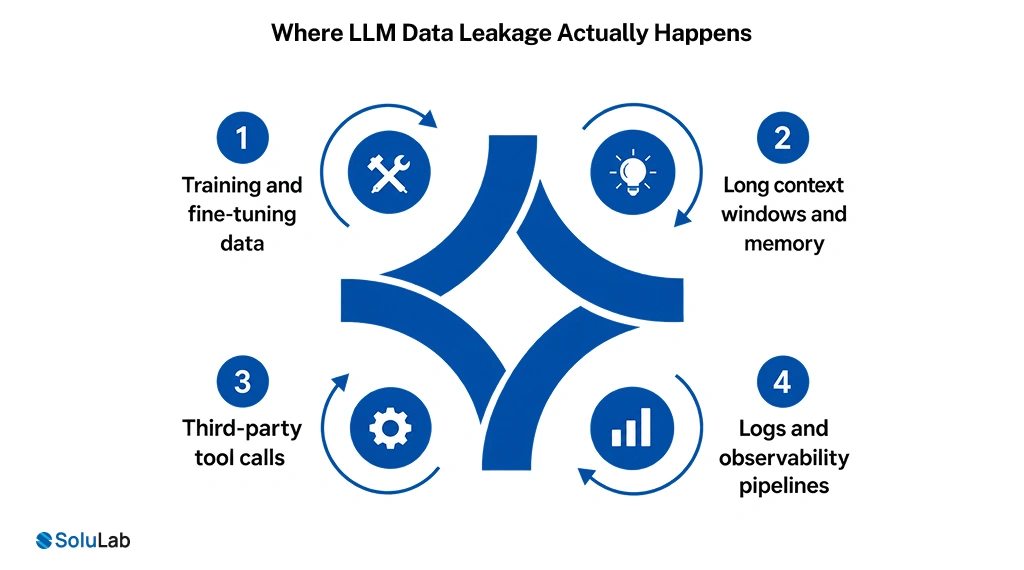
- Training and fine-tuning data: A model fine-tuned on internal tickets or contracts can memorize and later regurgitate fragments of that data.
- Long context windows and memory: Persistent memory features can carry sensitive details from one session into an unrelated conversation if access controls are not scoped correctly.
- Third-party tool calls: An agent that queries a CRM or search API can leak data simply by including it in a response shown to the wrong user.
- Logs and observability pipelines: Prompts and completions stored for debugging often contain the exact sensitive data a company is trying to protect elsewhere.
AI data leakage is rarely a single point of failure. It is usually a chain of reasonable-looking decisions, none of which look dangerous in isolation, that add up to an exposed record.
Inside the OWASP LLM Top 10
The OWASP LLM Top 10 gives security and engineering teams a shared reference for the risks unique to large language model applications, similar to how the original OWASP Top 10 standardized web application security conversations two decades ago. It does not replace traditional application security. It sits alongside it.
The current list covers:
- Prompt injection
- Sensitive information disclosure
- Supply chain vulnerabilities
- Data and model poisoning
- Improper output handling
- Excessive agency
- System prompt leakage
- Vector and embedding weaknesses
- Misinformation
- Unbounded consumption
Two entries deserve extra attention because they are frequently underestimated. Excessive agency describes what happens when an LLM-based agent is given more permission than its task actually requires, such as a customer support bot that can issue refunds without a human approval step. Improper output handling covers what happens when an application trusts an LLM’s output enough to execute it directly, whether that is rendering it as HTML, running it as code, or passing it straight into another system.
Gartner projects that 25% of all enterprise generative AI applications will experience at least five minor security incidents per year, up from 9%, largely driven by the same immature practices the OWASP list is trying to correct. The framework is useful precisely because it turns vague anxiety about “AI risk” into a specific, testable checklist that engineering teams can actually action.
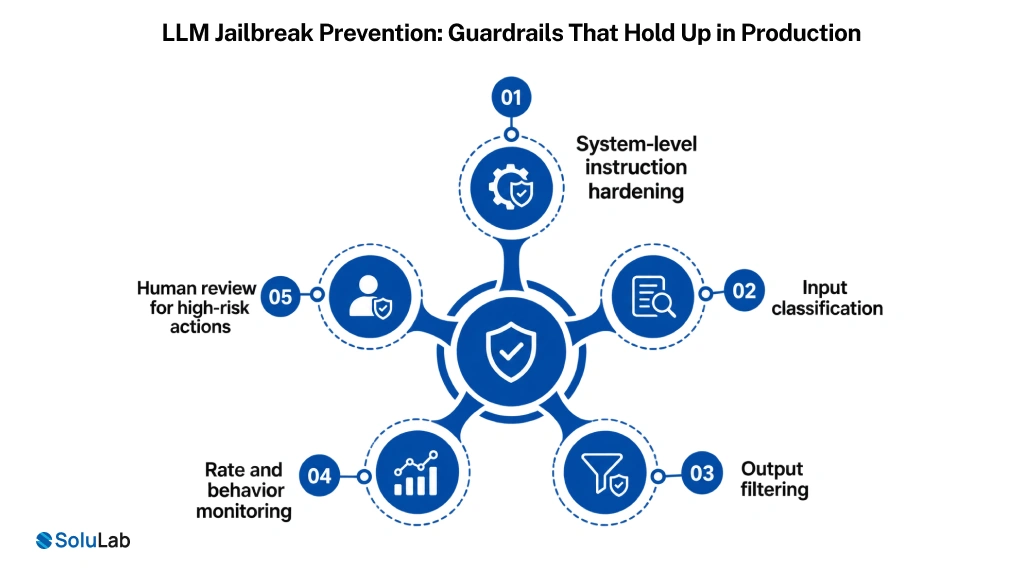
LLM Jailbreak Prevention: Guardrails That Hold Up in Production
A jailbreak is any technique used to bypass an LLM’s built-in safety behavior, usually through role-play framing, encoded instructions, or multi-step prompts that gradually erode the model’s guardrails. LLM jailbreak prevention cannot rely on a single filter, because attackers iterate faster than any static rule set can keep up with.
A Layered Defense Model
- System-level instruction hardening: Write system prompts that explicitly define boundaries and are tested against known jailbreak patterns before launch.
- Input classification: Run incoming prompts through a lightweight classifier that flags known manipulation patterns before they reach the core model.
- Output filtering: Screen the model’s response before it reaches the user or another system, catching leaked instructions or unsafe content the input filter missed.
- Rate and behavior monitoring: Watch for unusual sequences of prompts from the same session, since many jailbreaks build up over several turns rather than landing in one message.
- Human review for high-risk actions: Require a human checkpoint before an agent executes anything irreversible, like a financial transaction or a data deletion.
SoluLab applied a version of this layered approach while building the Cyberhulk platform case study, where guardrail testing and continuous prompt monitoring were built into the platform from the first sprint rather than added after a security review flagged gaps.
That sequencing matters. Retrofitting guardrails onto a live product is always more expensive and more disruptive than designing them in from day one.

LLM Input Validation and Output Sanitization: The Non-Negotiables
LLM input validation deserves the same rigor that web developers already apply to form fields and API payloads, just adapted for natural language. That means setting length limits, stripping or flagging suspicious formatting like hidden Unicode characters, and separating system instructions from user content using structured formats rather than plain string concatenation.
Output sanitization is the other half of the equation. If an LLM’s response gets rendered in a browser, inserted into a database query, or passed to another automated system, it needs to go through the same escaping and validation any untrusted input would. Treating a model’s output as inherently safe just because it came from “your own AI” is one of the most common mistakes teams make.
A few practical habits reduce risk significantly:
- Separate system prompts from user input structurally, not just with a line break.
- Cap input and output length to reduce the blast radius of unbounded consumption attacks.
- Validate structured outputs (JSON, function calls) against a strict schema before execution.
- Log anomalies for review without storing raw sensitive data longer than necessary.
Are AI Agents a Bigger Security Risk Than Standalone LLMs?
Yes, generally, because agents do not just generate text; they take actions. An LLM that writes a misleading paragraph is a content problem. An agent with the same flaw that has permission to send emails, modify records, or call external APIs turns that flaw into an operational incident.
Deloitte’s global enterprise AI research found that only 21% of enterprises have mature governance in place to manage the risks of agentic AI, even as adoption accelerates. That gap between ambition and governance is precisely where excessive agency incidents originate. An agent built without tightly scoped permissions will eventually be asked, intentionally or not, to do something it should not.
Teams investing in AI agent development should scope permissions the same way they would for a new employee: start narrow, expand only with justification, and log every consequential action. A support agent that can look up an order does not need the ability to issue a refund. A research agent that can browse the web does not need write access to internal systems. This principle, often called least privilege, predates AI by decades, but it has never mattered more than it does now.
AI Supply Chain Security: Securing What You Didn’t Build
AI supply chain security covers everything a team did not build in-house but is still relying on: pretrained foundation models, open-source fine-tuning datasets, third-party plugins, vector databases, and the APIs that connect them all. Each of these is a potential entry point, and most organizations have far less visibility into this chain than they do into their traditional software dependencies.
Model poisoning is the clearest example. If a fine-tuning dataset is compromised, or if a widely used open-source model checkpoint is tampered with before distribution, the vulnerability ships silently to every downstream user. Plugin and connector risk is close behind it. An LLM agent integrated with a third-party tool inherits that tool’s security posture, whether or not anyone documented that dependency.
Organizations operating across AI and blockchain systems face a related but distinct challenge, since smart contracts, tokenized assets, and on-chain agent actions raise contractual and regulatory questions that traditional software supply chains rarely touch. This is where AI and Web3 legal consulting becomes relevant well before launch, not after a dispute or a breach forces the conversation.
Practical steps for reducing supply chain exposure include:
- Maintain an inventory of every model, dataset, plugin, and API an LLM application depends on.
- Vet third-party model providers for their own security disclosures and incident history.
- Pin model and library versions rather than always pulling the latest release automatically.
- Re-test guardrails after any model, plugin, or dependency update, since behavior can shift even without a visible code change.
Building a Security-First LLM Development Practice
Security cannot be a phase that happens right before launch. It has to be part of how the system is architected from the first design conversation, alongside decisions about model selection, data flow, and agent permissions.
A practical starting checklist for teams building or scaling an LLM application looks like this:
- Map every place untrusted content enters the system, including documents, emails, and third-party data feeds.
- Apply the OWASP LLM Top 10 as a design-time checklist, not just a post-launch audit.
- Build layered jailbreak defenses instead of relying on the base model’s built-in safety training alone.
- Scope every agent’s permissions to the narrowest set of actions its task requires.
- Treat every model output as untrusted input to whatever system receives it next.
- Establish an incident response plan specific to AI failures, separate from your general security runbook.
Organizations that lack in-house AI security expertise often find it faster and more reliable to bring in a partner rather than build this capability from scratch under launch pressure. Working with experienced AI consulting services early in a project, rather than after an incident, tends to be the difference between a security review that catches problems in a sprint and one that catches them in production.
Conclusion
LLM security is not a single control you bolt on before shipping. It is a discipline that spans how you design system prompts, how you scope agent permissions, how you validate input and sanitize output, and how closely you track the models and third-party tools your application depends on.
The OWASP LLM Top 10 gives teams a shared language for these risks, but turning that framework into a genuinely secure product takes deliberate architecture, testing, and monitoring.
SoluLab, as an LLM development company with hands-on experience building and securing production AI systems, can help your business design guardrails, validate inputs and outputs, and build agent permissions the right way from day one, rather than retrofitting them after something goes wrong.
FAQs
The post LLM Security: Prompt Injection, Data Leakage, and the OWASP LLM Top 10 appeared first on SoluLab - Blockchain & AI Development Company.

 Alastair Campbell
 Deshon Johnson's College Scholarship Foundation
  KFF
KFF 
 DUDE FOR FOOD
 MoreThanDigital
  eLearning Industry