


The science of predicting chaotic systems lies at the intriguing intersection of physics and computer science. This field delves into understanding and forecasting the unpredictable nature of systems where small initial changes can lead to significantly divergent outcomes. It’s a realm where the butterfly effect reigns supreme, challenging the traditional notions of predictability and order.
Central to the challenge in this domain is the unpredictability inherent in chaotic systems. Forecasting these systems is complex due to their sensitive dependence on initial conditions, making long-term predictions highly challenging. Researchers strive to find methods that can accurately anticipate the future states of such systems despite the inherent unpredictability.
Prior approaches in chaotic system prediction have largely centered around domain-specific and physics-based models. These models, informed by an understanding of the underlying physical processes, have been the traditional tools for tackling the complexities of chaotic systems. However, their effectiveness is often limited by the intricate nature of the systems they attempt to predict.
Researchers from the University of Texas at Austin Introduce a new spectrum of domain-agnostic models diverging from traditional physics-based approaches. These models are based on leveraging large-scale machine learning techniques, utilizing extensive datasets to navigate the complexities of chaotic systems without relying heavily on domain-specific knowledge.
The novel methodology employs large-scale, overparametrized statistical learning models, such as transformers and hierarchical neural networks. These models utilize their extensive scale and access to substantial time series datasets, enabling them to forecast chaotic systems effectively. The approach signifies a shift from relying on domain knowledge to using data-driven predictions.
The performance of these new models is noteworthy. They consistently produce accurate predictions over extended periods, well beyond the traditional forecasting horizons. This advancement represents a significant leap in the field, demonstrating that the ability to forecast chaotic systems can extend far beyond previously established limits.
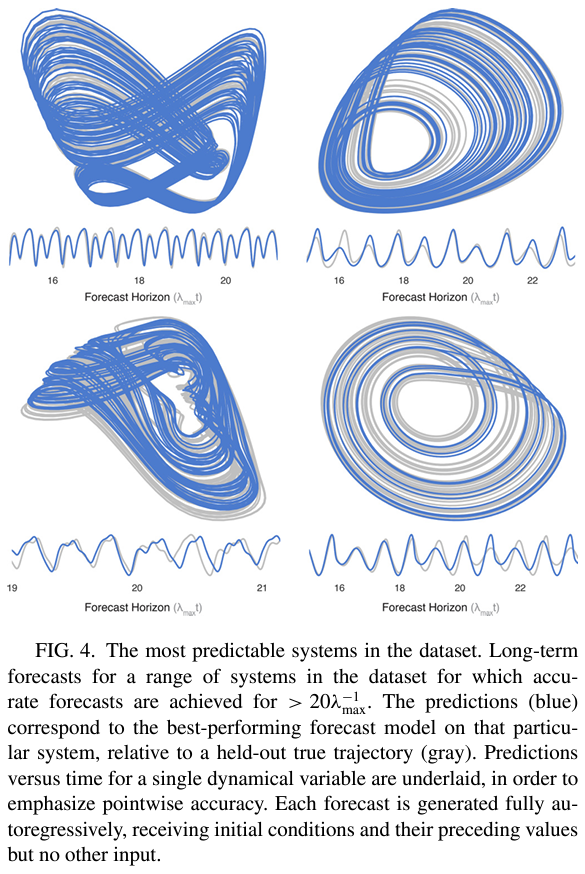
In conclusion, the paper reveals an intriguing development in forecasting chaotic systems. The transition from domain-specific models to large-scale, data-driven approaches opens new avenues in predicting the unpredictable. It highlights a growing trend where the scale and availability of data, coupled with advanced machine learning techniques, are reshaping our approach to understanding and forecasting chaotic systems.
Check out the Paper. All credit for this research goes to the researchers of this project. Also, don’t forget to join our 35k+ ML SubReddit, 41k+ Facebook Community, Discord Channel, and Email Newsletter, where we share the latest AI research news, cool AI projects, and more.
If you like our work, you will love our newsletter..
The post Can Machine Learning Predict Chaos? This Paper from UT Austin Performs a Large-Scale Comparison of Modern Forecasting Methods on a Giant Dataset of 135 Chaotic Systems appeared first on MarkTechPost.