 10,000 Birds
 “Stop paddling. Quiet now!” Hissed our guide as the canoe rounded a bend in the blackwaters canal which connects the Rio Napo with the oxbow lake where our lodge was located. Everything stopped. I was as quiet as a church mouse, waked the camera and let the lens rest on my lap. We were in the remote Amazonian forests and not a sound was to be heard except for the rhythmical dripping of water from the raised paddles.
“Listen! Do you hear that song?” He added. At first nothing. Then I heard it. It was a series of deep, hollow notes, too fast to count and extremely constant in pace. The local guide who was at the bow stood up. He was very alert now, scanning the right bank with his eagle eyes. He then pointed to a dense patch of tangles about a meter above the ground. A rather small black bird moved about, making short hops to and fro until finally it stopped for a couple of seconds, lowering its head to the side watching us inquisitively. It was a male Cocha Antshrike (Thamnophilus praecox), an entirely black inconspicuous bird (except for white underwing coverts rarely seen) ,and that was my only window for a shot. Suddenly it darted off into the jungle never to return. That’s how it is with most smaller Amazonian birds. You usually get about a second or two at most before they disappear and if you’re really lucky you might get a couple more seconds as a bonus. Anyway, off it went leaving me to stare at an empty branch with the camera lens still in hand. I never got to see the female though, with its beautiful chestnut brown plumage, although I am quite sure she was somewhere close by.
Before my first trip to the tropics many years ago I always wondered how is it even possible that new bird species are discovered with all the deforestation and general habitat obliteration going on all over the world. I mean, we as a species are today basically everywhere. We have spread to every corner of the world, filled every nook and cranny imaginable, and still we keep taking over the last diminishing leftover habitats. But still new species are found. During my trip to Peru (where I almost got lost in the jungle trying to locate a rumoured Andean Cock-of-the-rock lek), my rambles in South-east Asia and also this last trip to Ecuador, I realised that this is more than possible because compared to the forests in these regions our European ones seem like a walk in the park. As much as I would love to expand this topic I better stop now and leave it for another time. In short, I truly believe that there still are, maybe not plenty but a good number of species that to this day go unnoticed to the scientific eye, but are surely known to the indigenous peoples (the best example is the newly discovered giant rat from the Solomon Islands). The Cocha Antshrike was one of these species not long ago.
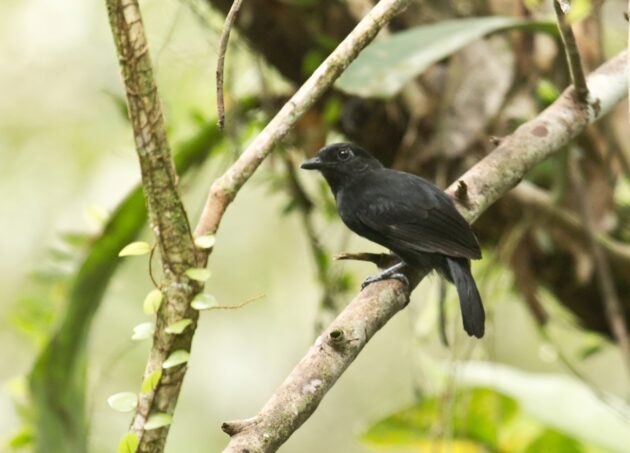 Cocha Antshrike (Thamnophilus praecox) – photo by Dušan Brinkhuizen
The Cocha Antshrike is a rather curious, interesting little bird of the Igapo (black-water flooded) forest undergrowth and streams, which was long known only from a single female specimen. Only in the late 1980’s was it “rediscovered” so to say, with the male being found at Imuya Cocha and described to science for the first time. Finally the species was complete. Being a very restricted-range species ( found only locally in NE Ecuador along the Rio Napo and its tributaries but with possible sightings in neighbouring Brazil and Colombia) and low-denstiy (confined to black-water drainages) its habits poorly known. For example nothing is known of its breeding habits, any accounts of its diet (it is assumed to feed on insects and other arthropods), ways of foraging and movement (presumed resident) are wanting. So basically next to nothing is known about this bird which makes me the more enthusiastic since I personally plan to get to know it better in the years to come.
The post The Cocha Antshrike first appeared on 10,000 Birds.
 Cash Flow Diaries