
 By: Nicole Assisi
When traveling for work and pleasure, I often share insights from the schools I visit, such as in Luxembourg and Alaska. As I continued my journey exploring place-based learning, my winter travels took me to a destination unlike any other: Chefchaouen, Morocco. Known as the “Blue Pearl,†this picturesque mountain town is composed of striking blue-washed buildings perched amid the rugged Rif Mountains. It was a captivating setting for my family and me to immerse ourselves in a vibrant cultural tapestry – and to reflect on the evolving concept of place-based learning.
In addition to the unique backdrop offered by Chefchaouen, the place also provided a new lens through which to explore placed-based learning: linguistic activism. Linguistic activism, according to the Linguistic Society of America, refers to the efforts and actions aimed at promoting, preserving, or revitalizing languages, often those that are endangered or marginalized, with the goal of fostering linguistic diversity, cultural identity, and social justice. This is exemplified in Chefchaouen, where education is not just about knowledge acquisition; it is about rediscovering and preserving ancestral stories, traditions, and identity through language.
A Legacy of Language and Culture
Chefchaouen’s history is as layered as its buildings’ stunning blue hues. Originally home to the Berber people, the town has been shaped by Andalusian, Jewish, and Arab influences, each leaving their mark on its streets, cuisine, and schools. Today, schools teach a blend of languages that reflect these, and more, influences. Students learn French, Modern Standard Arabic (a variation of the spoken Moroccan Arabic), Spanish, English, and Amazigh (the Berber language).Â
This blend of languages intrigued me on a personal level, having grown up speaking German and Luxembourgish, and now speaking Portuguese at home with my children, and Spanish and English in my work world. I know firsthand how much language and culture are intertwined and the deep meaning they jointly carry.Â
I loved learning that Morocco is embracing its cultural roots through a wave of linguistic activism. As the Harvard International Review describes: “Though the inclusion of French or English may promote economic mobility, it should not overshadow the importance of cultural continuity… Morocco has taken a significant step towards recognizing and celebrating its diverse linguistic heritage, reckoning with its dark colonial past.†Chefchaouen embodies this ethos by ensuring that education is not only preparing students for the current world – it is anchoring them in their past.
This approach is deeply embedded in the local understanding of education. Mohammed, our guide, spoke poignantly about the transformative power of language, saying that, “Teaching multiple languages equips students to navigate a globalized world, but Amazigh honors our heritage and keeps us connected to our roots.†Mohammed himself speaks four languages, a skill that has opened doors to him locally and internationally. He regrets, however, not learning Amazigh as a child, feeling that a piece of his story was lost. Now, he advocates for linguistic activism, championing the preservation of traditions and languages for future generations.
 Place-Based Learning and Linguistic Activism in Action
In Chefchaouen, place-based learning moves beyond the classroom, intertwining natural environments, cultural identity, and innovative linguistic preservation efforts. Students explore their town’s iconic blue walls, not just as an aesthetic marvel, but as a symbol of spiritual and historical significance. During a time of Jewish diaspora, families discovered that the blue hue also served as a practical bug repellant – a revelation that opened countless opportunities for scientific and cultural studies. From studying the architecture and history of their surroundings to exploring the languages that define their heritage, students connect deeply with their environment and culture, making learning dynamic and meaningful.
At the heart of this educational philosophy is linguistic activism, particularly the revitalization of the Amazigh language. Our guide Mohamed shared that until recently, only 300,000 students were learning Amazigh in schools, less than 4% of all K-12 students (based on 8.1 million K-12 students in Morocco). The Moroccan government, however, has set an ambitious goal: by 2030, they aim to reach 4 million students. Achieving this in remote and rural areas like Chefchaouen requires innovative strategies that can offer valuable lessons for language preservation worldwide – including in the United States, where many Indigenous languages remain untaught.
Here’s how Chefchaouen is making this vision a reality:
1. Technology for Accessibility:
Being rural or remote cannot be a barrier in a digital age. The Royal Institute of Amazigh Culture (IRCAM) standardized Amazigh curricula. IRCAM even developed “MOOC-IRCAM,†an online platform offering language lessons accessible to educators and students, even in rural areas. Â
2. Community and Culture as the Curriculum:Â
Community members, particularly elders, play a vital role in preserving the Amazigh language and culture. They are often invited into classrooms to share oral traditions, folklore, and traditional songs, enriching language instruction with deep cultural narratives. These interactions bridge generations, offering students authentic connections to their heritage through sharing stories, music, and crafts that breathe life into classroom lessons. Through cultural workshops, students engage in learning Amazigh crafts and traditions – experiential approaches that not only enhance language acquisition but also instill a profound sense of pride and belonging.
Though my family and I learned very little of the Amazigh language, we had the opportunity to take part in a cherished community tradition: using a communal oven. While many homes have ovens, bread and cookies are often baked in shared wood-burning ovens. Emphasizing the cultural importance of Amazigh traditions, a community member guided my children through the process of baking ancient bread, while his father, who was in his late 80s, captivated them with stories from his youth. My children were enthralled, and the experience offered us a profound connection to the culture while also demonstrating its emphasis on intergenerational learning. These experiential approaches not only deepen understanding of the language but also instill a sense of pride in heritage. [see picture below]
3. Students as Custodians of Culture
As a former project-based learning teacher, my heart skipped a beat when I saw student artwork all over the town. Teachers in Chefchaouen have transformed language acquisition into an engaging and immersive experience that is exhibited and shared proudly. Examples of this include:
- Heritage Projects: Students explore family histories in Amazigh, presenting findings in oral and written formats. We had a student share the tradition of mint tea in her home’s courtyard. She explained that mint tea, or “Moroccan whiskey,†is more than a beverage – it’s a symbol of hospitality, connection, and cultural pride. Traditionally prepared with green tea, fresh mint, and sugar, it is served to guests as a gesture of welcome and respect. Her demonstration not only highlighted the art of preparation but also the importance of sharing these customs as part of her cultural heritage.  [see picture below]
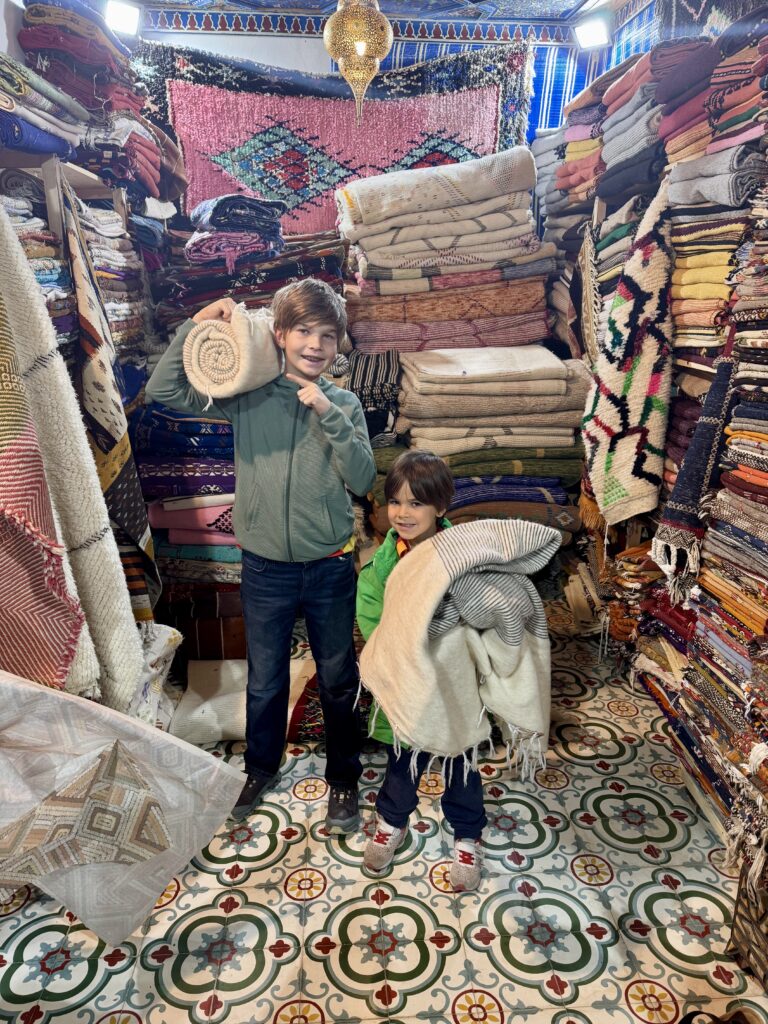
- Art and Language Integration: Chefchaouen’s streets are lined with murals and ceramic art, offering a backdrop for students to engage in functional art. Students use Berber symbols to design traditional carpets, blending cultural expression with practical skills. This practice not only preserves cultural heritage but also provides an opportunity for students to earn extra income for their families. During our visit, we admired some of the wonderfully soft blankets created by students, showcasing their creativity and connection to tradition.  [see picture below]
- Cultural Documentation: Though we didn’t get to see it ourselves because school was on winter break, Muhammad told us about a recent teacher-led project in which students created digital archives of Amazigh proverbs, songs, and poems by interviewing elders and translating their stories. The result is a showcase of culture and heritage through the eyes of students. These stories can now be found in the school library and Muhammad promised to take us there next time we visit, giving us even more incentive to return.Â
Chefchaouen demonstrates that it is possible to preserve and revitalize endangered languages through a combination of government support, community engagement, and experiential learning. By embedding Amazigh in everyday life, Chefchaouen ensures the language isn’t just taught – it’s lived.
Lessons for the U.S. and Beyond
Chefchaouen’s approach offers a blueprint for integrating Indigenous languages into education in the United States and other countries. It invites us to see education as a tool for cultural preservation and offers a template for how to incorporate all parts of a place’s history into current life and learning, including both the proud and the painful.Â
Like all forms of activism, linguistic activism can be a vehicle for giving voice to unheard and overlooked people and pieces of history. It is another tool we have to reflect on what has come before us and how that shapes our current world.Â
How might we embrace linguistic activism and place-based learning in our own communities? How can we use this approach to amplify what has previously been silenced? What stories and traditions can we bring into our classrooms to celebrate diversity and identity?
As I reflect on my time in Chefchaouen, I am reminded that education is not just about what we teach but how and why we teach it. Let us draw inspiration from this Moroccan town to create educational experiences that honor the past, celebrate the present, and empower the future.Â
Nicole Assisi, CEO of Thrive.
The post Linguistic Activism in Chefchaouen: Place-Based Learning with a Twist appeared first on Getting Smart.