Â
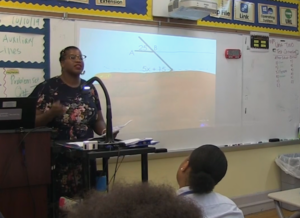
Ijeoma Duru’s visual guidance addresses the Transient Information Effect.
Â
It’s no secret that students in the U.S. are falling behind in mathematics. Students are not only performing worse on national assessments like NAEP, they’re also falling behind the rest of the world on international assessments like the Program for International Assessment (PISA) as well as the Trends in International Mathematics and Science Study (TIMSS).Â
The consequences of this crisis in math achievement recently made national headlines when the University of California at San Diego found that roughly 1 in 8 incoming freshmen to UCSD required remedial math- a nearly thirty-fold increase from 2020. And while there’s a tendency to blame the pandemic, countries like the U.K. are faring far better, climbing from 27th in 2009 to 11th in international rankings on PISA, while the US has hovered at 26th with its lowest score ever.Â
Something else is afoot. One major factor behind students’ poor performance in math has been the slowness of American educators to take concepts from the science of learning and apply them to math classrooms. At our first-ever national CFU in Math Trainer the Trainer workshop, February 10-11 in Houston, TX, we’ll explore how math educators can implement this research in their classrooms.Â
One of the topics from Cognitive Science that we’ll explore is the limitations on working memory. Working memory is the part of our mind that we use whenever we engage in complex problem-solving and reasoning. Unfortunately, it’s extremely limited. When you get a two-factor authentication code on your phone, it’s six digits long–and no more–because people can’t reliably hold more information than that in working memory. And if they try to hold more information than that, they’re going to have trouble doing much else. If you’re trying to remember that six digit code and your spouse asks you where you put the car keys you won’t be able to answer or you’ll forget the code.Â
Unless of course you write the code down.Â
This is a manifestation of one of the most important concepts from cognitive science for teachers to understand: Transient Information Effect. That is, when the information you need to complete a task disappears you have to use the same scarce working memory you use to think and learn to merely remember the information.
But, if the object of study (say, a piece of student work) remains constantly in view, students don’t have to remember and can instead allocate scarce thinking resources to analyzing it. This explains why it’s so easy for us to forget the items a waiter recites from a long list of specials at dinner, or why students can sometimes struggle to follow a complex set of verbal instructions.
One way math teachers can overcome the Transient Information Effect is by using Show Call. This technique involves projecting a piece of student work to the class so students can analyze it together… and so that as they think, they can constantly refresh their working memory about the key details.
At our upcoming workshop in Houston, we’ll show several examples including this great clip of Ijeoma Duru, a high school math teacher at Uncommon Collegiate Charter School, expertly executing Show Call in her classroom.Â
The clip opens with Ijeoma calling the class together to analyze a piece of student work that shows some good math but contains a common gap that she noticed on students’ papers while she circulated. Ijeoma projects the work visually. Notice that the work Ijeoma Show Calls exactly mirrors the problem students completed. This makes it easy for students to immediately transfer the notes and annotations that the teacher makes to their own papers.
Ijeoma then covers the top of Deborah’s transversal while leaving the bottom half of her work visible and then prompts them to examine that portion only. This directs students’ attention to the most relevant part of the work and ensures that the ensuing discussion will be focused, productive, and efficient. The fact that students like Jules can visually see Deborah’s response ensures they’re able to discuss its strengths with depth and precision!
Ijeoma then reveals the covered portion of Deborah’s solution, and once again directs students’ attention: “Look at the top of her angles.†She asks students where she should place a star for a corresponding angle and Josiah indicates they should place a star on a larger angle. He’s made a common error.Â
 “The entire angle?†Ijeoma asks. “Remember, when it’s cut by the auxiliary line, there’s a top, and then there’s a bottom.†Because Josiah is looking at Deborah’s work as he talks, he keeps his working memory free for analysis and quickly recognizes his mistake. Ijeoma then annotates the work clearly and reminds the class to get the correct response and her annotations in their own notes. This too is easy because the work she’s projecting mirrors their own.Â
The end result is that students walk away with a written record of what was discussed and a correct solution (or “Worked Exampleâ€) that they can refer back to for further study as they complete their Independent Practice. Thanks to Ijeoma’s use of Show Call, not only does Deborah feel celebrated for her work, she and her classmates leave this discussion clearer and better equipped to make the most of their remainder of their Independent Practice time.Â
Although there is no quick fix to solving the math crisis so many schools face, we know that the biggest driver of student achievement is the quality of instruction students receive. We believe we can make progress one classroom, one school, one system at a time by applying the findings from the science of learning to math instruction. We hope you’ll join us in Houston to learn from effective teachers like Ijeoma and bring improved teaching and learning to your community.
The post Improving Math Instruction with Cognitive Science: A Preview from Our Houston Workshop appeared first on Teach Like a Champion.