
 Getting Smart
 By: Kimberly Smith
A construction worker analyzing a job site with a drone and a business analyst running a query with AI don’t have much in common on paper, but both are using tools that didn’t exist when their parents were growing up. The impact of emerging technology, from cybersecurity to artificial intelligence (AI), is reshaping the workforce that today’s learners are entering, making K-12 education the critical frontline for preparing students for tomorrow’s careers.
The Burning Glass Institute identified that roughly 30% of core workplace skills have changed over the last 10 years, with digital advancements impacting job shifts two-thirds faster than the historical average. That shift is already affecting 35 million American workers, with more than 60% of job titles mentioning AI being non-tech roles.
In teaching and learning, we should distinguish between digital literacy and digital fluency, understanding why the latter is what actually matters in helping learners build future-forward skills. Jennifer Sparrow, Associate Vice President for Research and Instructional Technology and Chief Academic Officer at New York University, and an author of the digital fluency framework, describes the distinction this way:
“In learning a foreign language, a literate person can read, speak and listen for understanding in the new language. A fluent person can create something in the language: a story, a poem, a play or a conversation. Similarly, digital literacy is an understanding of how to use the tools; digital fluency is the ability to create something new with those tools.”
Put simply: Digital literacy is knowing how to use the tools. Digital fluency is knowing why and when to use them, and making informed decisions from there. For any given challenge, a digitally fluent learner can identify which tools apply, explain why, and use them to create something entirely new.
The digital fluency framework breaks this down into five components: curiosity fluency, communication fluency, creation fluency, data fluency, and innovation fluency. Based on our rapidly scaling work at Digital Promise’s Center for Learner Pathway Innovations in designing, implementing, and supporting credentialed cybersecurity pathways nationwide, we’d add a sixth: cybersecurity fluency. Every worker is now on the frontline of keeping information, apps, tools, and systems secure, whether or not “security” is written in their job title.
Digital fluency in practice looks like:
- Using digital tools to create new ideas, deepen critical thinking, and build something new
- Applying data to make informed decisions and understanding enough to push back on what the technology is suggesting
- Using technology to create narratives, empower storytelling, and visualize data
- Understanding cybersecurity risks and employing proactive steps to protect data and access
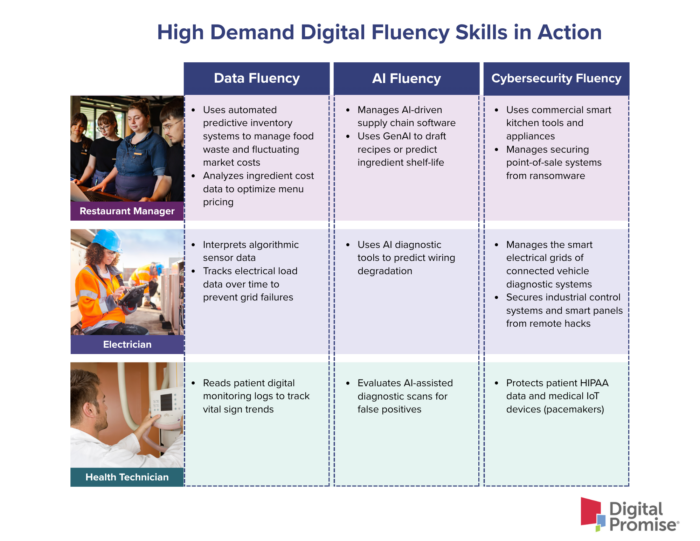
This table shows that these aren’t hypothetical skills for future “tech jobs,” they are foundational skills needed to thrive in jobs right now. Teaching digital fluency needs to be woven into the fabric of K-12 career pathway programs to ensure learners emerge with future-forward skills, work-based learning experiences, and industry-recognized credentials to keep up with today’s shifting labor market needs.
In Digital Promise’s work supporting school districts in rural Alabama in offering credentialed cybersecurity pathways, the ubiquity of need for technology skills is evident. Students participated in internships in a range of business sectors including hospitals, banks, retail, and education, demonstrating how every industry is seeking candidates with expertise in protecting the security of systems and data.
Some K-12 systems and educators are already piloting ways to bring digital fluency directly into career pathways learning experiences, from teaching students how to solve local food insecurity using scalable technologies to securing home networks in student-built tiny homes. Ample opportunities exist to support creative and effective approaches to engaging and credentialing students in digital fluency within career pathways.
As AI systems become more integrated with data pipelines, and cybersecurity becomes essential to protecting both, the overlap between these fields is where the most resilient, future-proof careers are being built. K-12 career pathway programs that embed digital fluency as a foundational skillset will be the difference between a learner who walks into an entry-level job and one who can build a career that keeps pace as technology evolves.
Kimberly Smith is Chief Innovation Officer at Digital Promise and co-leads the Center for Learner Pathway Innovations. She leads partnerships with school district leaders and their communities to co-research and co-design solutions that help every learner grow and thrive. She has held leadership roles at the Network for Teaching Entrepreneurship, PBS, Discovery Education, and CPB, advancing education technology and learner-centered models. An Aspen-Pahara Fellow and co-founder of the National Charter Collaborative, she holds an MBA from Johns Hopkins and a BS in Journalism from the University of Colorado. She serves on the boards of Beacon House, CatalystED, the Learner Centered Collaborative, and the National Charter Collaborative.
The post Digital Fluency Is the Missing Foundation in K-12 Career Pathways appeared first on Getting Smart.
 Elivechat
  Droidviews
 eSchool News
  Khan Academy Blog
 Nabamart
 SlashGear