
 Speech Sprouts
Let’s talk about something that trips up even experienced SLPs: figuring out whether you’re dealing with an articulation vs phonological disorder – and then knowing what to do about it.
This distinction isn’t just academic. Pick the wrong treatment approach, and you might spend months spinning your wheels with a child who isn’t making the progress they should. Get it right, and you’ll see meaningful change much faster.
Here’s your practical, no-fluff guide to making this differential diagnosis confidently – even on a packed school caseload.
First, Let’s Get Clear on the Difference Between Phonological and Articulation Disorders
What are the key differences between an articulation disorder and a phonological disorder?
Think of it this way:
- Articulation disorder = a motor/phonetic problem. The child has difficulty physically producing a sound correctly. The issue lives in the mouth – in the coordination, placement, or movement of the articulators.
- Phonological disorder = a linguistic/rule- based problem. The child can physically make the sound (or could with some cueing), but they’re applying the wrong mental rule about how sounds work in their language system.
Here’s a classic example: a child who says “tat” for “cat.” They can say /k/ – maybe you’ve even heard them produce it spontaneously in another word. But they’re consistently applying a fronting pattern, replacing back sounds with front ones. That’s a phonological rule problem, not a motor problem.
If you pull out traditional articulation techniques – placement cues, a mirror, shaping from /g/ in isolation – you’re addressing the wrong level of the problem. You need a phonological approach that targets the contrast and the rule.
Why Getting This Wrong Slows Everything Down
Research supports what many seasoned clinicians already know from experience: mismatching your approach to the disorder type leads to significantly slower progress (Baker & McLeod, 2011; Bernthal, Bankson & Flipsen, 2013).
Here’s what that looks like in practice:
- Using motor- based articulation therapy (isolation → syllable → word hierarchy) for a child with a phonological pattern = drilling a sound the child can already physically make, while never addressing the underlying rule.
- Using minimal pairs or cycles for a child with a true motor/phonetic articulation disorder = presenting contrasts the child genuinely can’t produce yet, leading to frustration and slow acquisition.
Neither of these kids is failing therapy. Their SLP just grabbed the wrong tool.
Your Quick Differential Diagnosis Checklist for Phonology vs Articulation Disorder
When you’re evaluating a child for a speech sound disorder, run through these questions:
Step 1: Can the child physically produce the sound at all?
- Try stimulability testing: can they imitate the sound in isolation with a model, tactile cue, or visual prompt?
- If YES, and they still don’t use it in words → lean toward phonological disorder
- If NO, and they truly cannot produce the sound even in isolation with cueing → lean toward articulation disorder
Step 2: Are the errors consistent and patterned?
- Look across your entire speech sample. Are errors predictable and rule-governed? (e.g., all final consonants deleted, all velars fronted, all clusters reduced)
- Consistent, patterned errors = phonological disorder (Rvachew & Matthews, 2024; ASHA Practice Portal)
- Variable errors that are inconsistent across repetitions of the same word may signal inconsistent phonological disorder or CAS. (And that takes us down a different treatment path.)
Step 3: Are multiple sounds affected in a systematic way?
- If a child has errors across an entire class of sounds (e.g., all fricatives, all velars), that’s a linguistic pattern – not a motor problem with every individual sound.
- One or two isolated sound errors (classic /r/ or /s/ distortion) → it’s more likely to be articulation
- Widespread, patterned errors across sound classes → more likely phonological
Step 4: What does intelligibility look like?
- Children with phonological disorders are often significantly less intelligible because patterns affect many words at once.
- Children with articulation disorders may have a mild-to-moderate impact on intelligibility, limited to specific sounds.
A Side-by-Side Comparison of an Articulation vs. Phonological Disorders
| Feature | Articulation Disorder | Phonological Disorder |
| Root cause | Motor/phonetic | Linguistic/rule- based |
| Stimulability | Often low – can’t produce the target sound | Often higher – can produce the sound with help |
| Error pattern | Specific sound errors (often distortions) | Systematic patterns across sound classes |
| Intelligibility impact | Mild to moderate | Often more severe |
| Best treatment | Traditional articulation, motor- based | Minimal pairs, cycles, multiple oppositions, complexity approach |
| Example error | /s/ distortion (lateral lisp) | “tat” for “cat” (fronting pattern) |
Wait – What About CAS? Where Does That Fit?
Great question, and one that deserves its own discussion (A great place to start is the first post in my apraxia series: Childhood Apraxia of Speech, What SLPs Need to Know)
But here’s the short version:
Childhood Apraxia of Speech is a neurologically-based impairment in the precision and consistency of the muscle movements necessary to produce speech. Programming of the movements is impaired, not the phonemes themselves.
This makes it distinct from both simple articulation disorders and phonological disorders.
Key red flags include:
- Inconsistent errors across repetitions of the same word (not a stable pattern)
- Prosody and stress errors
- Significant difficulty with longer or more complex words
- Vowel distortions
- Groping or trial and error in elicited words, especially on initial consonants
- Clumsy, awkward movements across syllables
If you’re seeing inconsistent whole-word variability that doesn’t resolve with the usual phonological approaches, CAS should be on your differential. (Rvachew & Matthews, 2024). Learn more here: 4 Essential Steps in Assessing Childhood Apraxia of Speech.
If it’s CAS, that child needs a motor-learning-based approach like DTTC (Dynamic Temporal and Tactile Cuing)- not minimal pairs, and not traditional drill.
Choosing the Right Intervention Approach
Once you’ve differentiated between an articulation vs phonology disorder and landed on your diagnosis, here’s your general roadmap:
For Articulation Disorders:
- Traditional articulation therapy (Van Riper hierarchy: isolation → syllable → word → phrase → sentence → conversation)
- Motor-based cueing (placement cues, tactile, visual)
- High repetition for motor learning
- DTTC if motor planning is involved (CAS)
For Phonological Disorders:
- Minimal pairs – teach the child that sound contrasts change meaning (e.g., “pin” vs. “bin”)
- Maximal oppositions / multiple oppositions – for children with phonemic collapses (one sound substituted for many targets)
- Cycles approach – great for highly unintelligible children with multiple patterns; targets are cycled rather than mastered before moving on (Hodson, 2010)
- Complexity approach – targeting late-developing, non-stimulable, complex clusters to maximize system-wide generalization (Gierut, 2007)
A good rule of thumb: the more patterns and the more unintelligible the child, the more you need a phonological approach. The more isolated and motor-based the error, the more you need a traditional or motor- based approach.
Practical Tips for School- Based SLPs
Let’s be real – you don’t always have hours to do a deep phonological analysis. Here’s how to make smart decisions efficiently:
- Always do stimulability testing during your eval. It takes 5 minutes and gives you critical information.
- Run a pattern analysis, even informally. After your standardized test, quickly sort errors: are they all in the same sound class? All in the same word position?
- Listen for consistency. Say the same word three times in different contexts. Consistent error = phonological. Variable = dig deeper.
- Trust your clinical intuition. If you’ve been drilling /k/ in isolation for 6 weeks and a child can already do it but keeps saying “tat” for “cat” in connected speech – that’s your signal to switch frameworks.
The Bottom Line
Determining if it’s an articulation vs. phonological disorder isn’t just a labeling exercise – it’s the foundation of your entire treatment plan. Getting this right means:
 Faster progress for your students
- More confident goal writing
- Better conversations with parents and teachers about why you’re doing what you’re doing
- Less frustration for everyone in the therapy room
When in doubt, go back to your assessment data. The pattern (or lack of one) will usually tell you what you need to know.
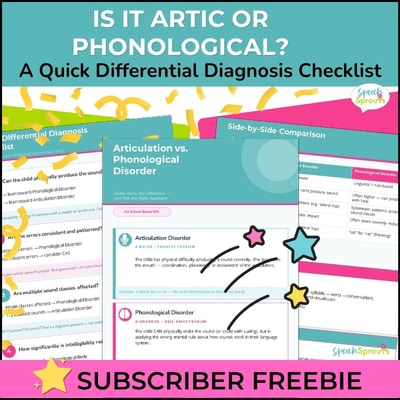
Here’s a quick handout to reference when making a differential diagnosis.
I created this handout for my newsletter subscribers. It includes the chart and tips, and it’s really helpful when you’re assessing speech sound disorders and need to tease out the difference between articulation vs phonological disorders or CAS (childhood apraxia of speech).
I love treating my subscriber peeps to freebies, plenty of therapy ideas, and tips, too. Want in? Just head here to sign up and get this handy articulation vs phonological disorder cheatsheet. I’ll see you inside!
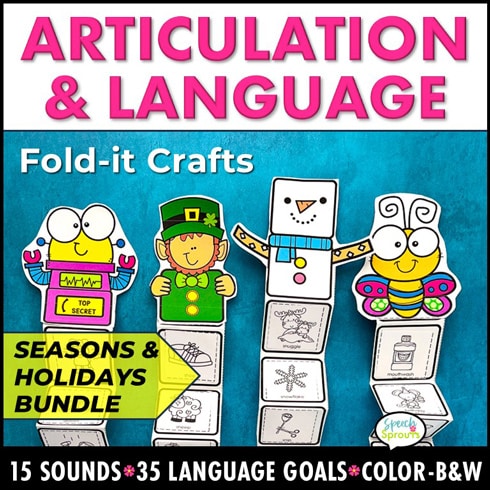
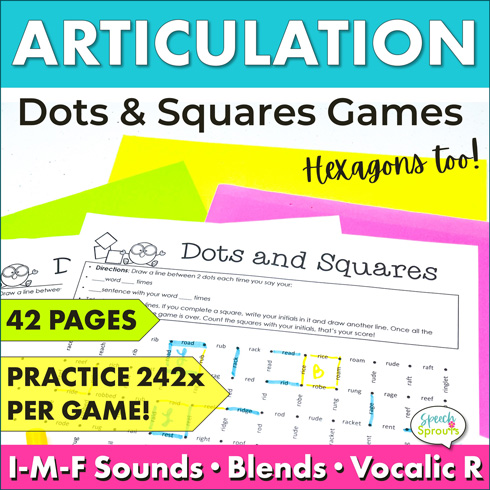
Finally, if you’re looking for a few fresh, easy articulation activities to motivate your students, you can find all my articulation activities on TPT, or check these out right here:
Recommended products

References
Baker, E., & McLeod, S. (2011). Evidence- based practice for children with speech sound disorders: Part 2 application to clinical practice. Language, Speech, and Hearing Services in Schools, 42(2), 140–151.
Bernthal, J., Bankson, N. W., & Flipsen, P., Jr. (2013). Articulation and phonological disorders (7th ed.). Pearson.
Gierut, J. A. (2007). Complexity in phonological treatment: Clinical factors. Language, Speech, and Hearing Services in Schools, 38(1), 93–98.
Hodson, B. W. (2010). Evaluating and enhancing children’s phonological systems. Thinking Publications.
Rvachew, S., & Matthews, T. (2024). Consistent and inconsistent phonological error patterns. In ASHA Practice Portal: Speech Sound Disorders.
ASHA Practice Portal. (n.d.). Speech sound disorders – articulation and phonology. American Speech- Language- Hearing Association. https://www.asha.org/practice- portal/clinical- topics/articulation- and- phonology/

 ReadWrite
  Hindu Blog
  ABC News - International
  Binary Stream
  Heritage Discovered Blog
 Beauty Cooks Kisses