NCDC: Eight States Account For 98% Of Nigeria’s Confirmed Diphtheria Cases is trending nowNiger HIV community battles use of anti-retroviral drugs on empty stomachs is trending nowWhy kidney disease ravages Nigerian children is trending nowOncoDaily Partners with World Radiotherapy Awareness Day to Champion Access, Awareness an… is trending nowVenus is often introduced as Earth’s twin because of its similar size and rocky compositi… is trending nowBetelgeuse's northeast hotspot held its spot from 2015 to 2023, outliving the large conve… is trending nowJames Webb Telescope opens a cosmic ‘Treasure Chest’ and finds one of the rarest stars in… is trending now70-Year-Old Chemistry Textbook Overturned: Hydrogen Bonding Knocks Copper Off Its Binding… is trending now'Best squad in the world!' - Ruben Amorim gives AC Milan transfer business 10/10 ahead of… is trending nowErling Haaland breaks new Sergio Aguero Man City record with 300th career goal vs. Covent… is trending nowÁlvarez a witness to the humiliation: Bilbao tear Atlético apart in a resounding defeat is trending nowMessi and Inter Miami suffer a last-minute blow is trending nowNCDC: Eight States Account For 98% Of Nigeria’s Confirmed Diphtheria Cases is trending nowNiger HIV community battles use of anti-retroviral drugs on empty stomachs is trending nowWhy kidney disease ravages Nigerian children is trending nowOncoDaily Partners with World Radiotherapy Awareness Day to Champion Access, Awareness an… is trending nowVenus is often introduced as Earth’s twin because of its similar size and rocky compositi… is trending nowBetelgeuse's northeast hotspot held its spot from 2015 to 2023, outliving the large conve… is trending nowJames Webb Telescope opens a cosmic ‘Treasure Chest’ and finds one of the rarest stars in… is trending now70-Year-Old Chemistry Textbook Overturned: Hydrogen Bonding Knocks Copper Off Its Binding… is trending now'Best squad in the world!' - Ruben Amorim gives AC Milan transfer business 10/10 ahead of… is trending nowErling Haaland breaks new Sergio Aguero Man City record with 300th career goal vs. Covent… is trending nowÁlvarez a witness to the humiliation: Bilbao tear Atlético apart in a resounding defeat is trending nowMessi and Inter Miami suffer a last-minute blow is trending now
Fashion Over 50
Don’t Worry – It Can’t Happen
Andart II ··116 views
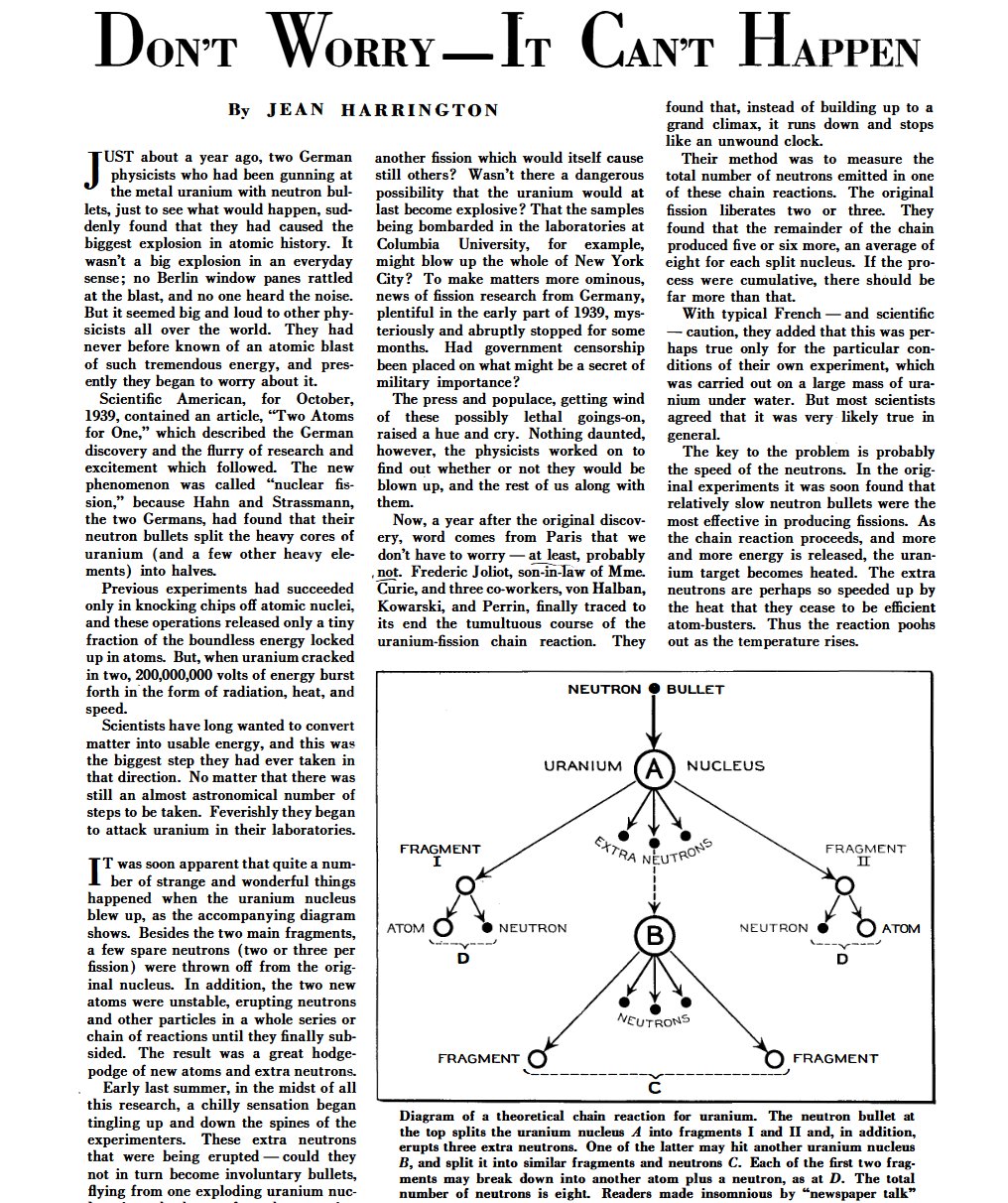
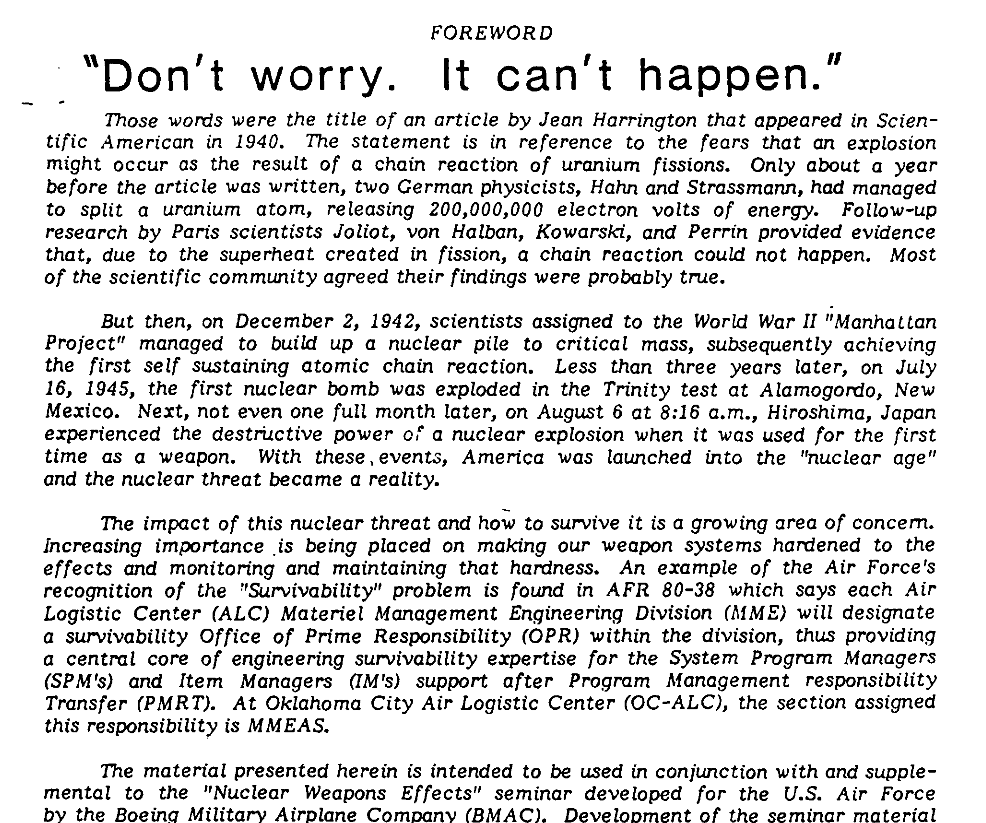
(Originally a twitter thread) When @fermatslibrary  brought up this 1940 paper about why we have nothing to worry about from nuclear chain reactions, I first checked that it was real and not a modern forgery. Because it seems almost too good to be true in the light of current AI safety talk. Yes, the paper was real: Harrington, […]
When @fermatslibrary  brought up this 1940 paper about why we have nothing to worry about from nuclear chain reactions, I first checked that it was real and not a modern forgery. Because it seems almost too good to be true in the light of current AI safety talk.
It gives a summary of a recent fission experiment that demonstrate a chain reaction where neutrons released from a split atom induces other atoms to split. The article claimed this caused widespread unease:
“Wasn’t there a dangerous possibility that the uranium would at last become explosive ? That the samples being bombarded in the laboratories at Columbia University, for example, might blow up the whole of New York City ? To make matters more ominous, news of fission research from Germany, plentiful in the early part of 1 939, mysteriously and abruptly stopped for some months. Had government censorship been placed on what might be a secret of military importance ?
The press and populace, getting wind of these possibly lethal goings-on, raised a hue and cry.â€
However, physicists were unafraid to of being blown up (and blowing up the rest of the world).
“Nothing daunted, however, the physicists worked on to find out whether or not they would be blown up, and the rest of us along with them.â€
Then comes a good description of the recent French experiment in making a self-sustaining chain reaction. The resulting neutrons are too fast to interact much with other atoms, making the net number dwindle despite a few initial induced fission. And since it runs out, there is no risk.
There are some caveats, but don’t worry, scientific consensus seems to be firmly on the safety side!
“With typical French – and scientific – caution, they added that this was per haps true only for the particular conditions of their own experiment, which was carried out on a large mass of uranium under water. But most scientists agreed that it was very likely true in general.â€
This article was 2 years before the Manhattan Project started, so it is unlikely to have been due to deliberate disinformation: it is an honest take on the state of knowledge at the time. Except of course that there was actually a fair bit to worry about soon…
Human engineering can change conditions *deliberately* to slow down neutrons with a moderator (making a reactor) or use an isotope where hot neutrons cause fission (the atomic bomb). The natural state is not a reliable indicator of the technical state.
It cannot have escaped the contemporary reader that this is very similar to many claims AI will remain safe. It is not reliable enough to self-improve or perform nefarious tasks well, so the chain reaction runs down. Surely nobody can make an AI moderator or find AI plutonium!
More generally, this seems a common argument failure mode: solid empirical evidence against something within known conditions cannot just be extrapolated reliably outside the conditions. What is needed is for the argument to work is (1) the conditions cannot be changed, (2) the result can be smoothly extrapolated, or (3) the impossibility needs to be relevant to the risk.
For nuclear chain reactions both (1) and (2) were wrong (moderators and plutonium). Arguments that AI will always hallucinate may be true, but that does not mean safety follows, since hallucinating humans (the results apply equally to us) are clearly potentially risky.
I think this is a relative to Arthur C. Clarke’s “failure of nerve†(not following extrapolation implications, often leading to overconfident impossibility claims) and “failure of imagination†(not looking outside the known domain or acknowledging there could be anything out there) he discusses in (1982). Profiles of the Future: An Inquiry to the Limits of the Possible.
Also, when reading the article I thought about my discussions with Tom Moynihan about how many tropes are earlier than the discoveries or events enabling them to become real – in the Scientific American article we already have the planet-destroying explosion and scientists “going dark†for military secrecy.
The funny thing is that this allows enlightened writers to poke fun at those naive people who merely believe in tropes, rather than the real science. The problem is that sometimes we make tropes true.

 Andart II
 Correr Es Mi Destino
  Sportelo
 StablWall Blog
  Collider
  Cloud Bookkeeping Services
 Crown Plumbing Service