

Table Of Content Cybersecurity Strategies once kept enterprises safe. They worked through keeping data behind firewalls and antivirus software. But gone are those days now. The modern world is facing a far more intelligent and evasive enemy. And it has spread throughout known as Ransomware 3.0. A hybrid of automation, social engineering, ...
Table Of Content
Cybersecurity Strategies once kept enterprises safe. They worked through keeping data behind firewalls and antivirus software. But gone are those days now. The modern world is facing a far more intelligent and evasive enemy. And it has spread throughout known as Ransomware 3.0. A hybrid of automation, social engineering, and multi-extortion. Where AI plays a great role in helping us with building greater everyday. It also brings attackers to ease to customize phishing by using artificial intelligence. This exploits zero-day vulnerabilities, and moves laterally inside networks before striking.
In this new digital battlefield, legacy defenses no longer stand a chance. Enterprises need integrated protection. That means they need something that thinks, adapts, and responds as fast as attackers do. Here’s what brings AlxTel to the front page. Our next-generation security frameworks represent this evolution. We transform protection from a reactive posture into a proactive defense system built for the age of ransomware.
The Evolution of Ransomware and Outdated Cybersecurity Strategies
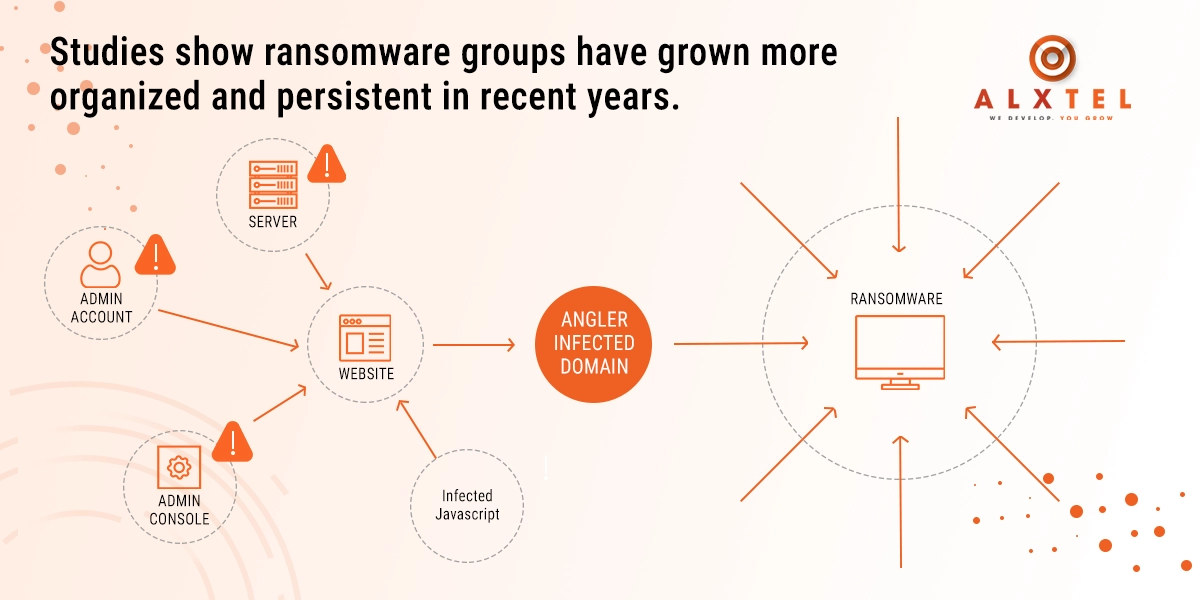
It didn’t start being this massive of a threat. Ransomware began as a simple digital lock. The attackers encrypted files. And they demanded a payment for unlock those. That was Ransomware 1.0. It was disruptive, yes but it was limited. Further, Ransomware 2.0 came. It evolved with data exfiltration and public leaks. It combined financial pressure with reputational damage. Now, we’ve entered Ransomware 3.0. Which is an era of stealth and persistence. This is where threats infiltrate entire ecosystem like cloud, endpoints, IoT, and supply chains.
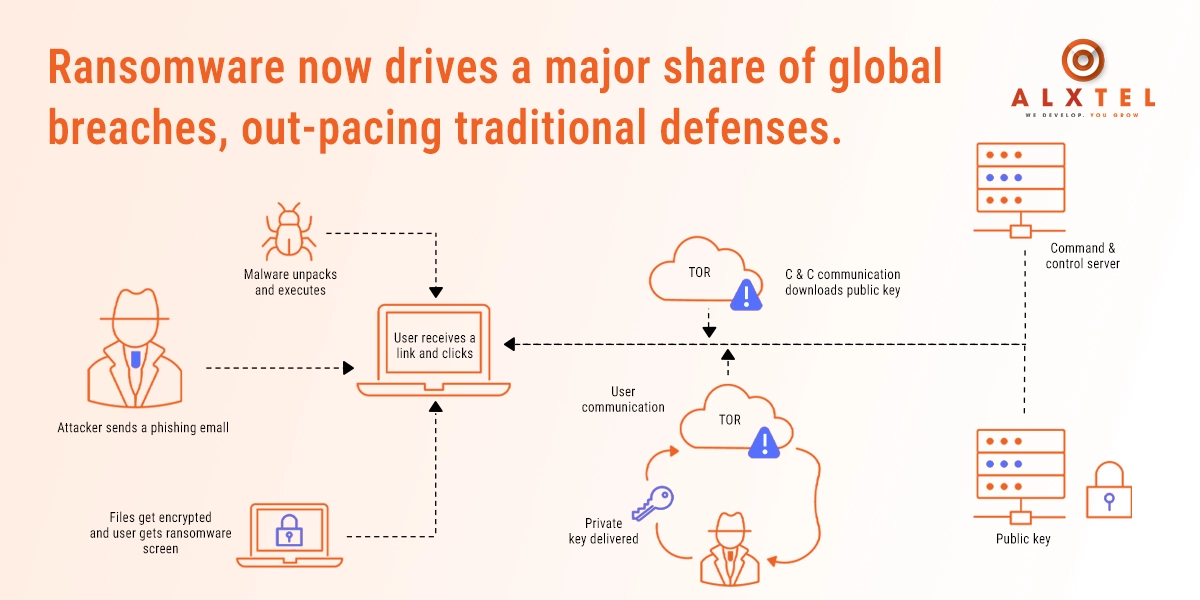
Unfortunately, outdated Cybersecurity Strategies still rely on static defenses. These include perimeter firewalls, signature-based antivirus, and scheduled patching. These tools can’t see into encrypted traffic. Neither they can handle from the remote devices or SaaS environments. This is where attackers have advantage. Attackers know this and thus they exploit this invisibility. The corrupting threats hide inside legitimate processes. They delay activation until they’ve mapped every weakness.
Moreover, traditional incident response happens after an attack occurs. This is where the late response can be catastrophic. By the time IT teams notice irregular activity. The systems are already locked and sensitive data is gone. The absence of predictive monitoring, automated response, and AI-driven analytics turns every delay into a disaster.
Therefore, organizations must rethink their entire security foundation. It’s not enough to block. Modern defense requires visibility. Along with adaptability, and intelligence. These are the core principles driving AlxTel’s cybersecurity framework.
Why Traditional Cybersecurity Strategies Fail Against Ransomware 3.0
Enterprises today operate across hybrid clouds, distributed teams, and connected devices. The perimeter has dissolved. But, old-school Cybersecurity Strategies still assume a clear boundary between “inside” and “outside.” That assumption creates blind spots, exactly where Ransomware 3.0 hides.
Traditional antivirus software can’t detect fileless attacks. Especially those that run entirely in memory. Firewalls can’t stop credential-stuffing or MFA-bypass tactics. Manual monitoring simply can’t keep pace with automated attacks scanning millions of endpoints every second.
In addition, legacy systems rarely communicate across platforms. Without centralized data correlation or machine-learning analysis, small warning signs remain scattered until it’s too late. Attackers exploit this fragmentation to slip through unnoticed. They move laterally, and trigger encryption simultaneously across hundreds of devices.
Furthermore, human-only response models are too slow. The difference between detection and disaster can be seconds, not hours. That’s why AlxTel built an ecosystem of automated, intelligence-driven solutions that detect, isolate, and neutralize threats before they spread. The shift from reactive security to active resilience defines the difference between traditional and next-generation protection.
Advanced Cybersecurity Strategies: Inside AlxTel’s Advanced Security Frameworks
Modern protection is not one product, it’s a synchronized system of services. AlxTel’s next-generation Cybersecurity Strategies combine visibility, automation, and zero-trust architecture to safeguard every digital layer. Let’s explore how each component reinforces enterprise security against Ransomware 3.0.
- Security Operations Center (SOC): 24/7 Threat Intelligence
AlxTel’s SOC operates around the clock, analyzing billions of data points in real time. Using AI-driven analytics, it detects anomalies, correlates logs, and identifies malicious activity long before encryption starts. This continuous monitoring eliminates “downtime gaps,” ensuring that even when employees sleep, the system stays vigilant. SOC teams also perform digital forensics to trace attack origins and strengthen future defenses.
- SASE and Zero-Trust Architecture: Perimeterless Protection
The Secure Access Service Edge (SASE) model merges network security with cloud-native access control. Combined with Zero-Trust principles, AlxTel’s framework verifies every device, user, and application before granting access, regardless of location. This means no implicit trust, no internal safe zone, and no easy target. Every connection is inspected, encrypted, and authenticated dynamically. These measures directly counter modern ransomware tactics like stolen credentials and lateral movement.
- MDR / EDR / SIEM: Intelligent Detection and Response
MDR also knows as Managed Detection and Response and EDR known as Endpoint Detection and Response allow instant identification of suspicious behaviour. Through the SIEM platform AlxTel supports collection and analysis of data from across the organization. Together, these solutions transform alert fatigue into actionable insights. Instead of drowning in notifications. AlxTel’s system automatically prioritizes and mitigates high-risk threats in seconds.
- Incident Response and Threat Hunting: Fighting Back Faster
Even with top-tier defenses, breaches can happen. What matters is how quickly you recover. AlxTel’s incident response services are designed for speed and precision. They isolate infected nodes, remove malicious code, restore operations, and ensure no residual payload remains. Proactive threat-hunting teams use behavioral analytics to uncover dormant threats before they activate. This preemptive action transforms cybersecurity from defense to offense.
- Cloud App Security and CASB Integration: Guarding the Cloud Edge
Ransomware 3.0 often enters through SaaS applications and shared cloud storage. AlxTel integrates Cloud Access Security Broker (CASB) controls to monitor file transfers, user behavior, and data sharing. If abnormal uploads or downloads occur, automated DLP (Data Loss Prevention) systems act instantly, blocking leaks before damage happens. This continuous visibility across hybrid clouds keeps sensitive information protected wherever it resides.
- Cybersecurity Management and Risk Assessment: Strategic Resilience
Beyond technology, AlxTel helps organizations establish risk-aware cultures. Their cybersecurity management services conduct regular audits, vulnerability assessments, and compliance checks. By mapping potential weaknesses against evolving ransomware patterns, enterprises stay ahead rather than playing catch-up. This ongoing evaluation ensures long-term resilience instead of temporary defense.
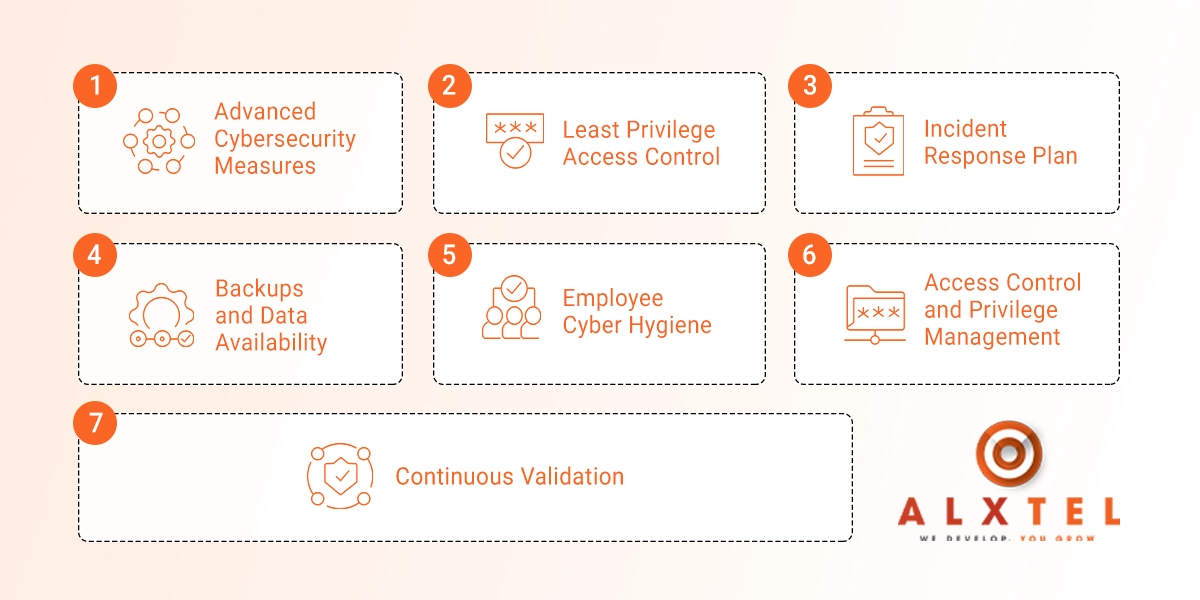
Together, these six pillars create a connected framework where prevention, detection, and recovery form a closed loop, an essential trait for surviving the Ransomware 3.0 era.
Mapping Ransomware 3.0 Tactics to AlxTel’s Cybersecurity Strategies
To understand how AlxTel neutralizes modern attacks, it helps to map each ransomware phase to a matching defense:
| Attack Phase | Ransomware 3.0 Technique | AlxTel Defense Mechanism |
| Initial Access | Phishing, zero-day exploit | Zero-Trust + MDR + EDR |
| Lateral Movement | Privilege escalation, remote control tools | SOC Monitoring + SIEM Analytics |
| Data Exfiltration & Encryption | Multi-extortion, double encryption | DLP + CASB + Incident Response |
| Persistence | Hidden backdoors, dormant payloads | Threat Hunting + Risk Assessment |
| Recovery | System reinstatement | Automated Rollback + Disaster Recovery Planning |
Each defense element works in unison. For instance, when MDR flags suspicious endpoint behavior, the SOC instantly receives an alert and cross-verifies it with SIEM data. If confirmed, the Zero-Trust policy cuts access while incident response starts containment. This choreography of protection proves that AlxTel’s Cybersecurity Strategies aren’t isolated tools, they’re an intelligent ecosystem.
The Business Impact: From Cyber Defense to Cyber Resilience
Beyond technology, the real question is business continuity. Every hour of downtime costs money, trust, and reputation. Studies show that ransomware recovery can drain millions, even for mid-size organizations. Traditional models treat security as a cost center, reacting only after an incident. AlxTel flips that logic. Its managed services convert security into a strategic advantage. Because detection and response are automated, productivity remains steady and compliance risks drop. Decision-makers gain clarity through analytics dashboards that display live threat status and resolution metrics.
Moreover, as ransomware gangs evolve with AI and deepfake-enabled extortion, AlxTel continuously updates its playbooks to stay one step ahead. These adaptive Cybersecurity Strategies not only defend assets but also future-proof the enterprise, ensuring continuity even when attackers change tactics. By transforming defense into resilience, AlxTel empowers businesses to operate fearlessly in a threat-saturated environment.
The Concluding Lines
Ransomware 3.0 has rewritten the rules of digital warfare. Static defenses, manual patching, and outdated Cybersecurity Strategies simply can’t survive the velocity and intelligence of modern threats. Enterprises need unified, AI-enhanced frameworks that can see, decide, and act instantly.
AlxTel delivers exactly that! An integrated ecosystem where SOC vigilance, Zero-Trust enforcement, MDR/EDR precision, and cloud-edge protection converge to neutralize ransomware before it takes root.
In this evolving landscape, survival depends on evolution. Organizations that modernize their Cybersecurity Strategies with AlxTel don’t just recover from attacks, they outsmart them, outpace them, and build digital trust for the future.
Frequently Asked Questions
- What is Ransomware 3.0?
Ransomware 3.0 refers to the latest generation of ransomware that uses multi-extortion tactics, targeting not just data encryption but also data theft, exposure threats, and supply-chain compromise. It’s intelligent, adaptive, and often AI-driven far beyond early ransomware models.
- Why are traditional cybersecurity strategies failing today?
Traditional cybersecurity strategies rely on perimeter-based defenses and signature detection. Modern attacks bypass these by using fileless malware, phishing vectors, and lateral movement inside cloud and hybrid networks, which static tools can’t handle.
- How does AlxTel address Ransomware 3.0 threats?
AlxTel integrates Managed Detection and Response (MDR), Zero-Trust Architecture, and a 24/7 Security Operations Center (SOC) to detect and neutralize ransomware at every stage from infiltration to encryption attempts.
- What makes next-gen cybersecurity strategies different?
Next-gen cybersecurity strategies focus on continuous verification, AI-driven analytics, and automated response. They unify endpoint, cloud, and network security into one adaptive framework offering visibility across the entire attack surface.
- What is Zero-Trust and why is it essential now?
Zero-Trust assumes no user or device is trustworthy by default. Every access request is verified continuously. In AlxTel’s model, this prevents unauthorized lateral movement and stops ransomware before it spreads.
- How does a Security Operations Center (SOC) support cyber resilience?
A SOC provides real-time monitoring, incident analysis, and rapid threat response. AlxTel’s SOC analysts use behavioral analytics and threat intelligence feeds to detect anomalies before damage occurs a cornerstone of cyber resilience.
- What role does MDR (Managed Detection and Response) play in modern cybersecurity strategies?
MDR combines technology and human expertise to monitor, detect, and respond to threats 24/7. It’s proactive rather than reactive minimizing breach impact and improving overall resilience.
- Can smaller enterprises adopt these advanced frameworks too?
Yes! AlxTel’s scalable cybersecurity solutions are designed for businesses of all sizes. SMEs can adopt Zero-Trust and MDR models without building an internal SOC reducing cost while maximizing protection.
- How does AlxTel partner with global tech leaders in cybersecurity?
AlxTel collaborates with Microsoft, Cisco, and known tech giants, integrating their advanced tools into a unified defense ecosystem. This ensures enterprises get enterprise-grade protection powered by proven global technologies.
- How can businesses future-proof their cybersecurity strategies?
By embracing AI-enhanced monitoring, Zero-Trust frameworks, and managed cybersecurity services, companies stay ahead of evolving threats. Partnering with AlxTel ensures continuous adaptation to new ransomware models and emerging attack vectors.
References

Senior Solution Architect with 23 years of experience in different Technology sectors. Diligent, forward-thinking, and adaptable to dynamic company, customer, and project needs.