NWU professor helps shape Africa’s first hypertension guidelines is trending nowSmoking reduces chances of successful fertility treatment, says WHO is trending nowCongo-Kinshasa: Ebola Fatigue? the Anglican Church in DR Congo Launches New Phase of Resp… is trending nowStrange 'fast radio bursts' across the universe could help solve major cosmic mysteries: … is trending nowBlue Origin to become first telco on Mars with $700m NASA contract is trending nowNew MRI agent to earlier detect lung cancer, hidden metastases is trending nowChalmers Researchers Make Bosonic Quantum Operations More Than 1,000 Times Faster is trending nowPSG dent Yaya Toure’s historic UCL night as Liverpool defeat Atletico is trending nowXabi Alonso blames himself! Chelsea boss admits he made it 'too difficult' for Blues star… is trending nowUS Open quarterfinal scores, highlights: Zverev, Khachanov advance, Gauff rallies is trending nowTottenham should be awarded 2016-17 Premier League title after Chelsea breaches, says Mau… is trending nowDavido’s ‘Oriadé’ Surpasses 100 Million Streams On Spotify is trending nowNWU professor helps shape Africa’s first hypertension guidelines is trending nowSmoking reduces chances of successful fertility treatment, says WHO is trending nowCongo-Kinshasa: Ebola Fatigue? the Anglican Church in DR Congo Launches New Phase of Resp… is trending nowStrange 'fast radio bursts' across the universe could help solve major cosmic mysteries: … is trending nowBlue Origin to become first telco on Mars with $700m NASA contract is trending nowNew MRI agent to earlier detect lung cancer, hidden metastases is trending nowChalmers Researchers Make Bosonic Quantum Operations More Than 1,000 Times Faster is trending nowPSG dent Yaya Toure’s historic UCL night as Liverpool defeat Atletico is trending nowXabi Alonso blames himself! Chelsea boss admits he made it 'too difficult' for Blues star… is trending nowUS Open quarterfinal scores, highlights: Zverev, Khachanov advance, Gauff rallies is trending nowTottenham should be awarded 2016-17 Premier League title after Chelsea breaches, says Mau… is trending nowDavido’s ‘Oriadé’ Surpasses 100 Million Streams On Spotify is trending now
Lego
WILDLIFE PONDS
Landscaping Solutions ··108 views
If you’re motivated to make a difference to biodiversity or simply wish to while away the day watching wildlife then you need a pond in your garden.
A professional garden or landscape designer will know where best to place a pond in your garden.
Here’s how to make it happen;
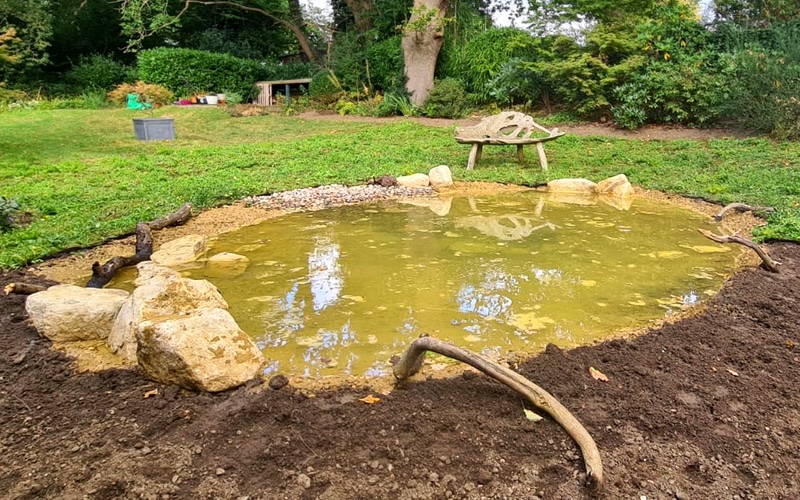
Take time to select an experienced professional to work with. A garden or landscape designer with a passion for creating naturalistic spaces will know how to attract wildlife to the garden and have an instinctive understanding of where best place to place the pond. This might be a natural dip in the lay of the land or an open area away from overhanging trees, preferably in a sunny spot as most insect and plant life thrives in warm, shallow and sunlit conditions. However, we ensure there’s at least two to three feet of depth at some point so hibernating frogs have a place to overwinter. Pond sides should gently slope to the depths to provide trouble-free wildlife access so we always create a shallow ‘beach’ area at one end.
A shallow beach area at one end of the pond provides trouble-free access for wildlife.
A clever designer will plan to save and reuse as much excavated material as possible during the build process. Fertile topsoil can be used to create borders or banks elsewhere in the garden and less fertile sub-soil can be used as growing media in the pond.
Then it’s time to get creative with the planting. Our planting schemes utilise oxygenators such as Hornwort, Water Crowfoot or Spiked Milfoil along with some floating species such as Frogbit, Fringed Water Lilly and Water Soldier. A smattering of emergent species and marginal plants such Amphibious Bistort, Brooklime, Water Avens, Purple Loosestrife, Marsh Marigold, Water Mint and Hard and Soft Rush can be planted directly in to the soil layer in and around the pond.
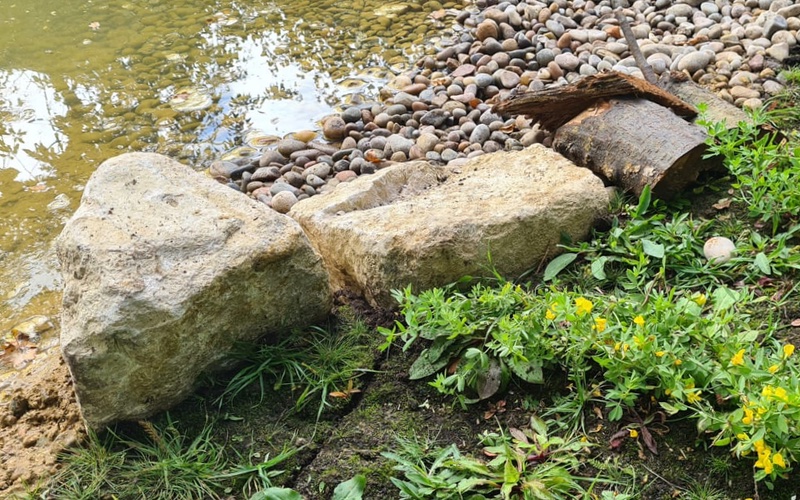
Boulders and deadwood are great for providing a hiding place for amphibians.
To make the pond more naturalistic we add boulders, stumps, deadwood, bark and branches to provide hiding places for amphibians and perches for birds and dragonflies. Now it’s time to sit back to see what comes in. It won’t be long before beetles, backswimmers, water boatmen and pond-skaters start to arrive. Snails won’t be far behind followed by frogs, toads and newts once the vegetation establishes. Within a year or so you’ll have a fully functioning ecosystem helping to redress the balance of habitat loss in the wider countryside and a constant source of enjoyment and learning.
For more information on how Landscaping Solutions can transform your garden, contact Ben West on 0208 241 2402 or email [email protected]
If you’re motivated to make a difference to biodiversity or simply wish to while away the day watching wildlife then you need a pond in your garden.
A professional garden or landscape designer will know where best to place a pond in your garden.
Here’s how to make it happen;
Take time to select an experienced professional to work with. A garden or landscape designer with a passion for creating naturalistic spaces will know how to attract wildlife to the garden and have an instinctive understanding of where best place to place the pond. This might be a natural dip in the lay of the land or an open area away from overhanging trees, preferably in a sunny spot as most insect and plant life thrives in warm, shallow and sunlit conditions. However, we ensure there’s at least two to three feet of depth at some point so hibernating frogs have a place to overwinter. Pond sides should gently slope to the depths to provide trouble-free wildlife access so we always create a shallow ‘beach’ area at one end.
A shallow beach area at one end of the pond provides trouble-free access for wildlife.
A clever designer will plan to save and reuse as much excavated material as possible during the build process. Fertile topsoil can be used to create borders or banks elsewhere in the garden and less fertile sub-soil can be used as growing media in the pond.
Then it’s time to get creative with the planting. Our planting schemes utilise oxygenators such as Hornwort, Water Crowfoot or Spiked Milfoil along with some floating species such as Frogbit, Fringed Water Lilly and Water Soldier. A smattering of emergent species and marginal plants such Amphibious Bistort, Brooklime, Water Avens, Purple Loosestrife, Marsh Marigold, Water Mint and Hard and Soft Rush can be planted directly in to the soil layer in and around the pond.
Boulders and deadwood are great for providing a hiding place for amphibians.
To make the pond more naturalistic we add boulders, stumps, deadwood, bark and branches to provide hiding places for amphibians and perches for birds and dragonflies. Now it’s time to sit back to see what comes in. It won’t be long before beetles, backswimmers, water boatmen and pond-skaters start to arrive. Snails won’t be far behind followed by frogs, toads and newts once the vegetation establishes. Within a year or so you’ll have a fully functioning ecosystem helping to redress the balance of habitat loss in the wider countryside and a constant source of enjoyment and learning.
For more information on how Landscaping Solutions can transform your garden, contact Ben West on 0208 241 2402 or email [email protected]

 Landscaping Solutions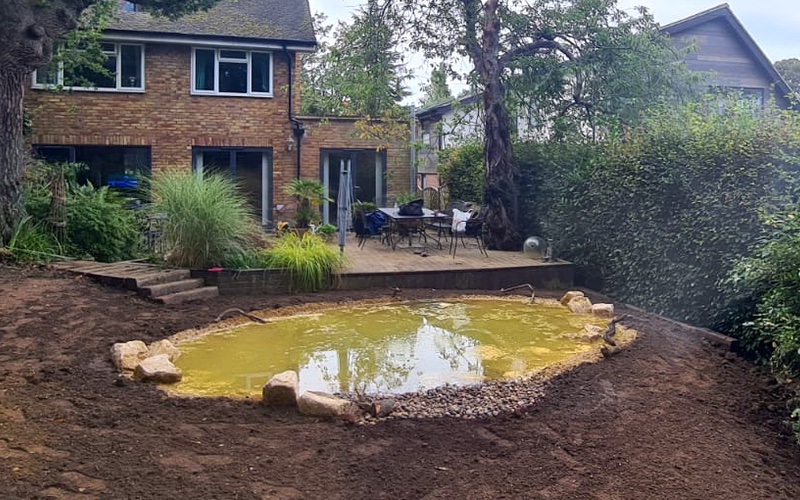
 Set My Trip Blog
  The New York Times - Politics
 Coleman Concierge
  Environment America
  South China Morning Post
  London Cottage Garden