
Failing to extend the ACA tax credits poses an electoral threat to incumbents in five Republican-held swing districts.
By Anika Dandekar
Last week, the Senate took two votes on proposals around extending and modifying Affordable Care Act (ACA) subsidies to lower health care premium costs for millions of Americans. Both the Democratic- and Republican-led proposals failed to meet the 60-vote threshold and thus failed to pass the Senate. The House of Representatives is expected to take a similar series of steps.
Data for Progress and Care in Action released new polling of likely voters in five Republican-held swing districts (AZ-06, CA-22, PA-07, VA-02, and WI-03) regarding ACA funding and health care. The polling shows that health costs are a top concern, Democratic health care proposals are far more popular than Republican ones, and failing to extend the ACA tax credits poses electoral threats to incumbents in these districts.
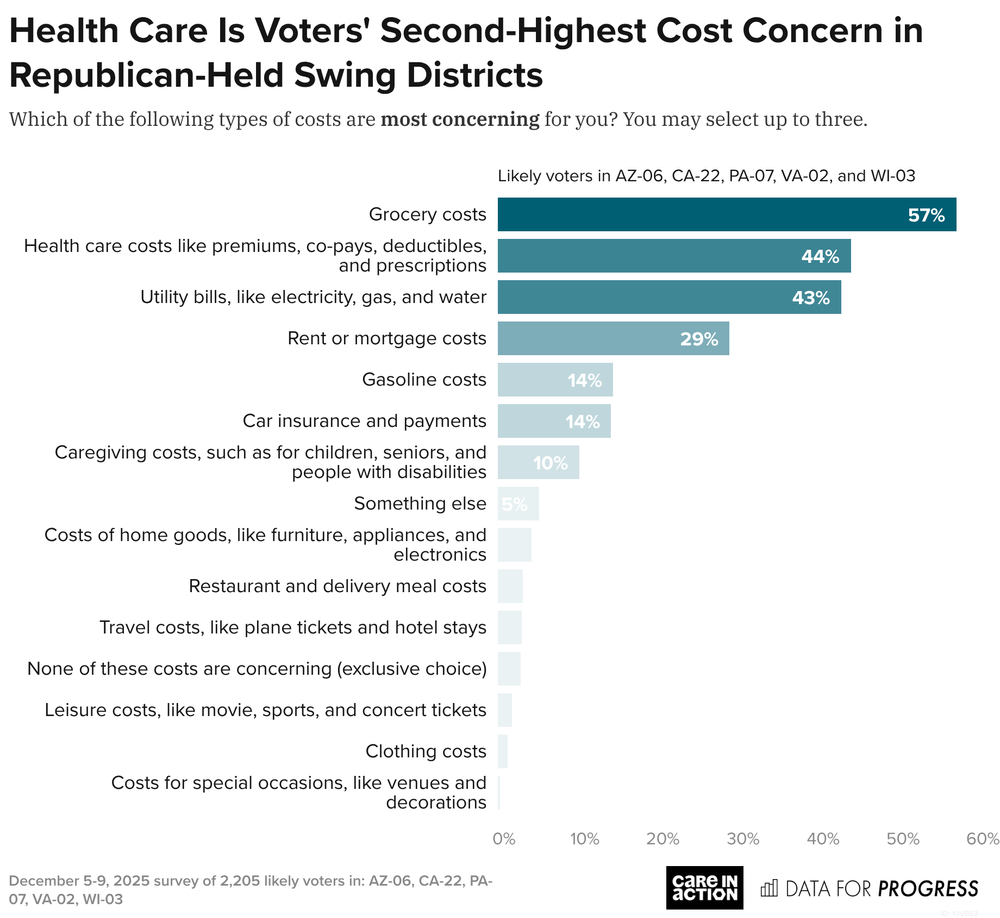
Health care costs, including premiums and prescriptions, are the second-highest cost concern (44%) after grocery prices (57%). Utility bills, like electricity, gas, and water, rank a close third, with (43%) of voters in the district expressing concern.
The polling also shows that 74% are either “very concerned” or “somewhat concerned” about health insurance premiums rising, including 88% of Democrats, 73% of Independents, and 63% of Republicans. ACA recipients show especially high concern at 91%.
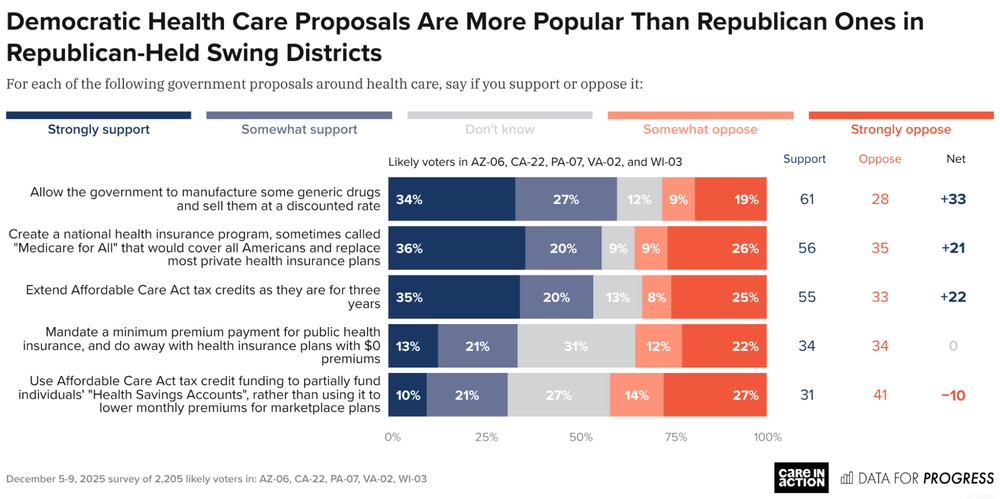
The survey asked voters in these districts about various health care policies that have been put forward by Democrats and Republicans in Congress.
Democratic health care proposals are popular:
Government manufacturing of generic drugs receives 61% support (net +33) with majority support across all partisan groups, including 63% of Republicans.
Medicare for All receives 56% support (net +21).
Extending ACA tax credits for three years receives 55% support (net +22).
Meanwhile, Republican health care proposals are met with more resistance:
Mandating minimum premium payments and eliminating $0 premium plans shows even support and opposition (34% to 34%, net 0).
Using ACA tax credit funding for Health Savings Accounts rather than lowering premiums faces opposition from a plurality (41% oppose, net -10).
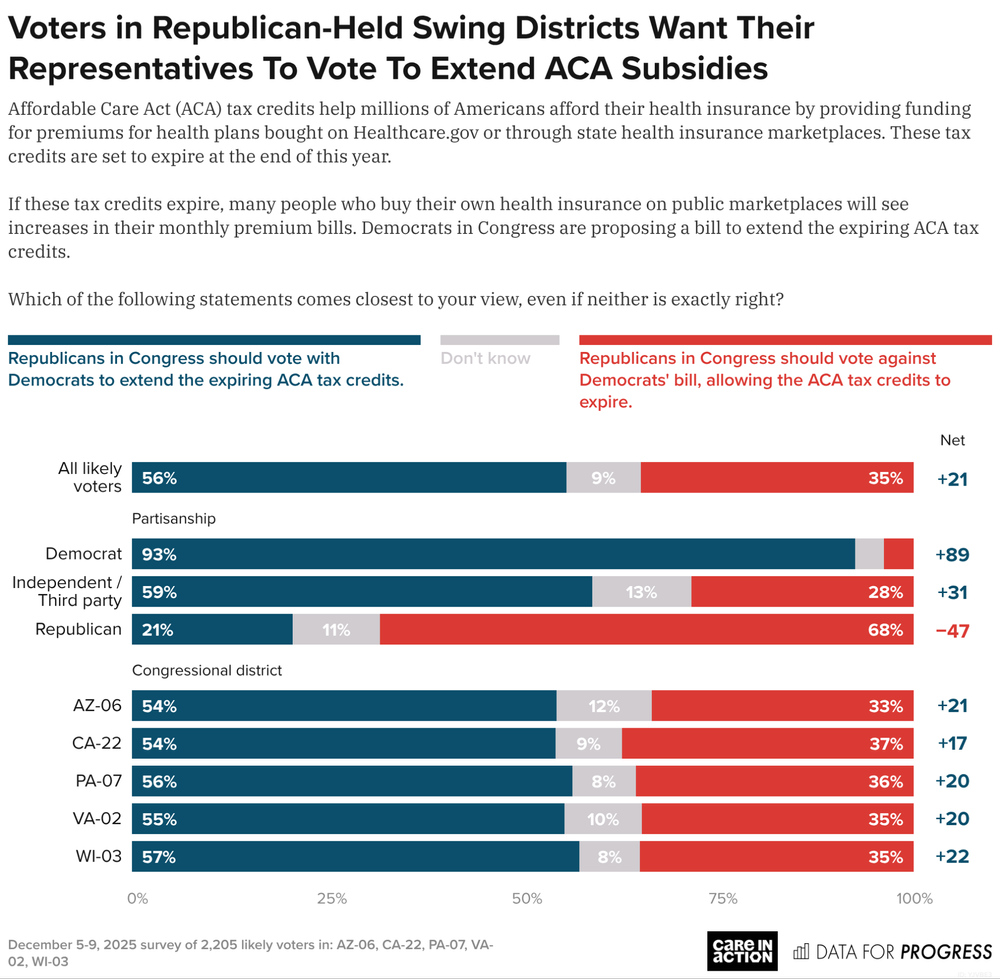
Voters were presented with background information on ACA subsidy funding and were told that Democrats in Congress were putting forward a proposal to extend those subsidies.
A majority of voters (56%) say Republicans in Congress should vote with Democrats to extend expiring ACA tax credits, versus 35% who support letting them expire. Support is overwhelming among Democrats (93%), and reaches a majority among Independents (59%). Among ACA recipients specifically, support reaches 76%. Majorities of voters across each of the five congressional districts tested also say that their Republican representative should vote with Democrats to extend ACA subsidies.
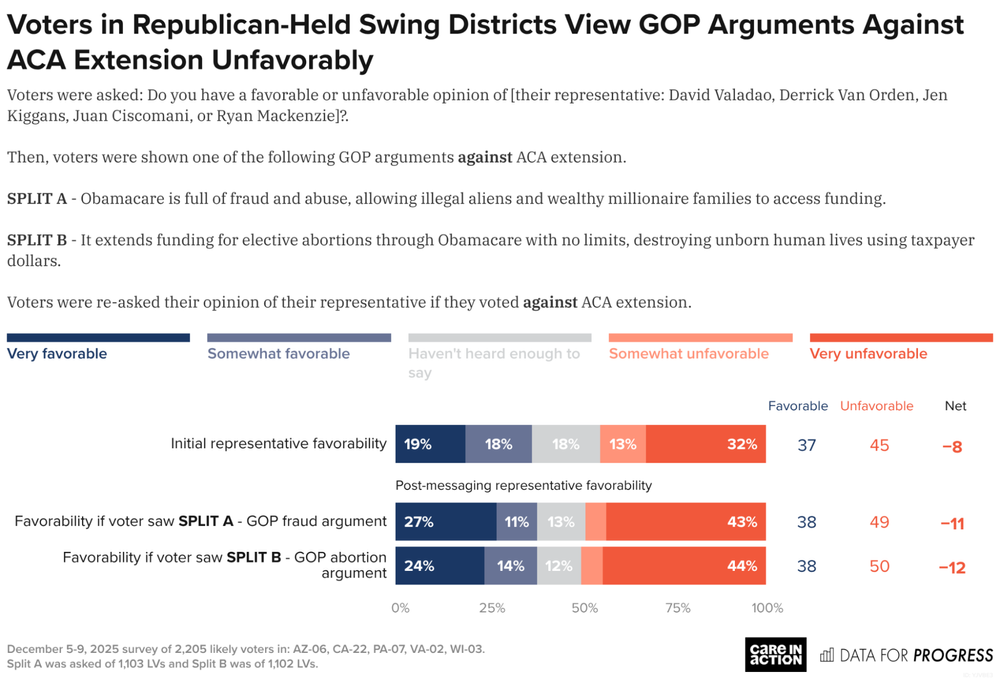
The survey also tested opposition messages against ACA funding, and finds that Republican messaging around the ACA does not improve the perception of representatives in these districts.
The net favorable rating of Republican representatives of the five districts (David Valadao, Derrick Van Orden, Jen Kiggans, Juan Ciscomani, Ryan Mackenzie) was initially -8, with 37% favorable and 45% unfavorable, on average.
When opposition to ACA extension is framed around abortion funding, Republican representatives receive a 50% unfavorable rating (net -12), versus a 49% unfavorable rating (net -11) when opposition is framed around fraud and illegal immigration. Both arguments slightly decrease Republican favorability from the initial ask.
The polling also suggests electoral vulnerability for Republicans who oppose ACA extensions. In the beginning of the survey, a generic Democrat, on average in the five districts, leads by a slim margin (47% to 46%) against a generic Republican. Then, later in the survey, voters were presented a hypothetical where their Republican representative votes against extending ACA tax credits. In that scenario, Democratic generic ballot advantage grows from +1 to +4 points (and similarly in named ballot tests). On average, voters prefer a generic Democrat more when provided with a hypothetical situation where their Republican representative voted against ACA extensions.
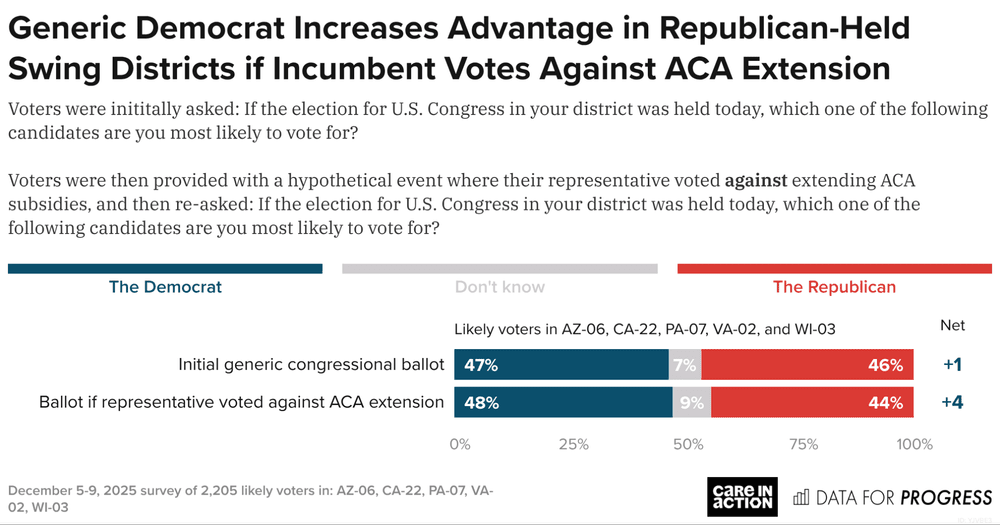
This polling shows that Republicans in more “purple” congressional seats cannot solely rely on their base and typical party messaging, especially when health care cost concerns are felt so broadly. They risk even greater electoral vulnerability to Democrats if they oppose extending ACA subsidies that impact the health premium costs of millions of Americans.
Survey Methodology
From December 5 to 9, 2025, Data for Progress conducted a survey of 2,205 likely voters using SMS and web panel respondents in the following congressional districts: AZ-06, CA-22, PA-07, VA-02, and WI-03. The sample was weighted to be representative of likely voters by age, gender, education, race, geography, and recalled presidential vote. The survey was conducted in English. The margin of error associated with the sample size is ±2 percentage points. Results for subgroups of the sample are subject to increased margins of error. Partisanship reflected in tabulations is based on self-identified party affiliation, not partisan registration. For more information please visit dataforprogress.org/our-methodology