
 Bahee Van de Bor Blog
 Written and clinically reviewed by Bahee Van de Bor, Registered Paediatric Dietitian | BSCAPSc, PGDipDiet, RD
Your child is constipated. You have probably already tried more fruit, more water, more fibre. Maybe prunes.
Or pear juice.
Maybe something you read about online.
So it is fair to wonder: is there a food that genuinely helps?
The honest answer is yes, sometimes. Whether food is enough depends on how mild or established the constipation is, whether your child is already withholding or retaining stool, and whether there is a genuine dietary gap to correct.
In this article, you will learn:
- Which foods may help soften stools naturally, including what the emerging kiwifruit evidence means for children
- How food, fluid and movement work together to support healthy bowel movements
- When increasing fibre can help, and when it may increase bloating or discomfort
- Why the type and amount of fibre matter
- When food changes alone are unlikely to be enough
This article helps you recognise constipation, make sensible first changes and understand when your child needs a more individual assessment.
Foods like kiwi, prunes and pears may help soften your child’s stools, particularly if constipation is mild or recent. The longer it has been present, the less likely food alone is to resolve it. For established constipation, dietary changes work best alongside medical support, not instead of it.
What do parents mean when they search for a “natural laxative” for their child?
Most of the time, it is not a specific product you are after.
It is permission to try something safe at home before reaching for the GP. That instinct is reasonable, but “natural” does not always mean gentler or safer, and a well-structured diet is the foundation either way.

Signs of constipation in children
Recognising constipation early can prevent pain, withholding, and long-term problems.
Recognising constipation early can prevent pain, withholding and longer-term problems.
Common signs include:
- Infrequent bowel movements
- Hard, dry or large stools
- Pain or straining when pooing
- Soiling or skid marks in underwear
- Tummy pain or bloating
Children may also show:
- Irritability or low mood
- Reduced appetite
- Fear or avoidance of using the toilet
If you are noticing these patterns, it helps to act early rather than waiting it out, because constipation can become harder to resolve over time.
If tummy pain is one of the symptoms you are seeing, our tummy pain quiz can help you work out whether it points to something more than constipation.
How to recognise constipation using a children’s stool chart
Healthcare professionals often use a stool chart, sometimes called the Bristol Stool Chart, to describe stool consistency.
You do not need to memorise it, but it can be a helpful way to recognise constipation at home.
In children, constipation commonly looks like:
- Type 1: small, hard pellets, sometimes described as rabbit droppings
- Type 2: a hard, lumpy, sausage-shaped stool
These stool types suggest that stool is spending too long in the bowel and losing water, which is why they are harder and more painful to pass, and often come with straining and withholding.
If your child regularly passes hard stools like these, even if they poo every day, this still counts as constipation and is worth addressing early.
Causes of constipation in kids
A single thing rarely causes constipation in children. Several factors usually combine, and it helps to separate what starts the constipation from what keeps it going once it takes hold.
Common nutritional and lifestyle contributors:
- Picky or restricted eating, which can mean low fibre intake and less stool bulk
- Inadequate fibre intake, where the type, amount and timing all matter
- Low fluid intake, which leaves stools drier, harder and more painful to pass
- Not much daily movement, since being active helps stimulate the gut
Factors that keep constipation going once it takes hold:
- Stool withholding, often triggered by a painful poo, which reinforces the pattern over time. If this sounds familiar, why is my child scared to do a poo may help
- Retained stool that stretches the bowel and dulls the urge to go
Sometimes there is an underlying medical reason:
- Constipation-predominant IBS, which can go undiagnosed
- Non-IgE-mediated cow’s milk protein allergy, which in a small number of babies can present with constipation
Constipation can also begin after an illness, such as a tummy bug that left your child eating and drinking less than usual. If that is your situation, you may find why some children stay constipated after a stomach bug helpful.
An important clinical note
H3: An important clinical note
If constipation has been present for weeks or months, generic nutrition or fibre advice alone rarely resolves it.
In my clinic, I often see children who have been:
- Given too much fibre too quickly
- Encouraged to drink more water as though this alone would soften stool that was already hard or retained
- Kept on prunes while the stool remains backed up
This is why you need to use natural laxatives strategically, not randomly.
If your child has struggled with constipation for several weeks or months despite dietary changes, or keeps improving with laxatives only for the constipation to return, the problem needs a more systematic assessment.
By this stage, nutrition may be only one part of the picture.
Pain, withholding, retained stool and toileting difficulties can all help keep the cycle going.
If your child has struggled with constipation for a while and is not improving, seek specialist input now, not after another six months on the same prescription.
Inside the Happy Belly Club®, I assess the child’s ordinary diet and fibre intake alongside their stool pattern, symptoms, withholding, toileting, fluids and treatment history. This helps us identify what everyone overlooked and introduce changes in a sequence that suits that child.
Which foods may help a constipated child?

Here is where I want to be specific, because “eat more fruit and veg” is not a constipation plan. These are the foods I consider in clinic, and why.
Oats and porridge
Oats provide fermentable fibre and can help increase your child’s overall fibre intake gradually. Porridge is often one of the more practical options, particularly for younger children.
Vegetables and legumes
Baked beans, peas, lentils and chickpeas are among the best fibre sources your child is likely to actually eat.
They provide both fermentable fibre and bulk, and they support the gut bacteria, which matters for longer-term gut health.
If your child finds some pulses hard to tolerate, it is worth knowing whether chickpeas are low FODMAP.
A note on bananas: they often top constipation-remedy lists, but the evidence stays mixed.
They contribute some fibre, but they are not a targeted constipation treatment, and individual responses vary.
If your child has IBS-type symptoms, you may find are bananas good for IBS helpful.
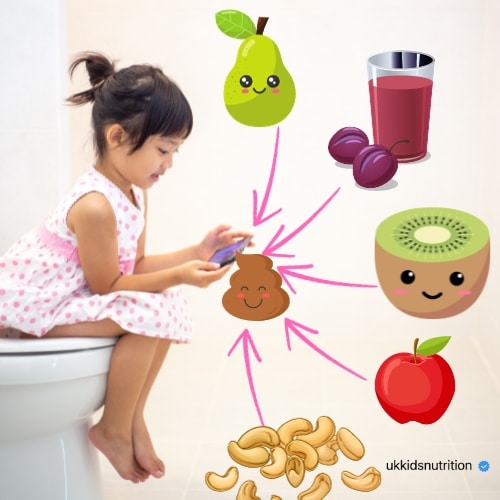
Nuts and seeds
Nuts and seeds add fibre along with useful micronutrients, and they work well once stools have started to soften.
Offer them in a form suited to your child’s age, such as smooth nut butters or finely chopped nuts for younger children, to reduce the risk of choking.
Pears
Pears provide fibre and contain sorbitol, which may help soften stools in some children. The appropriate portion depends on the child, as larger amounts can increase wind or bloating.
Kiwi fruit
Kiwi is one of the foods I use most often in clinic.
It provides fibre and water, and adult studies suggest that regular kiwi intake may improve stool frequency and comfort.
Paediatric research remains limited, so the portion I would consider depends on your child’s age, their current diet, and how they respond.
If you are wondering whether it matters which type to choose, I have written more on golden kiwi or green kiwi for constipation in children.
Prunes
Prunes contain sorbitol, a naturally occurring sugar alcohol that draws water into the gut and may help soften stools.
Whole prunes are generally preferable to juice because they also provide fibre.
Apricots, plums and cherries also contain sorbitol and may have a similar effect.
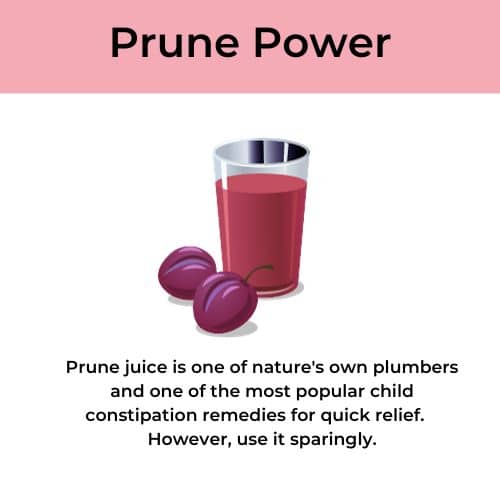
Prune juice for babies under 12 months
Ideally, do not offer fruit juice to infants under 12 months.
If you do give it at this age, NHS guidance is one part fruit juice to ten parts water, and serve it with a meal.
Constipation in infancy needs age-specific advice, so speak to your health visitor, GP or paediatric dietitian rather than relying on juice as a treatment.
Prune juice for toddlers
If your child will not eat prunes, you might consider prune juice, but it contains free sugars and can contribute to tooth decay if you do not handle it carefully.
I would recommend diluting it to reduce free sugar concentration and protect teeth, and serving it with a meal rather than on its own.
NHS guidance recommends no more than 150ml of fruit juice and smoothies per day across all sources.
The right approach depends on your child’s age, their overall diet and their dental health, so this is worth discussing with a healthcare professional.
What about dairy?
Parents often ask whether dairy is causing their child’s constipation.
For most children, there is no strong evidence that removing dairy helps, and cutting it out unnecessarily can reduce calcium and other important nutrients.
Fermented dairy foods such as yoghurt and kefir can also support the gut bacteria.
The exception is a small number of babies, where non-IgE cow’s milk protein allergy can present alongside constipation.
If you suspect this, do not start removing foods on your own, speak to your GP or a paediatric dietitian first.
Are probiotics good for constipated children?
Guidelines do not recommend probiotics as a routine treatment for functional constipation.
If a child has IBS as well as constipation, you might sometimes consider a carefully selected probiotic strain to help reduce abdominal pain. But it does not treat hard or infrequent stools.
I would not choose a probiotic simply because a child has constipation.
The child’s symptoms, diagnosis and the specific probiotic strain all matter.
Why does the type of fibre matter?
This is where it gets slightly more nuanced, but bear with me because it matters.
Different fibres behave differently in the gut.
Gut bacteria readily break some of them down, supporting the microbiome and stool consistency.
Others retain water or add useful bulk that helps the bowel move things through.
Most whole foods contain a mixture of both, which is one reason why simply adding bran or picking one high-fibre product so often fails to produce the result parents expect.
Increase fibre gradually. A sudden large increase can cause bloating, fullness or discomfort, particularly when the bowel is already holding stool.
Whole foods provide fibre alongside water, vitamins and plant compounds that supplements cannot replicate, and adding the wrong supplement may increase bloating without improving the stool.
What about psyllium husk?
Psyllium is a gel-forming fibre that absorbs water and can alter stool consistency.
It is not interchangeable with bran powders, inulin gummies or generic prebiotic supplements.
It is one of the interventions I sometimes consider when a child’s diet, stool pattern and clinical presentation make it appropriate.
The child’s age, fluid intake, swallowing ability and whether the bowel already holds retained or impacted stool all matter.
This is why I have deliberately not included an amount for parents to copy at home.
Before using psyllium for a child, discuss it with their GP, pharmacist or a registered paediatric dietitian.
This is especially important for children under six, because psyllium can be very filling and may reduce appetite or displace energy and nutrients if used inappropriately.

When parents contact me about persistent constipation, they’ve usually tried many of these strategies individually. What’s often missing isn’t another food or supplement – it’s a systematic approach that addresses the underlying pattern.
In the Happy Belly Club, we work through a structured 12-week protocol to:
- Soften stools systematically (not through guesswork)
- Rebuild toilet confidence
- Identify which strategies actually work for your child’s specific pattern
- Monitor and adjust based on clinical response
This is clinical support, not generic advice. → Book a 15-minute suitability check
How much fibre do children need per day?
Most children are not getting enough fibre, and it helps to know what the target actually is. The UK recommendations, set by SACN, increase with age.
Table 1.0 Fibre requirements per age
| Age (years) | Fibre requirements per age (grams per day) |
| 2-5 | 15g |
| 5-11 | 20g |
| 11-16 | 25g |
| 16-18 (adolescents) | 30g |
Only 14% of children aged 4 to 10 in the UK currently meet these targets.
So if your child is falling short, they are in the majority, not the exception.
Foods and approaches that can make your child’s constipation worse
You rarely need to cut out a single food completely.
But some approaches can work against you:
- suddenly adding large amounts of bran
- relying heavily on low-fibre snack foods
- using juice, dried fruit or “natural laxative” products in increasingly large amounts
- continuing to add fibre when your child may already have retained stool
Large amounts of coarse fibre can increase wind, bloating or discomfort, particularly once constipation has taken hold.
The aim is not simply to add as much fibre as possible, but to choose the right type and amount for your child.
Constipation in toddlers and very young children
For toddlers, the same principles apply but the portions are much smaller. Kiwi, pear and well-cooked vegetables and pulses are practical starting points.
Very large amounts of bran or adult-style fibre products can cause discomfort, fill a young child up quickly and displace energy and other important nutrients.
If your toddler has struggled with constipation for more than a few weeks, or passes stools that clearly distress them, get medical advice alongside any dietary changes.
If painful stools lead to withholding, the cycle can become increasingly established, so early assessment matters.
Dietary changes still help at this stage, but they need to be the right ones for your child, not a general fibre increase.

Why generic dietary advice so often falls short
Most parents hear the same advice: increase fruit, vegetables, fibre and water.
They do exactly that.
And nothing changes.
If that is you, you are not doing anything wrong.
This is not because diet cannot work.
Sometimes the advice was too vague to correct the nutritional gap.
In other cases, withholding and retained stool had already become too established for food changes alone to be enough.
When medication becomes the whole plan
What macrogol does
NICE recommends macrogol as the first-line laxative, and doctors often prescribe it as Movicol.
It is an osmotic laxative, which means it retains water in the stool to keep it soft enough to pass without pain.
It may provide essential symptom control, particularly when the bowel is already holding retained stool.
What it leaves untouched
But medication can become the entire plan, while the child’s diet, withholding, toileting and other contributors remain unexamined.
My concern is not that doctors prescribe laxatives, but that too many children receive a prescription and a generic fibre leaflet rather than an individual assessment of what is actually keeping the constipation going.
What I see in practice
One family I worked with recently had been through several rounds of laxatives and hospital investigations.
Each time the treatment restarted, the child’s stools improved.
But nobody had ever assessed what she was actually eating across an ordinary day.
Her parent had carefully prioritised protein because most of the nutrition advice she encountered focused on it.
It genuinely surprised her that no one had assessed her child’s fibre intake or helped her create a practical plan before.
The laxatives had worked as intended. But no one had shown the family how to use nutrition to support softer stools and reduce the risk of constipation returning.
Where I stand on laxatives and diet
Where my view sits alongside NICE
I want to be transparent about something.
My view is that children deserve a proper dietary assessment, not just a repeat prescription.
That view sits alongside, rather than neatly inside, NICE guidance, which recommends macrogol laxatives as first-line treatment for childhood idiopathic constipation.
NICE recommends macrogol because it has evidence behind it and offers a consistent way to soften retained stool.
Why medication is so often the default
In practice, medication is also far easier to provide at scale than specialist dietetic care, and that reality helps explain why so many families receive a prescription rather than an individual dietary assessment.
That is not a criticism of colleagues who follow the guidance. This simply describes how the NHS structures and delivers care.
What I would want for my own child
But first-line guidance for a pressured GP appointment is not the same as what is possible with a proper specialist dietary assessment over time.
If one of my own children had constipation that reflected gaps in their diet, I would want those gaps identified and corrected, not managed long-term with a stool softener.
That is my honest position, and it is why I work the way I do.
If a healthcare professional has prescribed laxatives for your child, speak to your GP before you stop giving them.
Soiling or frequent loose-looking accidents in a constipated child may be a sign of overflow rather than diarrhoea. This happens when liquid stool leaks around a blockage of retained harder stool. If your child is having accidents despite appearing constipated, it is worth seeking medical advice.
Read more about the signs of overflow diarrhoea in children.
A note on products marketed as “natural laxatives” for children
“Natural” or “herbal” does not automatically mean safe or suitable for a child.
Regulators apply different rules to these products, and manufacturers follow different testing standards. Do not confuse them with stimulant laxatives prescribed as part of a medically supervised treatment plan.
If you are considering anything beyond dietary food changes, the safest step is to discuss it with your GP, pharmacist or a paediatric dietitian before starting.

Natural strategies that genuinely help with constipation
How to make a child poo quickly
If you have searched “how to make a kid poop fast”, you are probably looking for relief from pain and discomfort, not a way to force a bowel movement.
There is no food or home remedy that can safely guarantee an instant poo.
But the right combination of fibre, fluid, everyday movement and calm toileting habits can soften stools and support a more regular pattern.
Fluid and movement
The section above explains fibre and the foods that provide it.
Alongside them, make sure your child is drinking enough for their age, and remember that repeatedly pushing water will not soften a stool that is already hard and retained.
If your child is a reluctant drinker, you may find 7 ways to get your child to drink water helpful.
Normal daily activity such as running, walking, dancing and active play also helps keep the gut moving, though it cannot clear significant retention by itself.
A relaxed toilet routine
Encourage your child to sit on the toilet for about five minutes after a meal, when the natural gastrocolic reflex makes the bowel more active.
Support your child’s feet so they do not dangle, and keep the experience calm and pressure-free.
Praise them for sitting and trying, not only for producing a poo.
What is the best laxative for kids?
There is no single laxative that is best for every child.
The right treatment depends on your child’s age and symptoms, whether they have retained stool and how established the constipation has become.
If your child needs a medical laxative, NICE recommends macrogol as the first-line treatment to clear retained stool and provide ongoing maintenance.
A healthcare professional may add another laxative or recommend an alternative if needed.
For painful, long-standing constipation, withholding or soiling, do not delay medical treatment while repeatedly trying stronger home remedies.
Laxatives are often necessary alongside dietary and toileting support, as set out in NHS guidance.
What if my child is severely constipated?
When constipation is severe or has been present for weeks or months, natural laxative foods alone are unlikely to be enough.
The child may have a large amount of retained stool, pain, withholding, soiling or a stretched rectum that no longer signals normally when they need to poo.
In this situation, prescribed laxatives may be necessary to clear retained stool and maintain consistently soft, pain-free bowel movements.
This is not a failure, and do not use diet as a reason to delay appropriate medical treatment.
If your child has severe constipation or you suspect a stool backlog, keep giving their prescribed laxatives.
Adding large amounts of bran, fibre powders or dried fruit can sometimes increase bloating, pain and fullness without resolving the blockage.
Some children with ongoing abdominal pain and constipation may have IBS-C, but constipation alone does not mean a child has IBS.
See the warning signs below if you are unsure whether your child needs prompt medical advice.
You might also be interested in: Is the Low FODMAP Diet for Constipation Effective in Children?
If loose stools are part of the picture, read what to do when the tests come back normal.
When to speak to a doctor
Seek medical advice promptly if your child has any of the following:
- Blood in the stool that is not clearly from a small fissure or skin tear
- Significant abdominal swelling or persistent vomiting
- Weight loss or faltering growth
- Fever alongside gut symptoms, or a child who appears generally unwell
- Severe or worsening abdominal pain
- Weakness or altered sensation in the legs
- Constipation that began in the first few weeks of life
- A delay in passing meconium (the first poo) as a newborn
It is also worth returning to your GP if constipation is persistent, regularly painful, accompanied by withholding or soiling, or keeps returning despite treatment.
A paediatric dietitian can assess whether nutritional factors are contributing and develop an individual plan alongside appropriate medical care.

Frequently asked questions
What is the best natural laxative for a child?
There is no single food that works for every child. Prunes and pears contain sorbitol, while kiwi provides fibre and water and may support bowel regularity through different mechanisms. Which food is appropriate depends on your child’s age, ordinary diet, symptoms and tolerance.
What are home remedies for constipation in a 2-year-old?
At this age, constipation often begins around potty training or after one painful poo, so the priority is keeping stools comfortable and not turning the toilet into a battle. Offer small amounts of suitable fibre from fruit, well-cooked vegetables and pulses, keep fluids up, and ease off any potty-training pressure while things are painful. A warm bath may help a distressed toddler relax, but it will not clear a hard, retained stool. If your toddler is withholding, in pain or not improving, speak to your GP or health visitor.
What are home remedies for constipation in a 4-year-old?
Around this age, children often start holding poo because they are busy playing or reluctant to go at preschool. A calm routine helps: a few minutes on the toilet after meals, feet supported on a step, and no pressure to perform. Keep offering age-appropriate fibre and fluids as part of everyday meals rather than as a fix. If your child is regularly holding on, or the constipation keeps returning, it is worth having it assessed.
What are home remedies for constipation in a 5-year-old?
By school age, many children avoid pooing at school and hold on all day, which makes constipation worse. A relaxed routine after school, and again after meals with their feet supported, gives the bowel a chance to work. This is also the age when soiling can appear, which is often overflow around retained stool rather than diarrhoea. If you are seeing soiling, withholding or pain, that is a sign to seek advice rather than adding more fibre.
Can my child come off laxatives once their diet improves?
Possibly, but an improved diet does not mean laxatives should be stopped immediately. Whether they can be reduced depends on how established the constipation is, whether withholding or stool retention remains and how consistently soft stools have been maintained. Never reduce prescribed laxatives without speaking to your GP.
How much fibre does my child need each day?
UK targets range from 15g per day for 2 to 5 year olds up to 30g for older teenagers, and the full breakdown is earlier in this article. Increase fibre gradually and build fluids alongside it.
Not sure what to try next for your child’s constipation? Download the free Happy Belly Toolkit for three practical starting points that go beyond another generic fibre sheet, without removing foods unnecessarily.
About the author
Bahee Van de Bor is a Registered Paediatric Dietitian specialising in children’s digestive health. She presented at The European Society for Paediatric Gastroenterology Hepatology and Nutrition (ESPGHAN) in June 2026, on Nutritional Microbiome Therapies Post Antibiotics.
She has over 20 years of clinical experience, including 12 years working at Great Ormond Street Hospital. Bahee works with families whose children experience constipation, diarrhoea, tummy pain and IBS-type symptoms through her clinical programme, the Happy Belly Club®.
The post Natural Laxatives for Kids: Which Foods Can Help Them Poo? appeared first on Bahee Van de Bor.

 Dizziland
  St Paul's Senior Services Blog
  Mortgage Solutions
  Revit Template
  Palm PR Blog
  Irish Tech News