
 Literacy Edventures Blog
Every September, I find myself sitting in the same kind of meeting.
The assessment window has finally closed. Someone has printed the reports, the spreadsheets are spread across the table, and everyone is trying to make sense of benchmark scores, colors, and percentages. If you've been in education for any length of time, you've probably been there too.
Before long, someone asks the question we're all thinking.
"Okay...now what?"
Honestly, I think that's the hardest part.
Giving the assessment isn't usually the challenge. Organizing the data isn't either. The difficult part is deciding what tomorrow's instruction should look like because of what we've learned today.
I've sat in those meetings as a classroom teacher, an interventionist, a literacy coach, and now alongside school teams across Virginia. No matter where I go, I hear many of the same conversations. We ask who's below benchmark, who needs intervention, and who should be placed into small groups. Those are important questions, but over the years I've realized they aren't the first questions I want us asking.
Instead, I like to pause and ask something different.
What is this student trying to tell us?
That one question has completely changed the way I think about reading assessment data.
The purpose of assessment isn't to organize students into groups or create another spreadsheet. It's to help us make better instructional decisions. Once I started looking at data through that lens, the conversations I had with teachers—and the decisions we made together—began to change.
Here are the five instructional decisions I come back to every fall.
Decision #1: Let the Benchmark Start the Conversation—Not End It
I'll admit it. Early in my career, I treated benchmark scores like answers. I'd print the reports, sort students into colors, and immediately start thinking about intervention groups. If a student scored below benchmark, I assumed I knew what needed to happen next. If they met the benchmark, I breathed a sigh of relief and moved on.
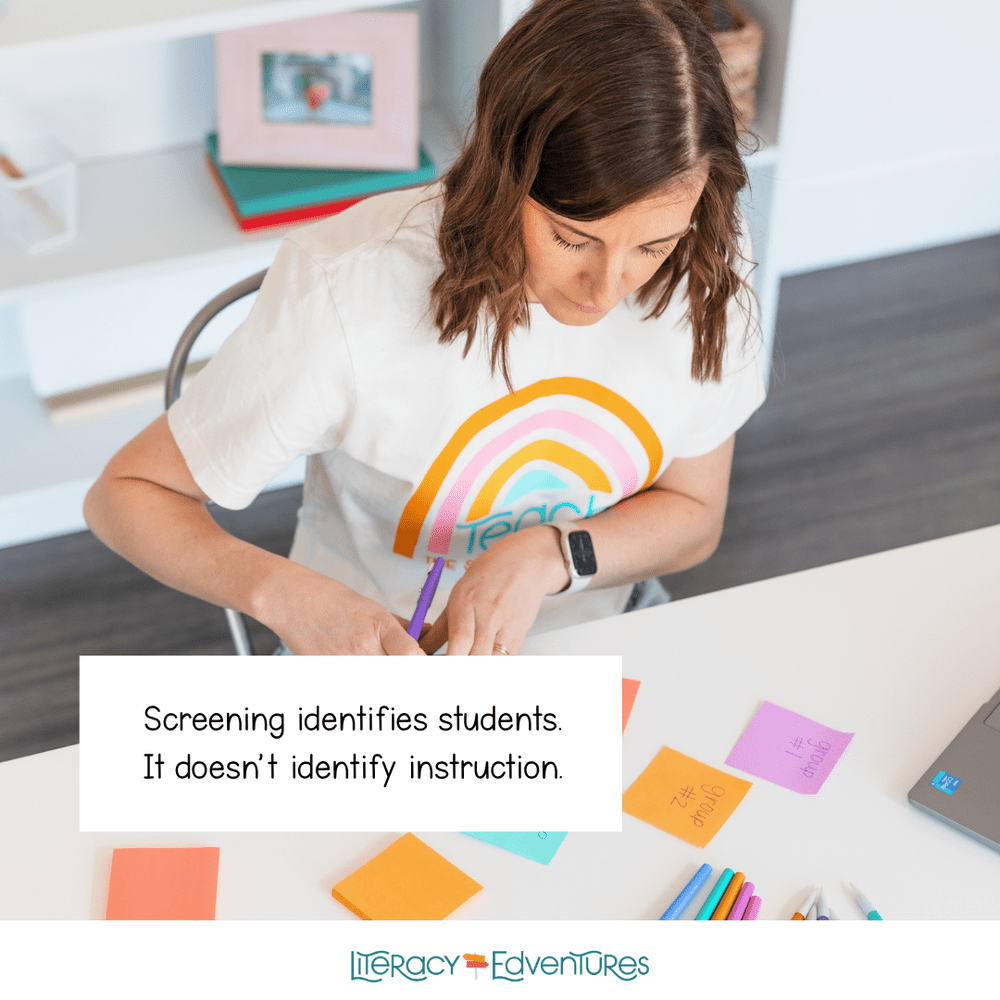
Over time, I realized I was asking the wrong question. A benchmark assessment is designed to identify students who may need additional support. It's a screening tool. It tells us who we should pay closer attention to, but it doesn't tell us exactly what that student needs or how we should respond instructionally. That's where I think many of us get stuck. We stop at the benchmark score. Instead of using it as the beginning of our thinking, we unintentionally treat it like the final answer.
Now, when I sit down with a grade-level team, I still look at the benchmark first. Of course I do. It's valuable information, and it helps us identify which students deserve a closer look. But almost immediately, I find myself asking a different question.
"Why?"
Why did this student score below benchmark? What skills are breaking down? What additional information do we need before we decide what to teach? Those questions move us beyond labels and toward instruction. Because at the end of the day, a benchmark score doesn't teach a child to read. Thoughtful instructional decisions do. I've found that one small shift in thinking changes the entire conversation. The benchmark doesn't tell me what to do—it tells me where to begin looking.
The benchmark starts the conversation. It shouldn't finish it.
Decision #2: Let Multiple Sources of Data Tell the Story
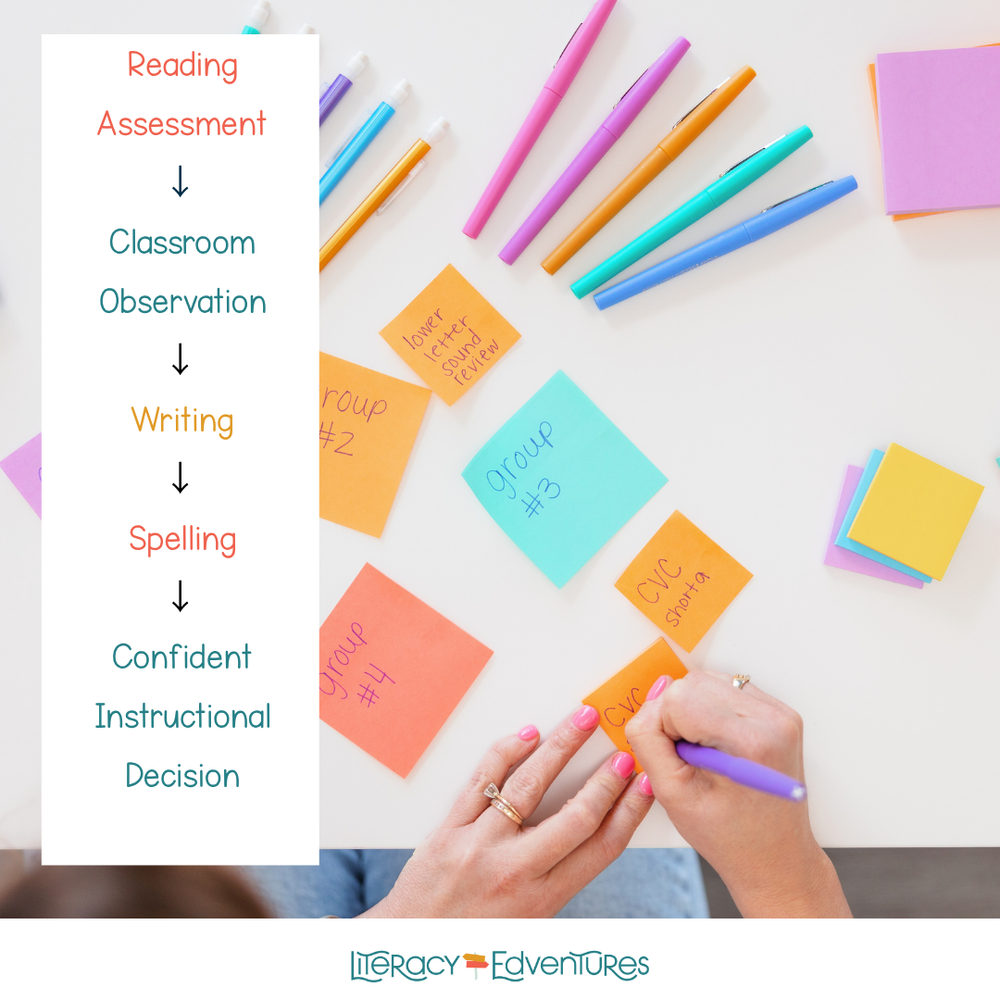
One assessment should rarely make an instructional decision by itself. We've all had students who had an off day. We've all had students surprise us. That's why I never want one score deciding for me. Instead, I start looking for patterns. Does the same need appear during whole-group instruction? Do I notice it during spelling? Writing? Oral reading? Are classroom observations telling the same story as the assessment? When several pieces of evidence point in the same direction, I can move forward with much more confidence. If they don't, that's okay too. It simply tells me I need to gather more information before deciding what that student needs. Reading assessment data should strengthen our professional judgment—not replace it.
Decision #3: Decide Whether Tier 1 Needs to Change First
This has probably been the biggest shift in my own thinking over the last several years.
When I first became a literacy coach, my instinct was to ask, "Who needs a small group?" Honestly, my answer was often, "Everyone."
Now I ask a different question first.
"Does the data suggest this student's needs are being met through Tier 1 whole-group instruction?"
That question changes everything.
Before I create another small group or add another layer of support, I want to know whether the student is responding to the instruction they're already receiving. Are they making progress? Are they demonstrating growth during whole-group lessons? Does the data show that the current level of instructional support is enough, or is the student still struggling despite strong Tier 1 instruction?
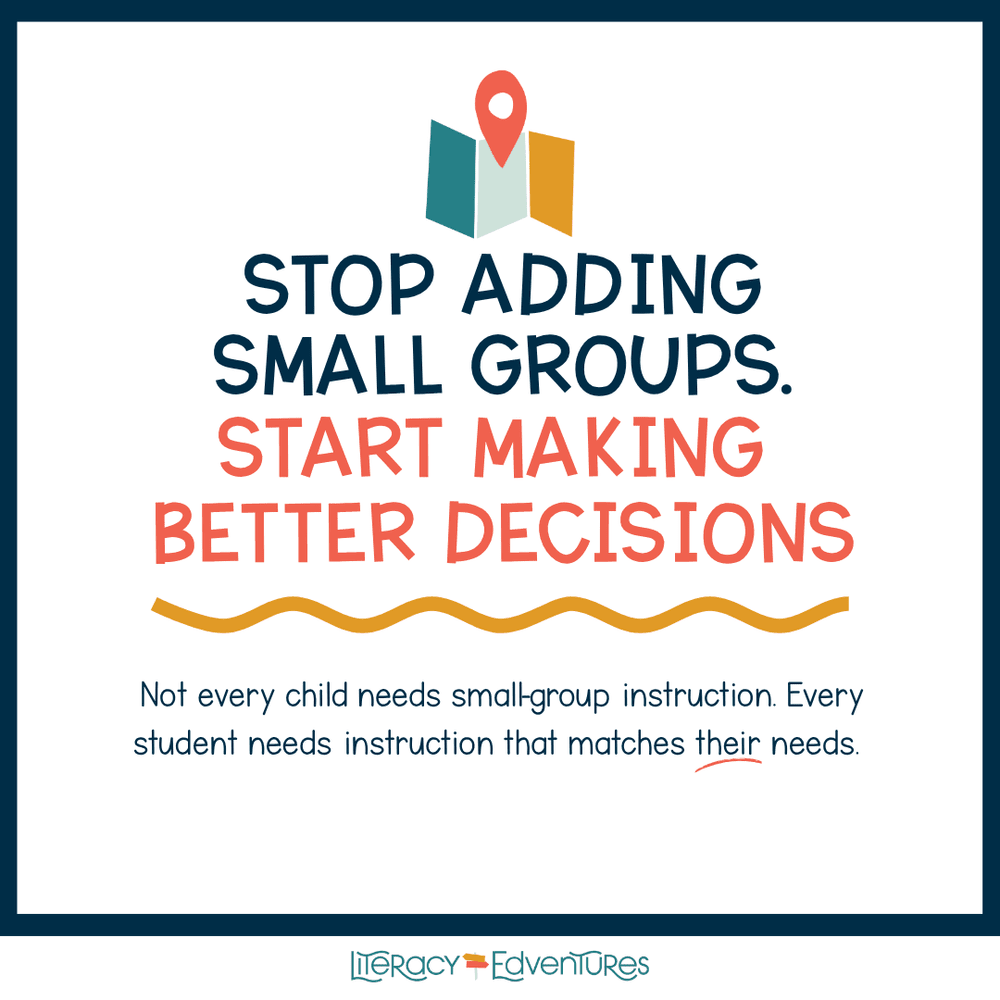
If a student's needs are being met during whole-group instruction, adding another instructional setting may not be necessary. More instruction isn't always better instruction. Our goal is to provide the right level of instructional intensity, not simply more instructional time.
If the data shows that a student is not making adequate progress despite strong Tier 1 instruction, then it's time to consider targeted small-group instruction. At that point, the question is no longer whether the student needs additional support, but what type of support is most likely to help them move forward.
That distinction has changed the way I think about small groups. Tier 1 is the foundation for every student. Small-group instruction isn't the next step for everyone below benchmark. It's an additional layer of instructional intensity for students whose needs are not being met through high-quality core instruction alone.
Decision #4: Decide Whether the Student's Needs Are Being Met in Tier 1
Once you've determined that a student will benefit from additional instructional intensity, the next decision isn't where to place them. It's what you're going to teach.
This is where I think many of us unintentionally create "low groups." We gather students who scored below benchmark, assuming they all need the same instruction. But when we take a closer look at the data, we often discover they're struggling for very different reasons.
One student may need additional phonemic awareness instruction. Another may need explicit decoding practice with vowel teams. A third may be reading accurately but still needs support building automaticity and fluency. While all three students may have scored below benchmark, putting them in the same group simply because of their score won't provide the targeted instruction they need.
Instead, I encourage teachers to think about instruction first and groups second.
When I sit down to plan small groups, I'm not asking, "Who scored the same?" I'm asking, "Who needs the same next lesson?" That one question completely changes how groups are formed. Students come together because they share a common instructional need—not because they landed in the same benchmark category.
I've found that this shift makes small-group instruction far more focused and effective. Instead of trying to meet several different needs in one lesson, I can provide explicit instruction, guided practice, and feedback around a single skill. The instruction becomes more intentional, students have more opportunities to practice, and progress becomes much easier to monitor.
At the end of the day, the goal isn't to create small groups.
The goal is to create the right instruction.
When we organize instruction first, the groups tend to organize themselves.
Decision #5: Let the Data Change Tomorrow's Instruction
This is the decision I hope every teacher walks away with after a data meeting.
"What am I going to do differently tomorrow because of this information?"
Maybe tomorrow's whole-group lesson includes additional cumulative review because several students need more practice with a previously taught skill.
Maybe one small group spends the week focusing on continuous blending.
Maybe you realize a student doesn't need additional intervention at all—they simply need more opportunities to respond during Tier 1.
Whatever the answer, assessment should always lead to action.
Otherwise, it's simply another spreadsheet.
Your Next Instructional Decision
As you sit down with your beginning-of-year reading assessment data this month, I'd encourage you to slow down before creating groups or planning interventions.
Start by asking yourself:
Is the benchmark helping me ask better questions?
What story is the data telling across multiple sources of evidence?
Does this student need more instructional intensity, or do I need to strengthen Tier 1?
Who will truly benefit from targeted small-group instruction?
What will I do differently tomorrow because of what I've learned?
Those questions have changed the way I think about assessment, and I hope they'll change the way you think about it too.
Because at the end of the day, reading assessment data isn't about spreadsheets.
It isn't about labels.
It isn't even about benchmark scores.
It's about making better instructional decisions so every student has the opportunity to become a successful reader.
Ready to Turn Assessment Into Action?
If beginning-of-year data feels overwhelming, you're not alone. Every fall, I work with teachers who are trying to make sense of assessment results while planning meaningful instruction.
That's exactly why we spend so much time on assessment, grouping, progress monitoring, and instructional planning inside Route2Reading. Together, we work through real classroom scenarios, build practical systems, and focus on the question that matters most:
"What's the best instructional decision for this student?"
If you're looking for practical coaching, ready-to-use tools, and a community of educators committed to improving reading outcomes, I'd love to welcome you inside.

 G2 Blog
 The College Investor
 GeekWire
  Kitces
 Better Living
  POLITICO Europe