Trending
New AI method can support real-time management of infectious diseases is trending now Katsina Government Opens New Diphtheria Isolation, Treatment Centre is trending now Role of ethics education in accounting fraud prevention is trending now Even ancient bacteria possessed intercellular communication structures like humans today,… is trending now NASA inaugurates first telescope named after female scientist is trending now Salah's successor arrives at Anfield: Liverpool sign Barcola in a historic deal is trending now Aston Villa vs Arsenal: Shearer predicts Monday’s EPL fixture is trending now Man City agree £65m deal for Everton's Ndiaye is trending now Barcelona's comeback against Rayo Vallecano reminds Real Madrid of a painful past is trending now Ikogosi Resort partners AFRIMMA to promote Nigeria’s tourism is trending now Mindustry Conference Partners Warner Music Africa/Africori For Fifth Edition, Opens Regis… is trending now BBNaija S11: Aikou, Flora Risk Losing Gambit Status is trending now New AI method can support real-time management of infectious diseases is trending now Katsina Government Opens New Diphtheria Isolation, Treatment Centre is trending now Role of ethics education in accounting fraud prevention is trending now Even ancient bacteria possessed intercellular communication structures like humans today,… is trending now NASA inaugurates first telescope named after female scientist is trending now Salah's successor arrives at Anfield: Liverpool sign Barcola in a historic deal is trending now Aston Villa vs Arsenal: Shearer predicts Monday’s EPL fixture is trending now Man City agree £65m deal for Everton's Ndiaye is trending now Barcelona's comeback against Rayo Vallecano reminds Real Madrid of a painful past is trending now Ikogosi Resort partners AFRIMMA to promote Nigeria’s tourism is trending now Mindustry Conference Partners Warner Music Africa/Africori For Fifth Edition, Opens Regis… is trending now BBNaija S11: Aikou, Flora Risk Losing Gambit Status is trending now
Technology

Boosting Antihydrogen Production using Beryllium Ions

Boosting Antihydrogen Production using Beryllium Ions

Antihydrogen forms an ideal study subject for deciphering the secrets of fundamental physics due to it being the most simple anti-matter atom. However, keeping it from casually annihilating itself along …read more

Antihydrogen forms an ideal study subject for deciphering the secrets of fundamental physics due to it being the most simple anti-matter atom. However, keeping it from casually annihilating itself along with some matter hasn’t gotten much easier since it was first produced in 1995. Recently ALPHA researchers at CERN’s Antimatter Factory announced that they managed to produce and trap no fewer than 15,000 antihydrogen atoms in less than seven hours using a new beryllium-enhanced trap. This is an eight-fold increase compared to previous methods.

To produce an antihydrogen atom from a positron and an antiproton, the components and resulting atoms can not simply be trapped in an electromagnetic field, but requires that they are cooled to the point where they’re effectively stationary. This also makes adding more than one of such atom to a trap into a tedious process since the first successful capture in 2017.

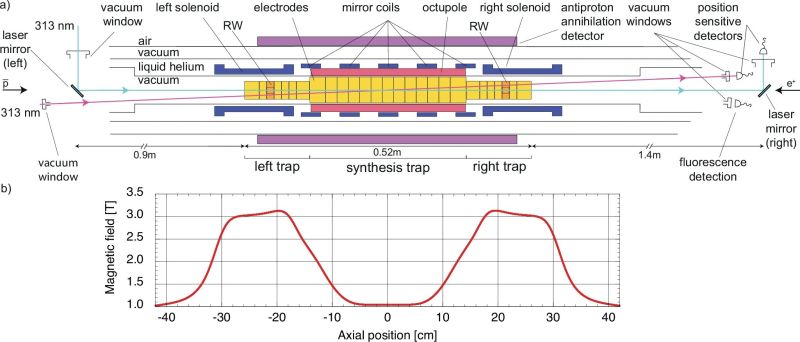
In the open access paper in Nature Communications by [R. Akbari] et al. the process is described, starting with the merging of anti-protons from the CERN Antiproton Decelerator with positrons sourced from the radioactive decay of sodium-22 (β+ decay). The typical Penning-Malmberg trap is used, but laser-cooled beryllium ions (Be+) are added to provide sympathetic cooling during the synthesis step.

Together with an increased availability of positrons, the eight-fold increase in antihydrogen production was thus achieved. The researchers speculate that the sympathetic cooling is more efficient at keeping a constant temperature than alternative cooling methods, which allows for the increased rate of production.

View original source →

Related

More from Hackaday Blog