

Colon cancer is not currently on VA's Agent Orange presumptive list, but veterans exposed to Agent Orange can still win colon cancer disability claims by establishing direct service connection under 38 CFR § 3.303. The path is just harder. VA often denies these claims, so the evidence must do the work to show that the…
Colon cancer is not currently on VA’s Agent Orange presumptive list, but veterans exposed to Agent Orange can still win colon cancer disability claims by establishing direct service connection under 38 CFR § 3.303. The path is just harder. VA often denies these claims, so the evidence must do the work to show that the condition is related to Agent Orange exposure.
Veterans need records showing exposure, pathology reports, medical research, and a strong nexus letter from a qualified physician. With this evidence and the correct legal argument, even previously denied claims can be approved on appeal, potentially with thousands of dollars in back pay.
How Does Agent Orange Exposure Relate to Colon Cancer?
Agent Orange was a tactical herbicide used during the Vietnam War era. Veterans may have been exposed through spraying, contaminated soil, contaminated equipment, inhalation, or contact with food and water in affected areas.
VA has not added colon cancer to the Agent Orange presumptive list. The National Academies’ Veterans and Agent Orange: Update 11 (2018) report placed colorectal cancers in the “inadequate or insufficient” evidence category.
That does not mean Agent Orange could not contribute to colon cancer in an individual case. It means VA usually requires medical evidence that explains why the veteran’s cancer is at least as likely as not related to herbicide exposure.
The biological argument usually focuses on 2,3,7,8-TCDD, the dioxin contaminant in Agent Orange. The International Agency for Research on Cancer has classified TCDD as carcinogenic to humans, its highest classification.
This can support a nexus opinion when a physician explains how that exposure fits the veteran’s medical history. Potential mechanisms include:
- DNA damage and impaired DNA repair, which can increase the risk of abnormal cell growth.
- Chronic inflammation, including inflammation affecting tissues like the gut lining.
- Immune disruption, which may make it harder for the body to control abnormal cells.
- Acceleration of existing precancerous changes, such as adenomatous polyps.
Over time, a qualified physician may argue that cellular injury and chronic inflammation contributed to the veteran’s development of adenomatous polyps or invasive colorectal cancer, depending on the medical record.
This biological plausibility can support direct service connection. But it usually works only when a qualified physician writes a nexus letter that connects the science to the veteran’s actual exposure history, diagnosis, risk factors, and medical timeline.
What Types of Colon Cancer Can Be Claimed?
Colon cancer is often used as a broad term, but VA claims may involve several related diagnoses. The exact diagnosis matters because the pathology report helps shape the claim and the medical nexus opinion.
Adenocarcinoma of the Colon
Adenocarcinoma is the most common type of colorectal cancer. It begins in gland cells that line the colon or rectum.
Many adenocarcinomas develop from adenomatous polyps over time. That timeline can matter in an Agent Orange claim because earlier colonoscopy and pathology records may help show how long the cancer was developing.
Gather the earliest available records, not just the records from the final cancer diagnosis. Useful records include:
- colonoscopy reports
- biopsy reports
- pathology reports
- oncology records
- records showing earlier adenomatous polyps
Rectal Cancer
Rectal cancer starts in the lower part of the large intestine. It is often grouped with colon cancer under the broader term colorectal cancer.
For Agent Orange claims, Agent Orange colorectal cancer arguments generally use the same direct service connection logic as colon cancer. The claim should focus on the veteran’s exposure history, pathology, and medical opinion explaining why the cancer is at least as likely as not related to herbicide exposure.
Rectal cancer claims may also involve long-term complications such as bowel leakage, sphincter damage, urinary problems, sexual dysfunction, or permanent colostomy.
Colon Cancer Arising from Polyps and Pre-Cancerous Lesions
Agent Orange colon polyps claims require careful handling. Polyps are not the same as cancer, and most polyps are not automatically compensable.
Still, polyps can matter. Many colon cancers begin as adenomatous polyps that change over time. If a veteran had documented adenomatous polyps in the years after service, those records may help build the timeline for a later colon cancer claim.
Adenomatous polyps, villous adenomas, dysplasia, and repeated colonoscopies can show that the disease process did not appear out of nowhere. They may help a physician explain whether herbicide exposure could have contributed to earlier cellular changes or accelerated progression.
Hereditary conditions like Lynch syndrome or familial adenomatous polyposis can complicate the claim, but do not automatically defeat it. A doctor could still explain whether Agent Orange exposure aggravated or accelerated the disease process.
Learn to Prepare (and Win!) Your VA Claim with Our Free eBook
The Road to VA Compensation Benefits
Is Colon Cancer an Agent Orange Presumptive Condition?
No. Colon cancer is not currently on the VA’s Agent Orange presumptive list. Veterans are not automatically service-connected, but can still qualify through direct or secondary service connection and win VA disability ratings for colon cancer. Active colon cancer is rated 100% under Diagnostic Code 7343 (38 CFR § 4.114).
See VA ratings for colon cancerHow to Prove the Agent Orange Link
Because colon cancer is not presumptive for Agent Orange, successful claims need a clear theory of service connection. The veteran must show exposure, diagnosis, and a medical link between the two.
Direct Service Connection
Direct service connection is the most common path when no service-connected Agent Orange condition caused or aggravated the colon cancer. A direct claim generally needs:
- Qualifying Agent Orange exposure, often based on recognized Vietnam-era service locations.
- A current diagnosis of colon, rectal, or colorectal cancer, supported by pathology.
- A nexus letter from a qualified physician, preferably an oncologist or gastroenterologist.
The nexus letter is often the most important evidence. It should state that the veteran’s colon cancer is at least as likely as not related to Agent Orange exposure and explain why.
A generic letter that says “Agent Orange can cause cancer” is usually not enough. The doctor needs to connect the science to this veteran’s records. A strong opinion will discuss the veteran’s exposure history, pathology, medical timeline, family history, personal risk factors, and relevant research.
Connection Through Another Agent Orange Presumptive Cancer
Some veterans already have a service-connected Agent Orange presumptive cancer. If that cancer or its treatment caused or aggravated colon cancer, the veteran may have a secondary service connection argument.
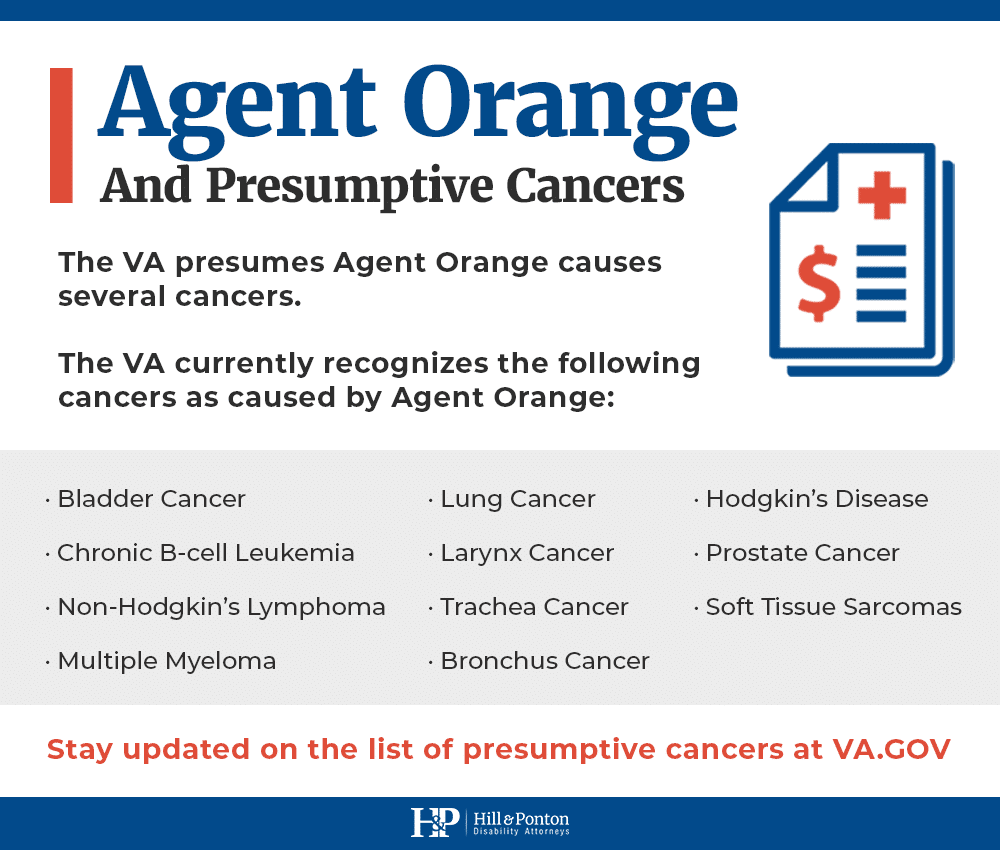
For example, a veteran may have a service-connected Agent Orange presumptive cancer that required chemotherapy, radiation, or immune-suppressing treatment. If a qualified oncologist explains that the treatment caused or aggravated the colon cancer, VA may grant secondary service connection.
This path is often overlooked. It is not enough to say both cancers happened in the same veteran. The medical opinion must explain how the first service-connected condition, or its treatment, caused or worsened the colon cancer.
Identify every service-connected Agent Orange condition, collect the treatment history, and ask the treating oncologist whether that condition or treatment contributed to colon cancer.
Get VA Benefits Even If You Were Previously Denied
Agent Orange colon cancer claims are difficult because VA does not presume the condition is related to herbicide exposure. That means many denials focus on the same issue: no medical nexus.
Additionally, many veterans are denied or underrated because the residual effects of their colon cancer are not properly evaluated. See how the VA rates colon cancer, its residuals and physical or mental secondary conditions stemming from it.
If VA denied your claim for Agent Orange-related colon cancer or its complications, we may be able to help. Request a free case evaluation to verify your options.
Did VA Deny Your Disability Claim?
Let our team review your case today!
START your free evaluation todayBenefits for Veterans’ Families
When Agent Orange-related colon cancer takes a veteran’s life, surviving family members may still qualify for VA benefits, primarily Dependency and Indemnity Compensation (DIC).
DIC is a tax-free monthly benefit for eligible survivors when a veteran’s death resulted from a service-connected condition. For DIC claims, VA looks at whether the service-connected disability was the principal cause of death or contributed substantially or materially to death under 38 C.F.R. § 3.312.
Because colon cancer is not on the Agent Orange presumptive list, surviving families may have to establish service connection for the cancer as part of the DIC claim. That means the family would need the same kind of evidence a living veteran would: exposure history, pathology reports, treatment records, and a nexus opinion.
Accrued benefits could be available if a claim or appeal was pending before the veteran died. This is when VA owes the deceased veteran unpaid benefits. Find out more about Agent Orange benefits for surviving spouses.
Content Reviewed by
Attorney Shelly M. Mark

Shelly is an attorney passionate about serving underserved communities, including veterans, homeless individuals, and those in need. With experience in VA disability claims and social security law, she has worked with non-profits and as an Equal Justice Works Fellow.