
Advertisers no longer tolerate agencies who run on flimsy spreadsheets. Here's how to transform your media team into a modern, data-driven media operation.
Media plans are designed to organize and communicate advertising campaigns.
But the data created during media planning drives far more than planning itself. It supports campaign activation, analysis, client reporting, and financial workflows. It also creates the foundation for the technologies shaping modern media operations.
Yet in many traditional agencies, the media plan still functions primarily as a standalone document.
In more modern media operations, media plans are a structured dataset that powers the entire campaign lifecycle.
That distinction changes how agencies operate, and whether they win or lose.
Traditionally, Media Plans Were Never Designed for Operations
Media planning historically evolved around spreadsheets. Those spreadsheets work well for organizing strategy, budgets, and placements. Media planners can structure information however they need and quickly adapt layouts to communicate campaign details.
But spreadsheets were designed for flexibility. They were not designed to power efficient, operational workflows.
The Real Issue: Spreadsheets Lack Structure
As campaigns move through media planning, activation, reporting, and finance, the same campaign information often gets recreated across systems.
Each task lives in a silo and solves the immediate problem in front of it. To get the job done, each team adds another tab or builds another spreadsheet. While the tasks gets done, this approach creates a big mess, and problems like this:
- Campaign naming conventions and tracking parameters are often generated in separate spreadsheets or tools, creating inconsistencies as campaigns move into activation.
- Orders are frequently managed manually, requiring repeated data entry.
- Teams lack the visibility needed to monitor pacing and results effectively, so they create another spreadsheet.
- Reconciliation requires manual comparison of orders, delivery, and vendor invoices. More spreadsheets and rekeying.
- Reporting can take days, sometimes weeks, as teams assemble the data required to ensure accountability to their clients.
- The same data appears in multiple spreadsheets and systems. It rarely matches perfectly and is quickly out of sync.
This fragmentation isn’t the result of poor processes. It is the natural outcome of how media operations evolved. Each workflow solves the problem directly in front of it. Over time, however, the campaign data itself begins to drift.
⬆️ The plan says one thing.
⬅️ The ad platform says another.
⬇️ The reporting dashboard groups campaigns differently.
➡️ The finance system sees something else entirely.
At that point, teams spend more time reconciling campaign data than putting it to work. The same campaigns exist in multiple systems. But they no longer represent the same information.
The Hidden Cost of Disposable Spreadsheets
Spreadsheets were never designed to provide the structured data foundation operational workflows depend on.
Without a consistent campaign structure, every fragmented task ends up rebuilding the same information in a different way to suit the job that needs to get done.
At first, this fragmentation can feel manageable. Your teams build workarounds to keep campaigns moving and the process becomes routine.
But the cost is wasted time, lost focus, and wasted money:
- The experienced media planners you hired for their strategic expertise end up spending hours managing spreadsheets instead of refining strategy.
- The operations teams you rely on to execute campaigns spend significant time preparing and rebuilding campaign data instead of improving execution.
- The analysts you expect to deliver insights spend hours assembling data before they can analyze it.
- The finance teams responsible for accuracy and accountability end up reconciling discrepancies that should never exist in the first place.
Highly skilled teams spend more time maintaining campaign data than using it to guide decisions and improve results.
How Structure Enables Operational Workflows
Modern agencies approach information differently.
Instead of treating the media plan as a document, they treat it as the operational dataset that supports the entire campaign lifecycle.
This shift is subtle, but powerful. It starts with how campaigns are structured.
In modern operations, campaign data structure is defined intentionally. Advertisers, campaigns, media plans, and placements follow a consistent structure. Structured fields and conventions allow the data to move between workflows without being recreated.
This sets the stage for campaigns to begin powering operational workflows across the campaign lifecycle.
For media planners, this structured dataset supports approvals, client presentations, and campaign analysis.
For media operations, it supports campaign naming standards, tracking URL generation, ad serving setup, and other activation workflows that prepare campaigns to run.
Order management becomes more seamless as campaigns move into execution.
Performance data can flow back into the same campaign framework, enabling pacing analysis, reporting, and ongoing campaign evaluation.
That dataset also supports downstream financial workflows, including vendor reconciliation and client billing processes.
This approach requires more discipline than traditional spreadsheet planning. Campaigns must be structured intentionally, with standardized fields and conventions that support reporting, integrations, and downstream workflows.
At first, this structure can feel less flexible than an open spreadsheet. But that discipline creates the foundation needed for both operational consistency while also supporting the flexibility agencies require.
Where Structure Begins to Change Operations
Agencies often notice the first benefits within planning itself, because that is where the campaign structure is originally created. Structured campaign data supports workflows such as automated flowcharts, streamlined RFP processes, and instant generation of media authorizations. Media planners can shift between different views of the same campaign data without rebuilding the plan.
But the larger impact appears once those same datasets begin supporting downstream workflows.
Execution becomes simpler because reliable campaign structures already exist. Campaign naming conventions and tracking parameters no longer need to be recreated manually. Plan data can flow consistently into order workflows, analysis, client reporting, and financial reconciliation. This enables teams to work from the same campaign structure across the entire campaign lifecycle.
The campaign structure is 100% consistent it moves across workflows, becoming the reliable, operational data foundation everyone works from.
The Three Stages of Operational Maturity
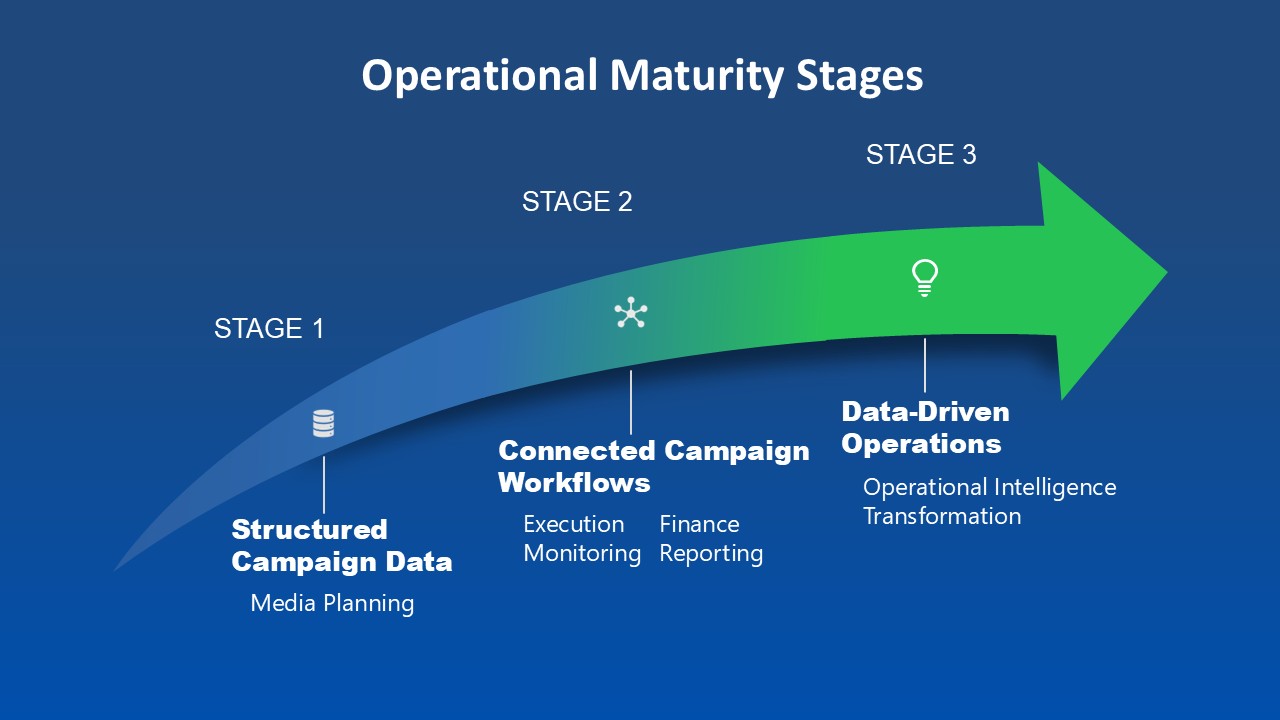
As agencies begin structuring and operationalizing campaigns in this way, clear patterns begin to emerge. Agencies typically progress through three stages as plans evolve from a planning resource into operational infrastructure.
- The first stage is structured campaign data. During planning, campaign structure and data fields are defined intentionally so the data inside the plan can support downstream workflows.
- The second stage is connected campaign workflows. Execution, reporting, and financial processes begin operating from the same campaign dataset rather than relying on recreated data across separate systems.
- The third stage is data-driven operations. Centralized campaign data powers reporting, integrations, and the technologies shaping modern media operations.
At that point, campaign data is no longer just something used to plan campaigns.
It becomes operational infrastructure.
And that shift is becoming increasingly important.
Complexity Drives Need for Structured Data
Media operations are growing more complex. Agencies now rely on activation platforms, reporting tools, financial systems, and an expanding set of technologies designed to support analysis, automation, and operational management.
All of those systems depend on one thing: Reliable data.
Agencies that continue operating with fragmented campaign datasets will struggle to operate efficiently across those systems. Agencies that establish a framework as their foundation will be able to operate more efficiently, generate clearer insights, and adapt more easily as new technologies reshape the industry.
In modern media operations, the media plan is no longer just a planning document.
It becomes the operational dataset that powers activation, reporting, financial workflows, and the broader technology ecosystem shaping the advertising industry.
Upgrade to Data-Driven Media Operations
Want to upgrade your media operations from flimsy spreadsheets to reliable data-driven media systems? Try Bionic for Agencies.
If you’re like other agencies on Bionic, you’ll be up and running and fully operational in less than 90 days.
The post How to Build the Foundation for Data-Driven Media Operations first appeared on Bionic Advertising Systems.