 Anthropology.net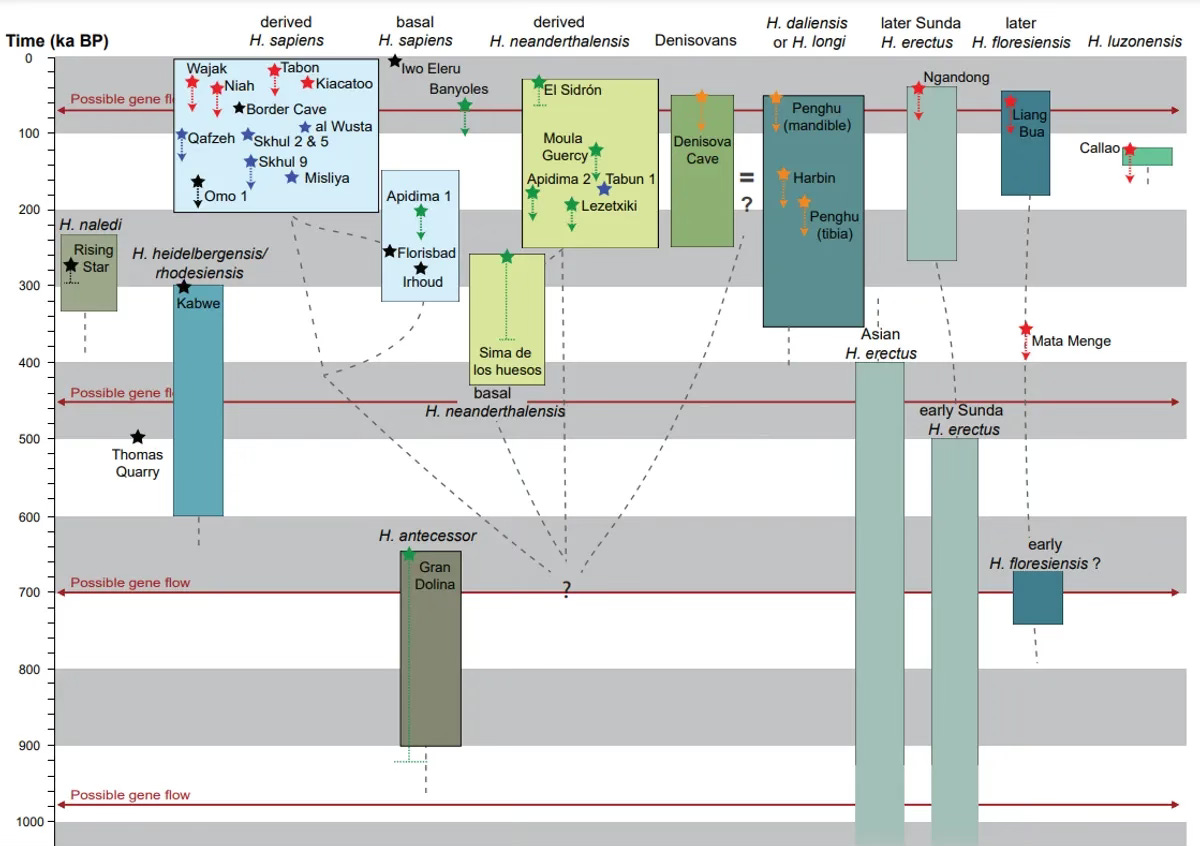
The beauty of science lies in its continuous evolution. Each discovery reshapes our understanding, challenging erstwhile beliefs, and heralding a paradigm shift in our comprehension of history. In the realm of human evolution, a groundbreaking study1 led by researchers at the Australian National University in Canberra and the Natural History Museum of London is poised to revolutionize our narrative of human ancestry. Remarkably, this seismic shift was catalyzed by a fresh appraisal of ancient fossils, breathing new life into the story of our evolution.
Dating archaeological finds involves various methodologies, with radiocarbon dating holding a notable place in the scientist's toolkit. This technique, rooted in nuclear physics, estimates the age of organic remains by analyzing the residual carbon-14 isotopes within bones or charcoal.
During an organism's life, it absorbs carbon-14 isotopes from the environment. Upon death, this absorption ceases, and the isotopes begin to decay at a predictable rate, with a half-life of approximately 5,730 years. However, radiocarbon dating's effectiveness is limited to fossils younger than 50,000 years. For older specimens, like dinosaur bones from millions of years ago, the remaining carbon-14 becomes infinitesimal, rendering precise measurement impossible.
Notably, miscalculations in dating methodologies have led to significant misconceptions in human evolutionary history. Akin to the case of Homo floresiensis, where initial estimates indicated recent existence, later rectifications revealed their existence over 60,000 years ago, distinct from Homo sapiens.
Similarly, the unearthing of Homo luzonensis in the Philippines initially suggested an age of around 65,000 years, seemingly coinciding with Homo sapiens' presence. However, meticulous reanalysis has debunked this notion, revealing that these remains are twice as old as initially presumed.
The revised analysis employed a novel approach—uranium-thorium dating, a technique existing for decades. The innovation lay in refining the methodology, allowing unprecedented precision. Innovations in the process enabled minuscule sample extraction using lasers, mitigating damage to invaluable fossils.
The revelations from this updated analysis have been groundbreaking. For instance, the Apidima Cave in Greece housed two skull fragments, initially presumed to be Homo sapiens and Neanderthal skulls, respectively. The radiometric dating had perplexingly suggested a 40,000-year gap between the two—discrepancies casting doubts on the accuracy.

The recalibrated methods have illuminated the origins of these skull fragments. The fossils were deposited separately and later found together in the cave. Consequently, the fragment initially identified as Homo sapiens, dating back over 150,000 years earlier than anticipated human migration into Europe, stands as Europe's oldest known Homo sapiens fossil.
"These findings are truly astonishing," remarked Grün. "They hold promise in advancing our comprehension of human evolution."
The study, published in Quaternary Science Reviews, signifies a transformative step in unraveling the complexities of our evolutionary past. As science progresses, these meticulous revisions underscore the dynamic nature of our understanding and open new avenues to explore the intriguing saga of human evolution.
Grün, R., & Stringer, C. (2023). Direct dating of human fossils and the ever-changing story of human evolution. Quaternary Science Reviews, 322(108379), 108379. https://doi.org/10.1016/j.quascirev.2023.108379
 The Blast » Entertainment
  Man and Machine » Revit
  The Global Climate and Health Alliance Blog
  Health Care News
  Colorado Pols
  CBN News