 Residential Design Blog
 Australian Architects and Architecture Blog by Bleuscape Design
The act of building is not grounded in shelter, nor in territory, but in passage. I wanted to focus on the manner in which my houses operate as places of passage.
I live in a house where downstairs has a long passage connecting the front entrance with stairs going up, a garage, a study, bedrooms, a bathroom, a laundry, a side garden, a studio, and a rear courtyard. That passage brings the house to life, it keeps the family together and apart. Children's games running and hiding, slamming bedroom doors, late night conversations with laughter and tears, putting out the pets, bringing in the washing, going out to the garden, the quiet of night and the sounds of early morning.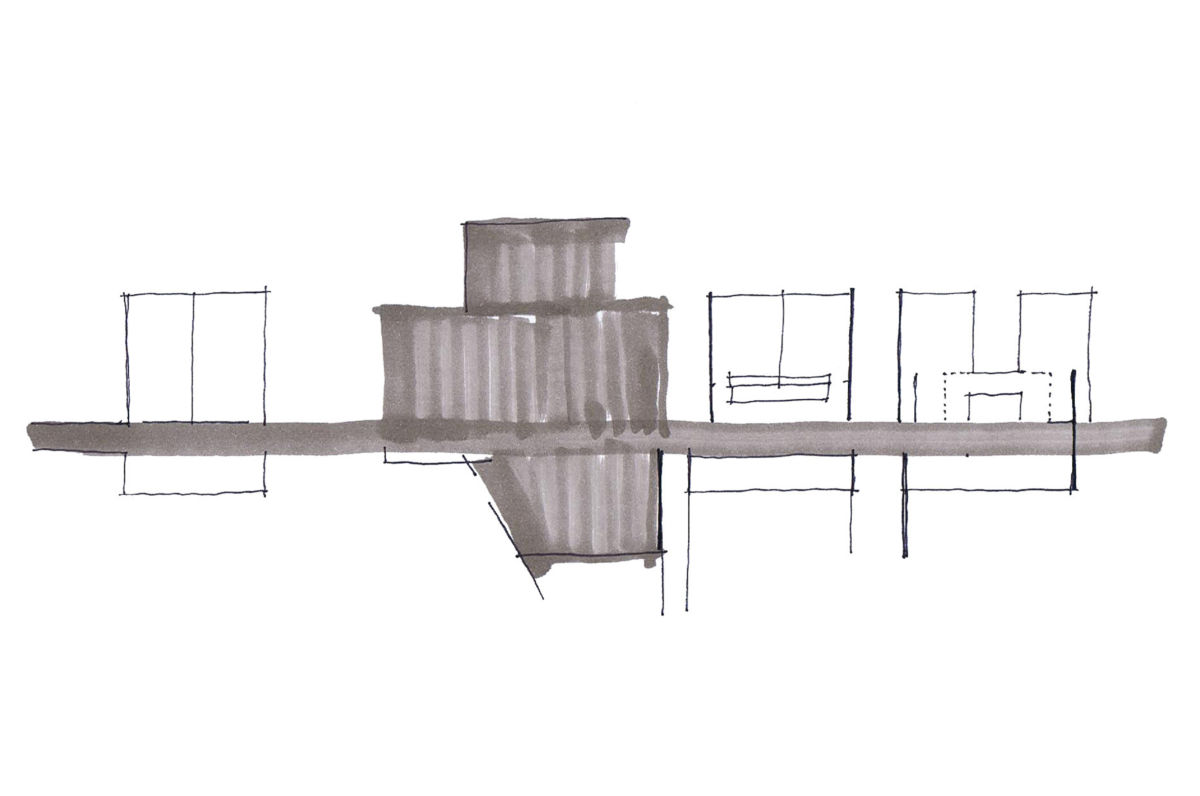
Bleuscape Design - Valentine House Sketch
In Camera Lucida, Barthes was also focused on the complexity of the manners by which art, in this case the art of the photograph, might operate as passage. Camera Lucida was Barthes' last book. It was written concurrently with his 'mourning diary' detailing his grief at the loss of his mother, Henriette. Barthes loved his mother deeply and had lived with her for most of his life. (1) Following her death, Barthes began his own Orphic quest, hoping to find his mother?-?in a photograph. Not just her image, but what he would describe as her air.
The desire for that which we can't see, hear and hold often leads us to place something more tangible in our grasp. To have something firm in our hand. A photograph or a postcard. A syringe or a drink. The right hand in the left. Stilettos or a piece of blue velvet. Rosary beads or icons. Madeleine for Proust. Cocaine for Cocteau. These items are not the point. They are the means. We place flowers on graves and at the edge of the diving platform we hold a handrail. We don't want the flowers or the rail; we desire the air. That which we touch is often a vector pointing toward that which we can't hold. These objects become places of passage.
In this way built space is like these pencils, photographs and postcards, rosary beads and icons, stilettos and pieces of blue velvet. It is an object of passage. Connection to the other and outside. Intense and immediate. A wonderful aberration. A joyous false idolatry. A magnificent wound. When architecture is approached in this manner, designers by consequence are less fetishists in denial and more like wayfarers. By assembling tools and techniques, materials, objects and subjects, as a photographer might gently manipulate bodies, light and lenses, in order to approach to that unholdable air.
As designers of built form, it is important that we disorganise ourselves somewhat, to become a little more object among objects. It is important that we sufficiently dismantle ourselves and liberate our faculties in order to allow our work to breathe. This disorganisation of the self is not about loss but rather about 'moving on'. It is as important as the departing from preconceptions, traditions and the habits of thought that otherwise contain us. We do this in order that we can explore and experiment and approach desires afresh. Intensely afresh.
Postscript
Barthes wrote in Camera Lucida that he found a photograph which he felt had the air of his mother. It was taken when she was five years old and visiting the Winter Garden in Paris with her, then seven-year-old, brother. Barthes had, of course, not known his mother at that time of her life. And yet the photograph harboured something of her, that 'intractable supplement of identity'. Barthes didn't reproduce the Winter Garden photograph of his mother in his book. He would write simply "for you, no wound". Barthes, Camera Lucida, 73.
(1) Roland Barthes, Mourning Diary: October 26, 1977?-?September 15, 1979, (New York: Hill and Wang, 2010). Translation of Journal de Deuil, (Paris: E?ditions du Seuil, 2009), by Richard Howard.
 Dangerously Irrelevant By Scott McLeod
  Westwood One Sports
  Issues, Etc.
  France 24
  NYC Forever Podcast
  Small Wars Journal Blog