

In a previous post, we discussed two surgical approaches to the arthritic glenoid with increased retroversion (see this link).�One approach is to accept glenoid retroversion and reaming only enough achieve a single concavity of the desired curvature�Any excessive humeral...
In a previous post, we discussed two surgical approaches to the arthritic glenoid with increased retroversion (see this link).�

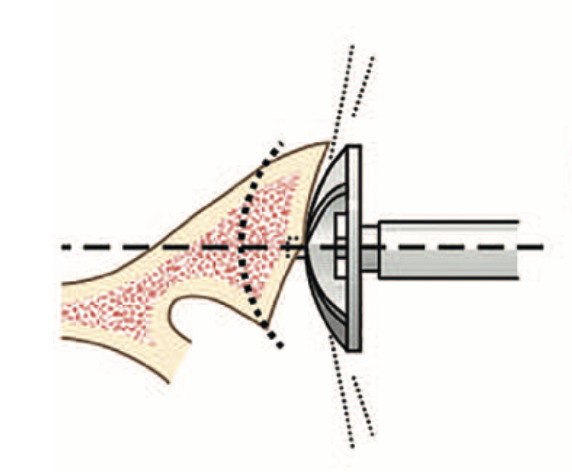
One approach is to accept glenoid retroversion and reaming only enough achieve a single concavity of the desired curvature�

Any excessive humeral translation is managed with an anteriorly eccentric humeral head and / or rotator interval plication.


Another approach is to correct glenoid retroversion with either a posteriorly augmented glenoid component (below left) or with eccentric reaming, removing bone from the anterior glenoid (below right).�

Currently some surgeons routinely use three-dimensional preoperative planning based on CT scans to determine the amount of correction�desired�and the means of achieving it.

Recently, the authors of�: �Does Glenoid Version and its Correction Impact Outcomes in Anatomic Shoulder Arthroplasty � a Systematic Review�looked at the published evidence�on the effect of preoperative and postoperative glenoid retroversion on functional and radiological outcomes in patients who underwent anatomic total shoulder arthroplasty.�
According to their analysis:
None of the studies that analyzed the effect of preoperative glenoid version on patient reported outcomes found a significant association on multivariable analysis.
None of studies that analyzed the effect of postoperative�retroversion on patient reported outcomes found a significant association.
None of the studies that analyzed the effect of preoperative or postoperative retroversion on radiographic outcomes found a significant association when the results were controlled for the duration of followup.
These authors concluded that their most important finding is that there is a paucity of�evidence comparatively analyzing whether correcting glenoid retroversion influences��postoperative outcomes. Given that non-corrective reaming demonstrated favorable�postoperative outcomes and that postoperative glenoid version was not consistently found to��impact outcomes, there is inconclusive evidence that glenoid retroversion correction�should routinely be required.
You can support cutting edge shoulder research and education that are leading to better care for patients with shoulder problems, click on this�link.
Follow on twitter:�https://twitter.com/RickMatsen�or�https://twitter.com/shoulderarth
Follow on facebook: click on this�link
Follow on facebook:�https://www.facebook.com/frederick.matsen
Follow on LinkedIn:�https://www.linkedin.com/in/rick-matsen-88b1a8133/
Here are some videos that are of shoulder interest
Shoulder arthritis - what you need to know (see this�link).
How to x-ray the shoulder (see this�link).
The ream and run procedure (see this�link).
The total shoulder arthroplasty (see this�link).
The cuff tear arthropathy arthroplasty (see this�link).
The reverse total shoulder arthroplasty (see this�link).
The smooth and move procedure for irreparable rotator cuff tears (see this�link).
Shoulder rehabilitation exercises (see this�link).