

Its 7.7-litre straight six makes 286bhp and 738lb ft when running on hydrogen Move away from diesel will reduce carbon emissions for special-use vehicles, such as verge-mowing test truck Mercedes-Benz is testing a Unimog equipped with a hydrogen�combustion engine,...
 Its 7.7-litre straight six makes 286bhp and 738lb ft when running on hydrogen
Move away from diesel will reduce carbon emissions for special-use vehicles, such as verge-mowing test truck
Its 7.7-litre straight six makes 286bhp and 738lb ft when running on hydrogen
Move away from diesel will reduce carbon emissions for special-use vehicles, such as verge-mowing test truck
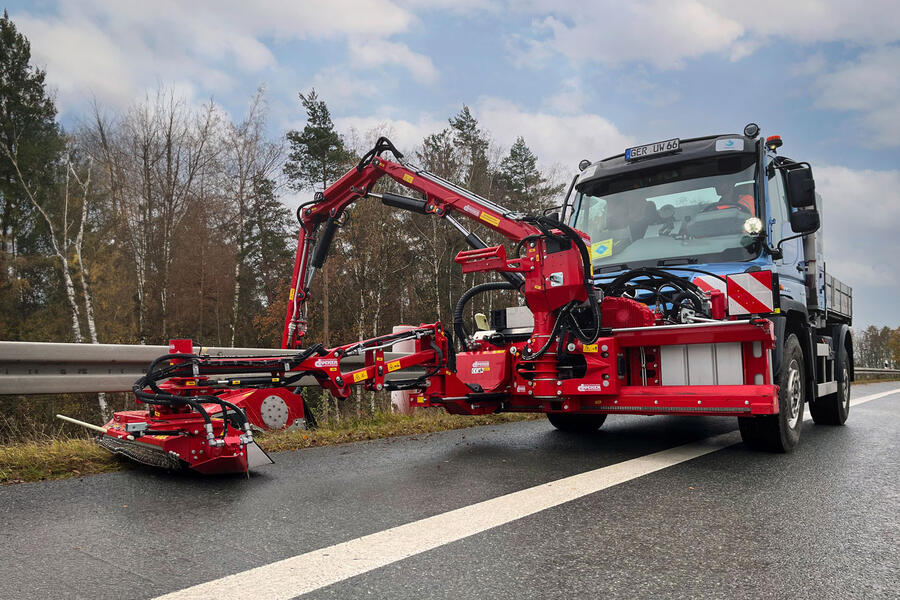
Mercedes-Benz is testing a Unimog equipped with a hydrogen�combustion engine, in a bid to eventually offer low-emission trucks with performance on a par with today�s diesels.
The German giant is using a Unimog U430, which packs a 7.7-litre straight six that ordinarily puts out 295bhp and 885lb ft.
These figures dip slightly when running on hydrogen�to 286bhp and 738lb ft. However, Mercedes notes that the engine is �noticeably quieter� when running on the gas.
It's fed by four tanks that hold around 14kg of hydrogen at a pressure of 700bar (10,152psi).
The next step of development is to increase the volume of hydrogen aboard to allow the Unimog to complete a full working day mowing a motorway verge without refilling.
Mercedes�hasn't shared any efficiency figures for the current test vehicle.
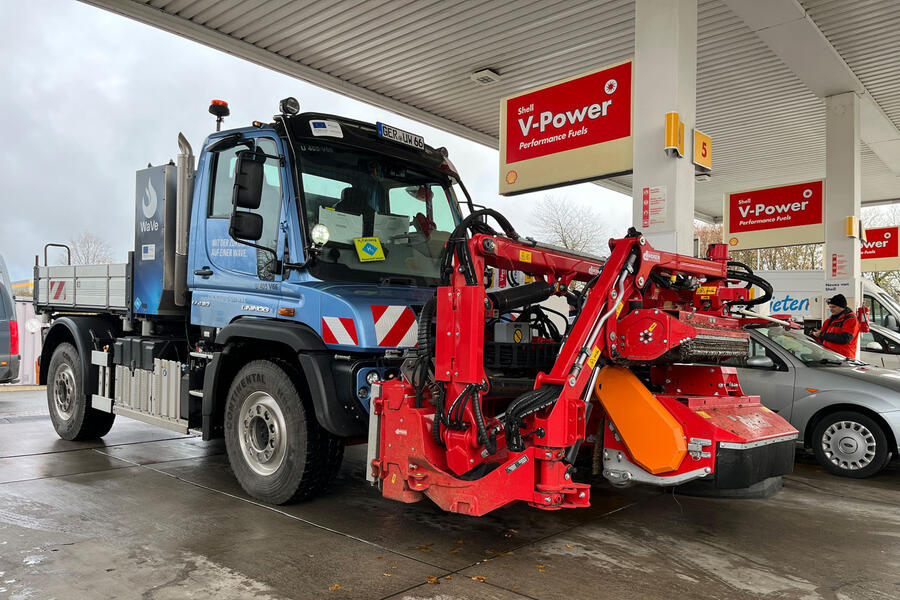
Mercedes describes the hydrogen combustion engine as a �complimentary� solution to decarbonisation for �special applications�, alongside battery electrification and the use of hydrogen fuel cells.
The advantage of hydrogen combustion is that it can have a significantly lower environmental impact than using fossil fuels, provided that the hydrogen is sourced by electrolysing water with renewable electricity (which emits no carbon).
Combusting hydrogen with the air � which mostly comprises nitrogen and oxygen � doesn't produce CO2 emissions. However, it does produce NOx, which is linked to respiratory problems such as asthma.
As such, hydrogen combustion is touted as more of a viable solution for commercial vehicles, which generally work outside cities and towns.
G�nter Pitz, head of powertrain development for�Mercedes-Benz Special Trucks, said: �The hydrogen combustion drive concept can serve as a blueprint for power-intensive applications in the specialty vehicle sector.
�Hydrogen combustion can make it possible to drive and work with very low emissions on construction sites, in municipal or agricultural sectors.
�To reach series maturity for such vehicles, reliable funding is and will be required."
Mercedes-Benz Trucks joins several major manfuacturers in investigating hydrogen combustion. Stellantis and Toyota are�actively developing the technology and�the Renault Group has signalled its interest through the Alpine Alpenglow concept.