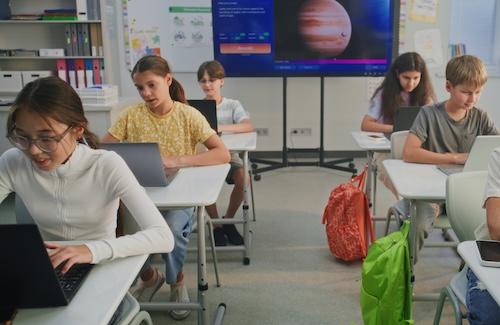

It’s truly incredible how much new technology has made its way into the classroom. Where once teaching consisted primarily of whiteboards and textbooks, you can now find tablets, smart screens, AI assistants, and a trove of learning apps designed to foster inquiry and maximize student growth.

Key points:
- 3D printing gives students something tangible to work with as they innovate
- How interactive tech simplifies IT and supercharges learning
- How 3D printing is changing education
- For more news on 3D printing, visit eSN’s Digital Learning hub
It’s truly incredible how much new technology has made its way into the classroom. Where once teaching consisted primarily of whiteboards and textbooks, you can now find tablets, smart screens, AI assistants, and a trove of learning apps designed to foster inquiry and maximize student growth.
While these new tools are certainly helpful, the flood of options means that educators can struggle to discern truly useful resources from one-time gimmicks. As a result, some of the best tools for sparking curiosity, creativity, and critical thinking often go overlooked.
Personally, I believe 3D printing is one such tool that doesn’t get nearly enough consideration for the way it transforms a classroom.
3D printing is the process of making a physical object from a three-dimensional digital model, typically by laying down many thin layers of material using a specialized printer. Using 3D printing, a teacher could make a model of a fossil to share with students, trophies for inter-class competitions, or even supplies for construction activities.
At first glance, this might not seem all that revolutionary. However, 3D printing offers three distinct educational advantages that have the potential to transform K–12 learning:
- It develops success skills: 3D printing encourages students to build a variety of success skills that prepare them for challenges outside the classroom. For starters, its inclusion creates opportunities for students to practice communication, collaboration, and other social-emotional skills. The process of moving from an idea to a physical, printed prototype fosters perseverance and creativity. Meanwhile, every print–regardless of its success–builds perseverance and problem-solving confidence. This is the type of hands-on, inquiry-based learning that students remember.
- It creates cross-curricular connections: 3D printing is intrinsically cross-curricular. Professional scientists, engineers, and technicians often use 3D printing to create product models or build prototypes for testing their hypotheses. This process involves documentation, symbolism, color theory, understanding of narrative, and countless other disciplines. It doesn’t take much imagination to see how these could also be beneficial to classroom learning. Students can observe for themselves how subjects connect, while teachers transform abstract concepts into tangible points of understanding.
- It’s aligned with engineering and NGSS: 3D printing aligns perfectly with Next Gen Science Standards. By focusing on the engineering design process (define, imagine, plan, create, improve) students learn to think and act like real scientists to overcome obstacles. This approach also emphasizes iteration and evidence-based conclusions. What better way to facilitate student engagement, hands-on inquiry, and creative expression?
3D printing might not be the flashiest educational tool, but its potential is undeniable. This flexible resource can give students something tangible to work with while sparking wonder and pushing them to explore new horizons.
So, take a moment to familiarize yourself with the technology. Maybe try running a few experiments of your own. When used with purpose, 3D printing transforms from a common classroom tool into a launchpad for student discovery.