Pernille Ripp
This week, I was invited to sit down with with Dr. Sarah Sansbury, Leah Gregory, and Janette Derucki for the Can’t Shelve This podcast (releasing February 10th). The invitation was simple: come talk about reading culture. About what we actually do in our classrooms and schools that either invites children into reading or quietly pushes them away.
That kind of conversation is my favorite. Not because I have the answers, but because I am still in it. I am still trying to build something that works for the kids in front of me. Much like so many others, I wonder if what I am doing is actually making a difference.
And as we kept circling those ideas, this kept rising to the forefront for me:
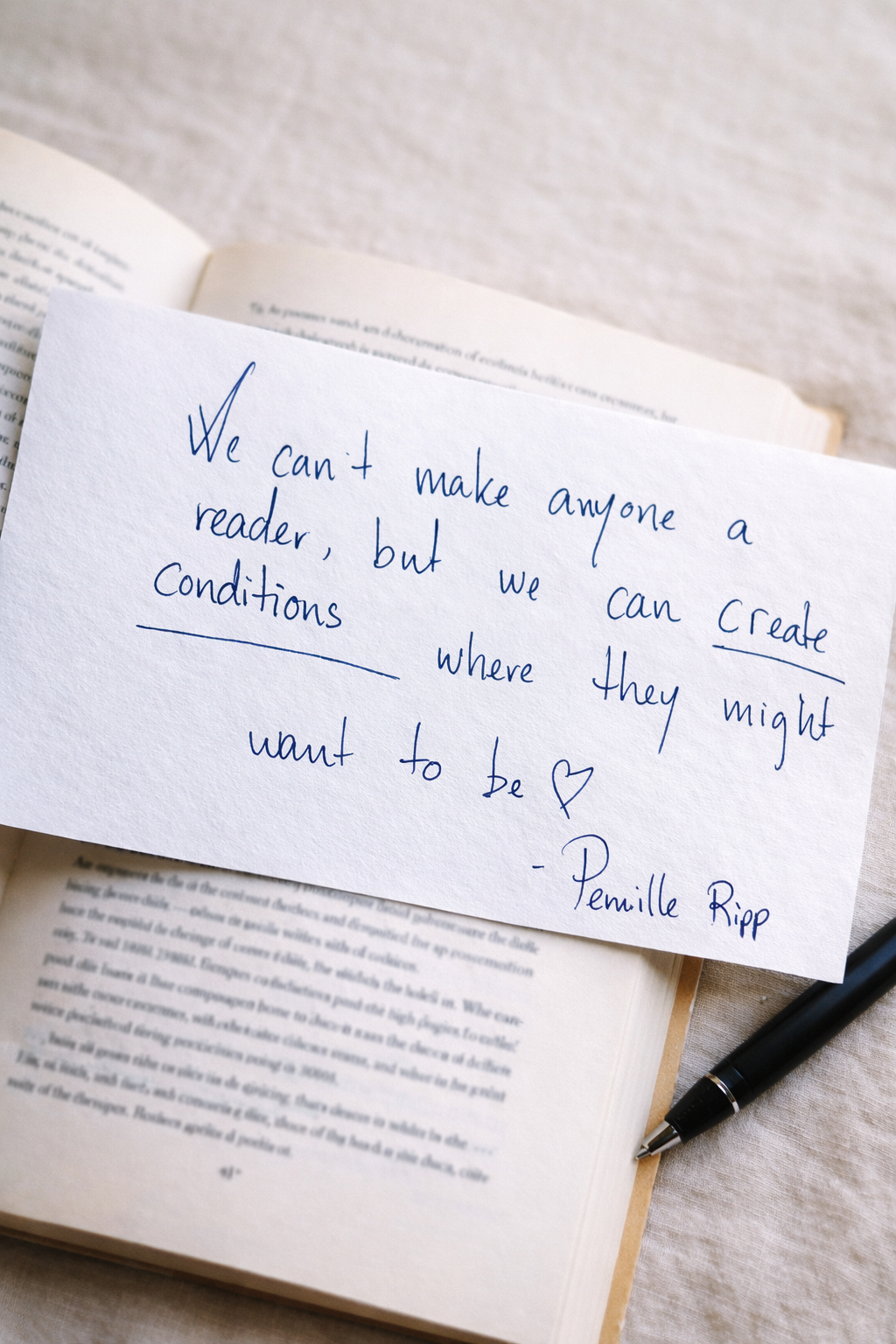
We can’t make readers. But we can create the conditions where they might want to be.
That really is the work.
Not forcing reading.
Not rewards.
But building spaces where children feel safe enough, curious enough, and seen enough to want to read.
That’s the heart of it.
Because so often, when we talk about getting kids to read, the conversation turns to compliance. Comprehension work. Logs. Levels. Programs. Points. Prizes. Proving that you are reading. Proving that you understood. Proving that you are a reader to begin with. More minutes. More data. More pressure.
And yet, none of those things create readers. Not really.
They create performers.
If we want reading to matter, then the culture around reading has to matter. The environment has to say:
You belong here.
Your choices matter.
Your pace is respected.
Your identity is not up for negotiation.
But before we can build better conditions, we have to look honestly at what we already have. Do we even know what the reading culture is in our spaces or do we just assume?
So some questions I use to take the temperature:
- Who is reading in my room? Only the kids who already love it?
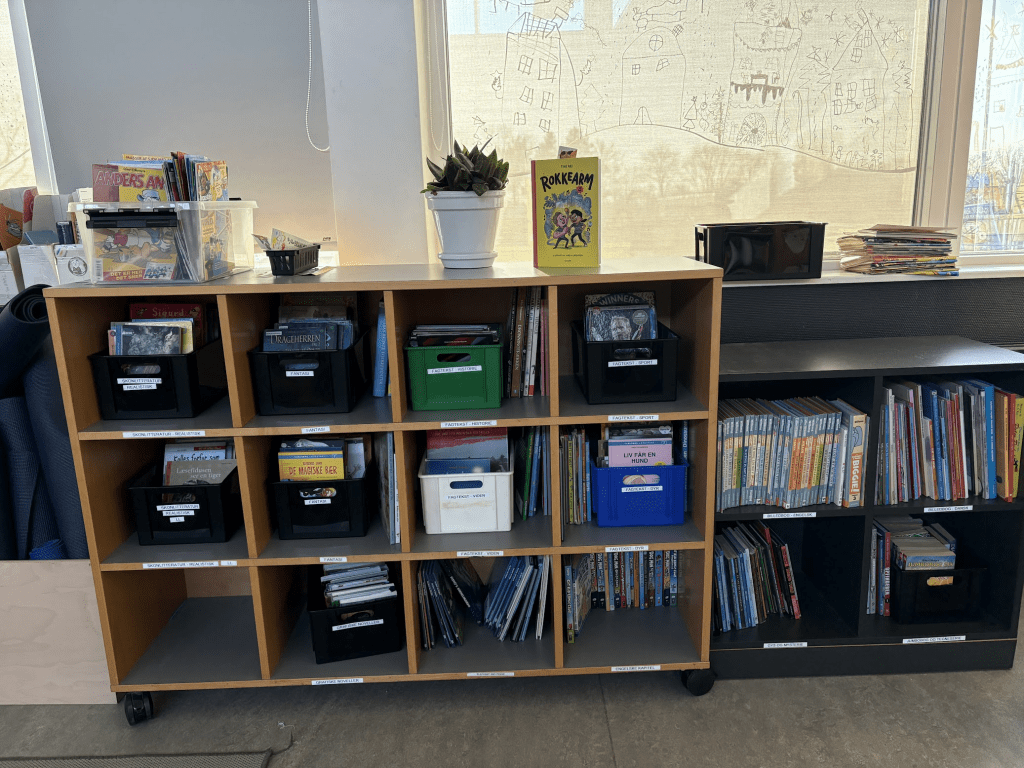
- What kinds of books are visible? Do they reflect the kids in front of me? Do they reflect the world?
- What happens when a child says, “I hate reading�
- Is reading something they do, or something they only are told to do?
- Are students trusted with their own reading decisions?
- Do I celebrate growth, or just volume and level?
- Who shapes our reading experience the most?
- Do they even feel like readers? And how do I know?
And then we get to work.
So we go back to the basics, that are really not so simple after all.
We protect choice.
Not “choice within a level.â€
Not “choice after you finish this.â€
Just…choice.
Let students pick what they read, when they abandon a book, and what kind of reading feels meaningful.
Because identity grows in the places where we feel trusted.
We build book collections that reflect the world.
Keep adding. Keep weeding. Keep listening to what they reach for. And we fight to protect those choices.
We remove reading as a punishment or somethng that always has to be proven.
No logs.
No always answering questions.
No reading “to earn†something. If reading only happens because they have to, then they never get to discover that they might want to.
We talk about books like they matter. Because they do.
And we protect the time to read. We would never go to math class and not actually practice math, so why are we told to limit independent reading.
Share what you’re reading. Share when you are reading, when you are not. Tell them what reading helps you with.
Let students share what they’re reading.
Have conversations, not quizzes. Protect independent reading time for all.
Make reading social, human, and alive.
And we make it safe to not be a reader yet.
Students need to know:
You are not behind.
You are not broken.
You are not failing.
You are becoming.
That is the only way they stay open long enough to grow.
It’s not flashy. It doesn’t come in a box. It doesn’t produce instant results.
But it honors students as readers in progress, not readers we are trying to manufacture.
Because the work is not about getting kids to read.
It’s about creating spaces where reading feels possible.
And then staying in that work, every single day. Even when the world tells you to stop. Especially then.
 Juice Beauty
  Editorialge
  Declutter Go Blog
 GeekWire
  Cash Flow Diaries
  Young Upstarts