 eSchool News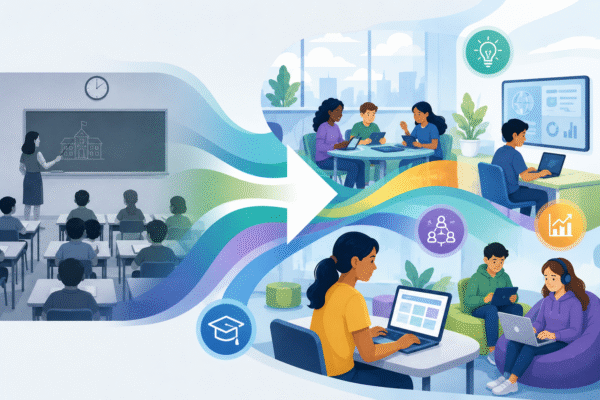
Key points:
- Online and hybrid models are becoming essential tools for meeting students where they are
- Does school design help or hinder adolescent learning?
- 4 things new principals can do to strengthen school culture
- For more on modernizing education, visit eSN’s Educational Leadership hub
Walk into almost any classroom in America, and you’ll see a system designed for consistency: same lesson, same pace, same expectations for every student. For decades, that model has served millions well.
But today’s learners are changing, and some of the most driven among them are quietly outgrowing the structure meant to support them.
Across the country, high-achieving students are hitting an unexpected ceiling. Not because they lack ability or ambition, but because traditional classrooms weren’t designed to move at their pace. These are students enrolling in college courses while still in high school, training at elite levels in sports or the performing arts, or pursuing advanced academic interests well beyond grade level.
The data reflects this shift. According to the National Center for Education Statistics, more than 2.5 million U.S. high school students take college courses each year through dual enrollment–a number that has grown steadily over the past decade. At the same time, research from the Fordham Institute has found that high-achieving students often make less than a year’s worth of academic growth in a year, suggesting they are not being sufficiently challenged.
Yet most K–12 school models still rely on fixed schedules, standardized pacing, and seat-time requirements that prioritize uniformity over flexibility. Progress is traditionally measured by time spent in a classroom, not mastery of material. For students ready to move faster or at a different pace, this can create a growing disconnect.
They finish assignments quickly but must wait for others to catch up. Over time, that mismatch can lead to disengagement, underachievement, or the need to look outside the traditional system for opportunities that match their abilities.
This isn’t a failure of teachers or schools. It’s a reflection of how the system was built.
Traditional education was designed for an earlier era, one that prioritized standardization, efficiency, and preparing students for a more predictable workforce. It made sense when access and consistency were the primary goals. But today’s world demands something different: adaptability, creativity, and highly individualized pathways.
That shift is already underway, but it’s not always inside the traditional classroom.
More families are exploring alternatives that allow students to “color outside the lines” of conventional education. Online and hybrid models, once considered niche, are now becoming essential tools for meeting students where they are. These environments offer flexible pacing, expanded course access, and personalized learning pathways aligned with how students learn best.
For high-achieving students, that flexibility can be transformative. It allows them to accelerate in areas of strength while still engaging deeply with complex material. It gives them the freedom to pursue passions, whether in music, the arts, or athletics, without sacrificing academic rigor. And importantly, it redefines success not by time spent in a seat, but by mastery, engagement, and real-world application.
This isn’t about creating a fast track for a select few. It’s about acknowledging that one-size-fits-all no longer fits anyone particularly well.
When we expand what school can look like, we create space for more students to thrive–not just those who struggle in traditional settings, but also those who are ready to move beyond them. Rigor, in this model, isn’t about moving faster for the sake of speed. It’s about meeting students where they are at the edge of their ability and helping them grow from there.
Education isn’t broken. But it is at an inflection point.
If we want to serve today’s most driven students and prepare all learners for what comes next, we have to be willing to rethink long-held assumptions. That may mean loosening our reliance on rigid structures, embracing new models, and yes, occasionally coloring outside the lines.
Because when we do, we’re not lowering standards. We’re raising the ceiling for all.
 Edu-Power
  Fran Cannon Slayton - Children's Author on An Unexpected Journey
 UoB PGR Development » Thesis
 IndieWire
  Amplified Opera