
Members of the Muscogee of Florida bring a native perspective to archeology and anthropology while connecting to their culture.
What follows is a discussion I’ve wanted to record for some time. Not long after we started covering archaeology on the Ecology Blog, I met Misty Penton. Misty is the storyteller and tradition keeper for the Muscogee Tribe of Florida, and she’s a bioarcheologist. Over the years, she has told Muscogee stories on the blog and with the WFSU Education team. Off camera, we had talked about her and her father’s native perspective as archeologists, uncovering a past that was part of their heritage.
Aspects of that heritage have become muddy over the last couple of hundred years. As European colonists expanded into what would become the United States, they displaced native people. When the British took north Florida from Spain in the early 1700s, they ran off the Apalachee people indigenous to the Tallahassee area. Seminoles and Miccosukees migrated into the area decades later, but after years of battles with forces led by Andrew Jackson, they moved further south into the peninsula. Other native groups in the southeast were forced to relocate to Oklahoma on the Trail of Tears.
Not all natives left, though. Their communities were shattered and out of place, but many passed on their traditions in secret.
A career in archeology let Dan and Misty reconnect to a culture that is beginning to flower after years in the dark. In turn, their traditional upbringing lets them see what other archeologists might miss. We’ll see a few examples below.
Additional Watching and Reading
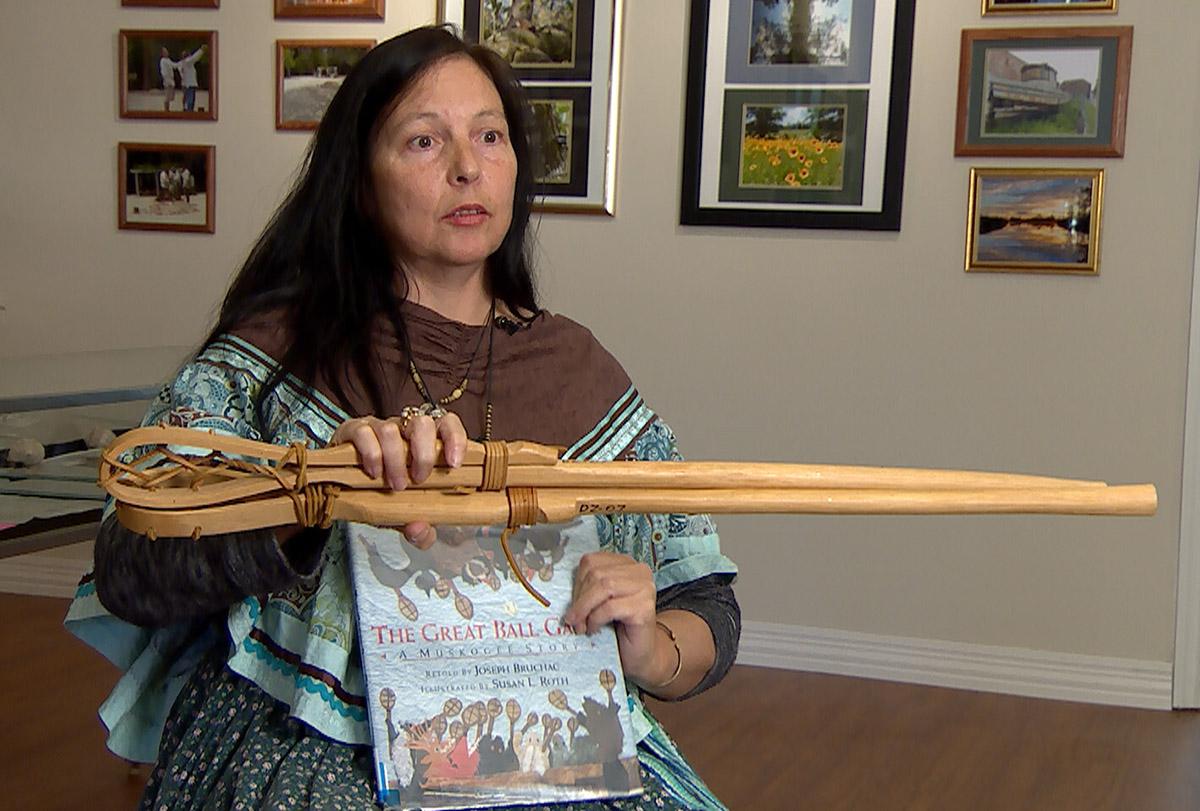
On this episode of Coast to Canopy, Misty mentioned a couple of projects she worked on with WFSU Education. Here are links to those, and other stories about archeology and Muscogee Culture.
- The Molly of Denali Virtual Museum: As Misty referred to in the podcast, she shared quite a bit of Muscogee tradition for this interactive page. It’s aimed at a younger audience, but it is a wealth of information.
- Lake Jackson Mounds State Park: Misty visited the Lake Jackson Mounds, a site occupied by the Apalachee people prior to the arrival of Europeans. In this video, Misty demonstrates a tobacco offering.
- Muscogee Shell Carving: We learn about the tradition of carving medicine cups from lightning whelks. As we discuss later, these whelks were traded throughout what is now the eastern United States. Whelks from Apalachee Bay have been found at archeological sites as far away as the Great Lakes.
- Finding the First Floridians: This is the recent WFSU Ecology documentary on Florida archeology, focusing on sites at the end of the Pleistocene Era, as old as 14,700 years old.
- Byrd Hammock: A more recent site than those we visit in Finding the First Floridians. We visit a site occupied between 2,000-1,000 years ago in the St. Marks Refuge, and see how pottery evolved in our area.
Meet our guests
Misty and Dan are joined by two other members of the Florida Muscogee. We will talk about a native perspective to archeology and anthropology, and about Muscogee culture in general.
- Dan Penton, a retired archeologist and traditional chief of the Florida Muscogee.
- His daughter, Misty Penton, a bioarchaeologist and the tribe’s storyteller and tradition keeper.
- Dr. Chris Bolfing, a cultural anthropologist.
- Doug Alderson, an award-winning author and Muscogee maker of medicine. We know Doug from several WFSU Ecology Blog adventures on north Florida waterways.
Coast to Canopy blog posts are curated transcripts, a distilled version of the longer conversation we hear in the embedded episode. My notes appear in italics.
Passing traditions down in secret
Dan Penton: Since 1853, I think that’s the right date, it was illegal in the state of Florida to live openly as American Indian. And you could not trade. They made it illegal for traders to even go and visit. They tried to starve them out, just like they did when they tried to kill old buffalo in the plains.
But they did not go after certain families… If you had a male member that was more white than not, they continued. But the Creeks were matrilineal and matriarchal. The women a lot of times were the tradition carriers, they still are. They’re the ones that select the maker of medicine and the makeup of the ground.
My mother’s father was a maker of medicine. I have a speaker staff. We use it on the grounds.
I spent time growing up as a young child with my grandparents. They selected me and nobody else in my family to see things and to show to medicine plants and go and collect things, like the gallberry (Ilex glabra, a relative of Yaupon holly, Ilex vomitoria, which is used to make the black drink) … when they were doing ceremonial things, and they would grab me and take me, and the two of them would go and do ceremonial things.
When I say ceremonial things, everything in life that is meaningful can be a ceremonial. So, those things that they viewed that way, they made sure that I was present. That’s how they continue by example.
Connecting to native culture through archeology
Dan Penton: Certainly before World War Two, and mostly after Vietnam, things started popping for southeastern Indians in their favor. You have a natural curiosity about that which is not addressed or which is “wink, wink, nod, nod.” Not talked about simply because you’re still in a state that technically you can’t legally be here.
The Civil Rights Act and the Voting Rights Act in the 60s is when a lot of these legal prohibitions were actually lifted.
My interest in archeology and native past was my attempt to try to flesh out what I was seeing from my own perspective… I met many of the what we consider the fathers of archeology in the southeastern U.S. that were my friends and contemporaries.
But… I had a different perspective on what we were looking at, and I still do.
To understand Muscogee culture is to understand the busk
Dan Penton: In the 1940s, there was a medical doctor in Savannah, Georgia by the name of Antonio J. Waring. He published in a Harvard publication in the 1940s about the southern death cult, or the Southeastern Ceremonial complex. His archeology as an amateur is the foundational work for the lower Atlantic seaboard.
He talked about the Creek ceremonial, the busk, and that thousands of years ago they were busking. And here we are in 1940s, and they’re still busking. In spite of all of the organized effort to eliminate the so-called Indian problem, the ceremonial heart is still beating. And it is today. And if you do southeastern archeology and you’re excavating a ceremonial site, if you don’t understand the elements of the Muscogee busk, you’re not going to understand anything you’re seeing in the archeological record.
That’s the kind of interplay that I’m looking for from the archeological profession, is that it benefits both sides of the equation. Both the researchers and the indigenous people.
We’ll learn about the busk in a little bit. But first –
Who are the Muscogee people?
Chris Bolfing: There are a different ways of looking at this culturally and geography. Geographically, if you look at the Southeastern United States… of all the groups that were Muscogee speaking, groups that were along the Piedmont (and Appalachian Mountains) are generally called Upper Creeks, whereas everyone that was down in the Gulf Coastal Plain were were considered the Lower Creeks.
Your Upper Creeks would include things like the Chickasaw, the Choctaw, Natchez. Down here, you would have the Muscogee, the Hitchiti. Then you’d have some Miccosukee and then some other tribes that didn’t speak Muscogee.
On the Piedmont, there were Cherokees that are Algonquin or Iroquoian speakers, and Shawnee, who are Siouxan speakers, I believe. There was kind of mixture of groups, and the things that generally held were the linguistic groupings. Between any of the two languages, they might be mutually unintelligible. They might be similar, like hearing Portuguese and Spanish. It’s like, I feel like I should know what you’re saying, but I just don’t quite understand.
But these larger groups likely didn’t distinguish themselves in those same categories. They were community based. And the community structure of communities interacting with other communities forms a larger network.
That pattern served as the pattern for the Creek Confederacy, which was an alternative political structure for the tribal organizations that the Americans were more familiar with in the northern woodland areas. So, like with your Iroquoian, your Algonquin… even the far eastern Siouxans and some of those peoples, there was a very different organizational structure, and it was all based on matrilineality.
Diaspora Communities
As native groups were displaced, their members joined other existing groups or formed new groupings.
Dan Penton: The groupings in the southeastern U.S. were all diaspora communities after the early 1700s. When you had the uprising, for example, among the Natchez, the contemporary French reporters talk about the ceremonial leaders of the Natchez, which were Muscogee speakers. [After the uprising], half went to the Overhill Cherokee and half went to the Upper Creeks. Their [Natchez] ceremonial life is infused into the Muscogee/ Creek ceremonial life.
And that’s just one instance. Every time that you had a disruption, whether it was the 1817/ 1818 illegal disruption of the town of Miccosukee by Andrew Jackson and his soldiers, they spread and they joined other groups.
The truth was that most native peoples, even the traditional enemies, were closer to each other in these diaspora communities than they were with the white intrusion… And I defy anybody in the southeast to show me a full blood community, because there is no such thing. You may have Cherokee. You may have had Hitchiti or Miccosukee.
A classic example is that the Seminoles are genetically, they’re same people [as the Muscogee]. They just happened to be on south of the 31st parallel whenever they came into being because of the Treaty of Ghent or whatever it was. It said that if you’re below this line, you’re Seminole. If you’re above that line, you’re Creek. So the same people were there, but their language is Hitchiti. It’s the Miccosukee language. They do not speak Muscogee.
We’re just a hodgepodge of survivors.

The Southeastern Ceremonial Complex
Misty Penton: You’re talking about the people and the languages. But also, overlaying that, is the Southeastern Ceremonial Complex, where you’ve got the mound systems and you’ve got the understandings of how people are interacting with nature and that system.
It encompassed Iroquoian folks and the mix of Muscogee dialects, brought all of us together in terms of understanding a symbolic type of communication. I think that made it much easier to communicate because we had a common language, if you will, in terms of our symbolic nature.
Dan Penton: And there was a trade language, too, called the Mobilian language.
Apparently it was used to communicate with people and the extensive trade network that existed, whether they were trading obsidian, or grizzly bear teeth and claws from far north in exchange for Busycon conch shells or carved shell gorgets (from the southeast), or copper coming out of the Michigan or North Georgia area.

All of these things were common, and it boggles the mind because we in contemporary society think we’re the apex of all of this stuff and [indigenous Americans] were just simple savages. Well, no, they weren’t. And I always like to encourage people that haven’t been to the council house at San Luis to go.
That’s a small example of council houses in Florida, and the ones that the Calusa had in South Florida were reported to be like five times bigger than that. And that that’s incredible.

Population density does not equal civilization
Misty Penton: I’m going to jump a little bit in terms of things that as a native person, in archeology, I see very differently. And that is the cycle of quote unquote civilization, the idea that in order to be civilized, you have to have this incredibly populated area.
What I would suggest is that natives consider that overpopulated. It is exceeding the carrying capacity. A natural thing to do is to move out from that center and set up a different town. We model our towns on beehives, and the queen has to be able to sniff all the bees. If it gets too big, she’s not doing her job, so she leaves her daughter in the old hive and goes to find a new one.
What happened to Cahokia? Oh, why did it not get civilized? The answer is, there was space where people could have carrying capacity in an appropriate relationship to the tribe and to the community, rather than forgetting who they were.
Cahokia was a mound complex that was occupied about 1,000 years ago. It was occupied by 10,000 people surrounded by tens of thousands more, mostly farmers. It was much larger than any North American indigenous occupation, and it was also a center of Mississippian culture, which covered the eastern half of the continent. Among other things, the Mississippian network spread the practice of mound building and the cultivation of maize.
Cahokia, a center of the Mississippian mound-building culture
Chris Bolfing: Cahokia is the largest mound site in native North America. It’s just across the [Mississippi] River from Saint Louis. Where Monk’s Mound is, which is the tallest, I think it’s somewhere around 86 feet… It’s been the source of a lot of archeological exploration and focus.
A lot of the iconographic material that you see in places like Spyro [Oklahoma] were constructed at Cahokia and moved around the country from out of there. So it was also a major production facility for symbolic items. It was a major, major city. But it’s not without its misinterpretations from archeology. This isn’t to downplay any of the archeologists. I know many of them. They’re brilliant people, and they work with the natives as much as they can, but sometimes they just make assumptions that, that for us as natives, just seem ludicrous.
A strawberry feast?
Chris Bolfing: I’ll give you one perfect story here in the literature. It was looking at one of the mounds as they were archeologically digging through it, and they found hundreds of thousands of strawberry seeds. They said it was evidence of a feast. And in my head I’m like, that is literally the most insane thing that I could possibly hear.
What, were they eating a bunch of strawberries and pooping on the mound? How is that in any way a related to a feast?
That is an offering. How many individual wild strawberries would have to be gathered for you to have close to a million strawberry seeds on a mound? You’re talking about a lot of work collecting that.
They weren’t eating them and throwing the seeds in the mound. This was a massive offering of stuff that could have fed most of the city for a day. This is a massive offering, and it was seen as evidence of a feast.
At my very first conference, I ran into the person [who conducted the research]. I was like, why did you say this? And why didn’t you just say say more simply that it was an offering? She just said it never crossed her mind.
Sometimes, no matter where their heart is… sometimes they’re just thinking about it from a very different perspective. They see massive amounts of foodstuffs… “if it’s all at one time, this is a feast.”
An offering for the little people
Misty Penton: Everybody at this table knows what the strawberry seeds were an offering to. But they haven’t told you yet. Since my job is to tell stories and secrets, the offering of wild strawberries is for the little people. In Ireland they have leprechauns. Here we have little people, i’sti lupu’tski.
I’m guessing everyone at this table puts out wild strawberries for the little people.
So again, there’s an opportunity. And Chris has stated that the archeologists are working with natives, but this is relatively new. They were, for the longest time, just sort of bothering to check in after the fact.
I think that there is a tremendous opportunity to match those things up.

Anhinga wings and the power of ceremonial objects
Dan Penton: One of my under-classmates did the analysis of the faunal remains that were in the primary fire basin of the grand village of the Natchez. A number of anhinga wing elements were found. They were talking about in the analysis that [the Natchez] were eating anhinga.
The anhinga wing is, was, and has always been a sacred fire-related item. It’s even used today in the peyote ceremonies. It is not ever going to be eaten. It is going to be used in ceremonial context.
When the sacredness of that was over, it was placed in the fire so that it was consumed.
There are two ways that that you can take care of ceremonial items that are laden with power and are dangerous to people that are not initiated. You put them out of the way where they will never be encountered, or you burn them. And that’s why you see a lot of broken medicine pots and things in burial mounds. They weren’t offerings for the burial.
They were just put in a place that people supposed that would not be disturbed and would not damage other members of the community that were still alive and not initiated. And that whole concept has been missed for hundreds of years.

Ceremonial Fire
Doug Alderson: When he talks about the fire, it’s a ceremonial fire. It’s on a small mound. It’s considered a piece of the sun. It is kept burning all year long and renewed every Green Corn, which is in June. In this day and age, it’s kept burning in a propane pilot light because we don’t have fires that you keep going anymore in a cook stove or an outdoor fire pit.
In the old days, you would have had a central fire area and everybody would have taken their fire home from that central fire. Fire is essential for life, obviously for cooking and so forth. But this particular fire is something you don’t put trash in, you don’t put saliva, and you treat it very special. In a biblical sense, it’s similar to the burning bush.
We believe the creator, or Hesaketvmesē, maker of breath, speaks through people through the fire. It’s considered a spiritual entity. So when [Dan] speaks of the fire, it’s a spiritual thing. It’s just one of many ways that creator can speak through the people, to the people. It can be also through birds, through the earth, through plants, through everything.
We believe everything is alive. Everything has a spirit, whether it’s breathing or not. In that way, we consider everything sacred, because it is all part of the maker of breath.
Gar teeth and the busk
Misty Penton: Here’s another example. There was an archeological site where they found a cache of gar teeth. Their assumption was – you want to guess? Fishing. People were eating the gar, which, by the way, we would eat the gar. I don’t know how many people had it. It’s starvation food. It’s not very good.
Doug Alderson: The gar fish jaws are used near the end of Saturday after certain dances are done. We take some of the herbal medicines and wash off with it. The men scratch with the gar teeth. We put some of the medicine on our arms and legs, sometimes backs, and we scratch.
It’s a ritualistic way of offering back to the Mother Earth, so it creates some some blood, yes. But they are scratches. They’re not deep wounds. They go away in a few days. You may see a scar, but it’s light. It’s a ritualistic way of giving back to the Mother Earth. And so the garfish jaws, that’s what we use.
Misty Penton: We use them in our ceremony. You were about to ask us about the busk, so I’ll let you ask it in that context.
Chris Bolfing: My scratches are still here.
The Muscogee Busk
Doug Alderson: I think Dan raised the term puskita (pusketv). It means to fast. That ties in with the Muscogee ceremonials. We fast four days before the ceremonies; we have four ceremonies a year. We do eat after dark, so it’s a little bit like Ramadan that way. I think partly because we have to still function in this world.
We do it for purification of mind, body, and spirit. We also do it in sympathy for those who don’t have enough food. But by the time the ceremony starts, we are prepared more because we have been fasting.
Fasting is an important part of the Muscogee life. I know Bearheart (one of Doug’s mentors) used to fast before he used to treat people, so he did a lot of fasting. It’s a way it’s a way to clear your mind. I notice when I fast I seem more in touch with nature, with animals, and it just kind of clears your being.
It’s not always easy, especially in this society. It’s not always easy to drive through rush hour traffic while you’re fasting. But if you’re out in nature, it seems natural. And that’s the core of the Muscogee ways. It’s inspired by the natural world. So if you are in tune with nature, with the animals and the way of the planets and the the moon, the moon phases and so forth, the Muscogee ceremonials make a lot of sense.
If you’re not in tune with all that, you don’t understand it. You come and observe and you have no idea what they’re doing. But the symbolism is always inspired by the natural world.

The tobacco offering
The Lower Creek people occupied the Flint and Chattahoochee River basins, and down to the Florida town of Chattahoochee, near where those rivers meet to form the Apalachicola. Doug and I have paddled the Apalachicola together a few times, and here, I learn something new about him.
Doug Alderson: What people don’t realize on [Apalachicola RiverTrek paddles] is, every day I’m giving a tobacco offering for that day. I do that quietly. I don’t make a production out of it. But it’s something you do as a traditional person. You’re asking for the safety of the group. You’re stating your intentions.
Because there are still the presence of those early peoples. And I feel that presence. I want to [say] we’re here in a good way. We’re here for this good purpose. And so far, knock on wood, we’ve had good luck on RiverTrek.
Certain places are believed to carry more energy than others. Dan and Misty Penton believe that Lake Jackson is one of those places.
Misty Penton: Rob, when we were doing the videoing for the mounds at Lake Jackson, the thing that I did with Tasha [Weinstein and the WFSU Education team]…
If people are curious, we did do a recording of the offering of tobacco that I gave, not just for myself. Because when I explained it to the crew, they were like, okay, can we be covered? I said, don’t worry, I was going to cover you anyway, much like Doug said. But there is an actual little video of that.
The Warrior King of Lake Jackson?
Misty Penton: For me, one of the more interesting reinterpretations of things has been Lake Jackson Mounds.
To go back to the understanding in terms of big-picture cultural things, the largest copper plate ever found was found in Lake Jackson on the on the chest of somebody. For 20 years, the Western archeologists identified that as a warrior king.
We’re matriarchal, and it’s the beloved woman that’s the ultimate authority. So when the bio archeology was done by Rebecca Story, who’s very well known, it turns out that that Warrior King was in fact a 40-something year old woman. For us native people, this just makes much more sense to us than, in fact, the other story did.
Matrilineality
Chris Bolfing: [Matriarchy] is not just simply an inverse of patriarchy. As, as an anthropologist, I can point out that the most important radical difference between patriarchy and matriarchy is knowing who you’re related to, without a doubt. In a patriarchal society, unless you have your significant other locked in a cell and watching her 24 hours a day, then you’re trusting that you’re the father of that progeny.
With matriarchy, everybody knows who they came out of. Everybody in the community knows who they came out of. It’s not a hidden thing. Knowing that changes a lot of the social dynamics. There’s not the types of tensions that you generally see in patriarchal societies. That’s not to say that there are not tensions in matriarchal societies.
It’s not like the sense of dominance that is imposed on patriarchy. The name changes, the sense of ownership. In Creek society, for example, divorce has always been a part of it. And divorce is easy. If you piss your wife off enough, she throws your s**t out on the porch and you go back and live with your mom.
That’s the Creek divorce. I want to paint a painting of it. Of just some guy’s stuff on the ground, and his moccasins all tumbled on top of it. The doors closed, latched, and you just see his shadow with him hanging his head down.
Misty Penton: As a matrilocal community, one of the jokes in the women group is, if you don’t raise your son right, you’re going to get to live with him the rest of your life.
Scroll up and press play for more on matrilineality, and on Muscogee culture
There is much more to this conversation, which you can hear in the episode embedded above. And we talked for quite a bit longer after we stopped recording. Maybe this is only part one...
Like what you read? Love natural north Florida? Subscribe to the WFSU Ecology Blog. You might also enjoy our ecology podcast, Coast to Canopy, and the WFSU Ecology YouTube channel. Most importantly, consider becoming a member to support the work we do.
We’d love to hear from you! Leave your comments below.