
Experience the afterlife through the lens of Steven Soderbergh's boldest experiment yet.
Steven Soderbergh is one of Hollywood’s most prolific directors and possibly the most anti-Hollywood. He’s unafraid to take an avant-garde approach to his films, going against convention with stylistic antagonism. Even if he’s making films that revolve around familiar concepts like revenge, morality, and the human condition, in blockbusters like the Ocean’s series and Magic Mike, he sets himself apart with an experimental style that rejects the mainstream touches we would normally expect.
His film, Unsane, caused a stir when it was learned that it was entirely shot on an iPhone. Many have done it since, and Sean Baker did it before him, but it shows that even a big-time director like Soderbergh isn’t afraid to try new things. He continues to do just that with his latest film, Presence.
Presence review: Steven Soderbergh Haunting Film
His love of tracking shots and creating suspense through first-person perspectives are used to the fullest with a film that’s entirely a POV narrative. Using first person, something once shuddered at in filmmaking, is becoming more common with films like Hardcore Henry and last year’s Nickel Boys. Presence uses this perspective deliciously for horror fans: The camera is used to show the perspective of a ghost. By doing so, the audience is privy to a fly-on-a-wall experience as they watch a complex family dynamic unravel.
The paranormal is something incredibly fascinating and yet so far from being truly explained. It has touched many believers and even goes unrealized to skeptics. Questions like, “Did I close that door?” or “Did I move those books?” are usually chalked up to bad memory, but it can also be something else entirely. But at one time or another, most people have stood in a room and felt they weren’t alone. They have felt that something unseen is watching them. This is exactly what Chloe (Callina Liang) feels when she and her family move into their new home. Her glances directly at the camera aren’t just a third wall break for the audience, but she’s sensing something.

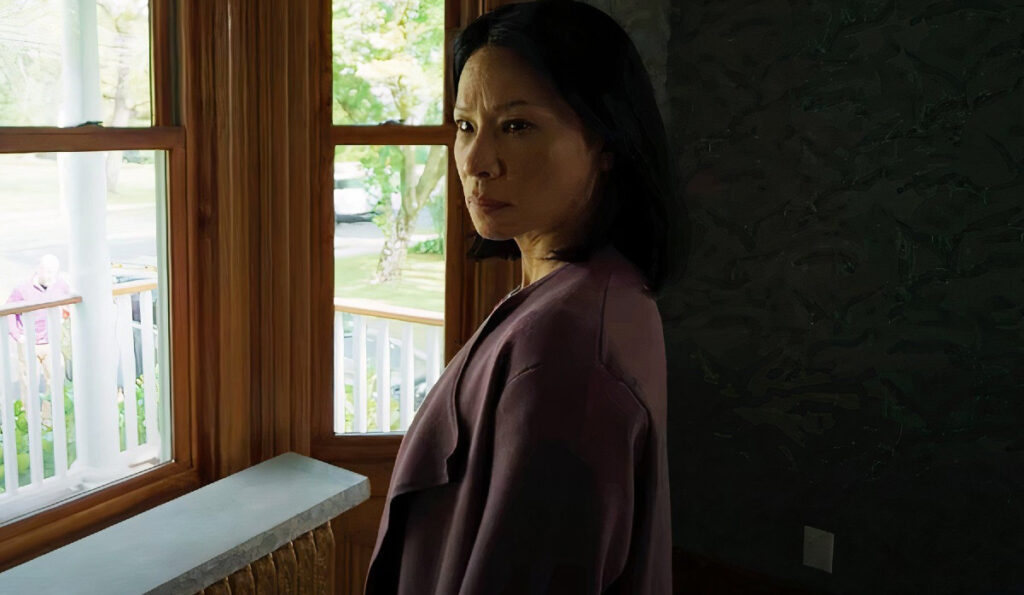
The paranormal sub-genre of horror is vast, and films like The Others have played with the perspective of ghosts before. But what makes Presence so unique is that this perspective is also the perspective of the audience. If the presence is the audience, what do they see? Through Soderbergh’s subjective camera, they see the complex dynamics of a family that’s slowly unraveling. The film’s dialogue contains plenty of snippets of conversations between the family, as well as phone conversations or private moments where a character is alone adding even more layers and causing you to ask even more questions about what lies under the surface of each interaction. But what’s most evident is the division that lies under this roof between husband (Chris Sullivan) and wife (Lucy Liu), mother and daughter, father and son (Eddy Maday), and brother and sister. It’s a compelling experience as each fluid movement of the camera around the characters makes you feel almost too involved in these private moments.
Follow us on MSN for more content like this.
It’s an almost anxiety-inducing experience, especially when tension builds as the camera gets in the personal space of each character, without them knowing of the presence right in front of them. The presence, or the audience, is as much a character in this space as those who live in it. The film’s voyeuristic lens also creates great sympathy, especially as we learn of the depression and grief that Chloe is going through. Having lost her best friend, Nadia, and being more in tune with this presence than the rest of the family, it becomes a sort of comfort for her. She believes it could be Nadia, leading to a discussion on how grief can often manifest. You get the sense that the presence is comforting Chloe, but it could also be a manifestation of the comfort she seeks. While in the end, it becomes clear who the presence actually is in a surprising twist, there’s so much to read from this perspective.

In the end, Presence becomes a fulfilling experience, not only in its technical crafts but how it ultimately sits as a deft reflection on death. Through its lens, there’s a strong internalized fear of being unseen or ignored, while the script brings up humanity’s keen interest in death, the inbetween and the after, but also the deep fear of all of that.
Follow us on MSN for more content like this.
Grade: A