
Children's Nebraska's new $114 million Behavioral Health & Wellness Center in Omaha was designed for healing and safety simultaneously rather than treating them as competing priorities. The post Facility of the Month: Children’s Nebraska Behavioral Health and Wellness Center Reflect Exemplifies Shift Toward Recovery-based Design appeared first on HCO News. The post Facility of the Month: Children’s Nebraska Behavioral Health and Wellness Center Reflect Exemplifies Shift Toward Recovery-based Design appeared first on HCO News.
The 107,000-square-foot facility opened Jan. 7. | Photo Credit (all): Bonnie Ryan/Children‘s Nebraska
By Sue Haigh
Behavioral health facilities present architects and builders with a difficult challenge: creating spaces that are safe for patients in crisis without making them feel institutional.
At Children’s Nebraska’s new $114 million Behavioral Health & Wellness Center in Omaha, project leaders said the answer was to design for healing and safety simultaneously rather than treating them as competing priorities.
“Sometimes when you only focus on safety, you engineer out all the things that actually help for healing,” said Renee Rafferty, Senior Vice President for Behavioral Health and Wellness at Children’s Nebraska, noting how the team met frequently during design and construction to stay on track with their mission. “We’ve learned that over time, really, those two things can exist at the same time.”
Brian Giebink, Director of Behavioral and Mental Health at project architect HDR, said safety is a “baseline” throughout the design process and HDR selects “materials, finishes, furniture and technology that meets aesthetic, therapeutic and functional goals without compromising safety.”
“The entire team embraced this approach, which informed a unique design solution that is calm, welcoming and instills a sense of hope to those who need it most,” he said.
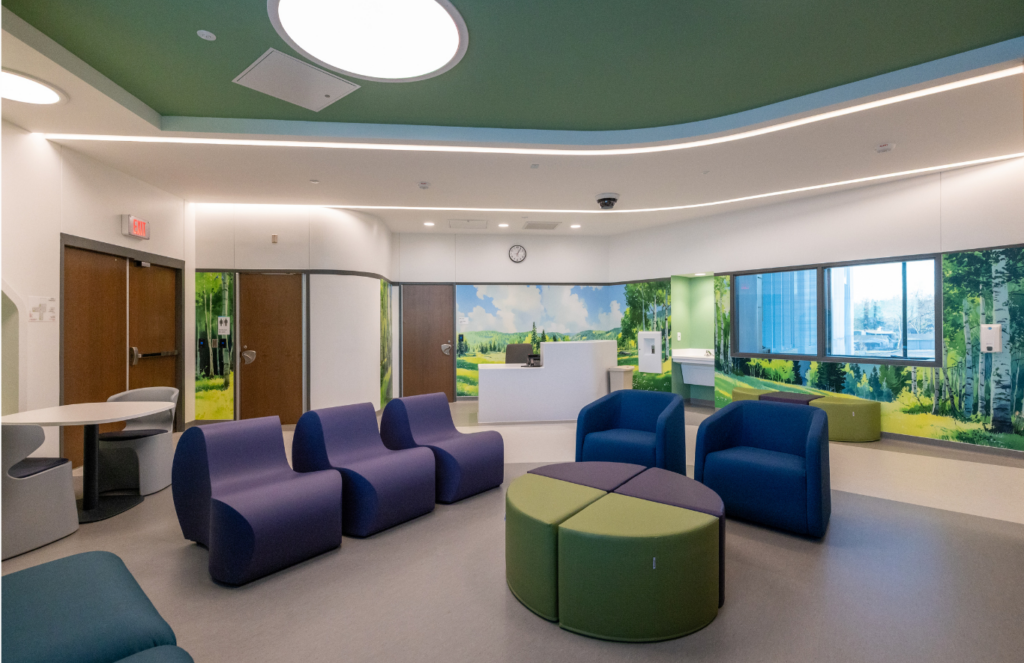
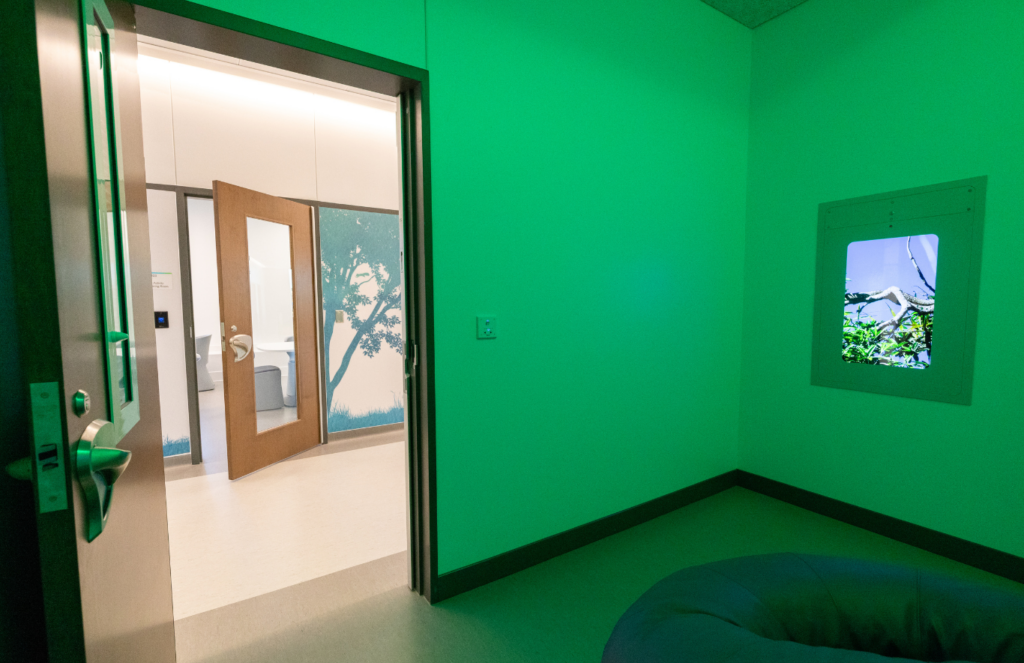
The 107,000-square-foot facility, which opened Jan. 7, features wide hallways and special lighting designed to make rooms feel open and spacious rather than closed in. Images from nature line many of the walls, from a peaceful birch forest and a green vista dotted with puffy white clouds to a waterfall framed by sun-dappled trees. Along one hallway, graphics of a towering pine tree share space with a playful cat chasing a butterfly. Nearby, the entrance to a private crisis stabilization room, painted blue with rounded edges throughout for safety, is softened by oversized prairie wildflower silhouettes.
Giebink said such wall graphics can be calming and simulate a connection to nature.
HDR also designed rooms to be “flexible and normative to promote a healing environment,” he said.
“Simple strategies like color-changing lights and comfortable moveable furniture go a long way to provide autonomy and choice which can be very therapeutic for behavioral health patients,” he said.
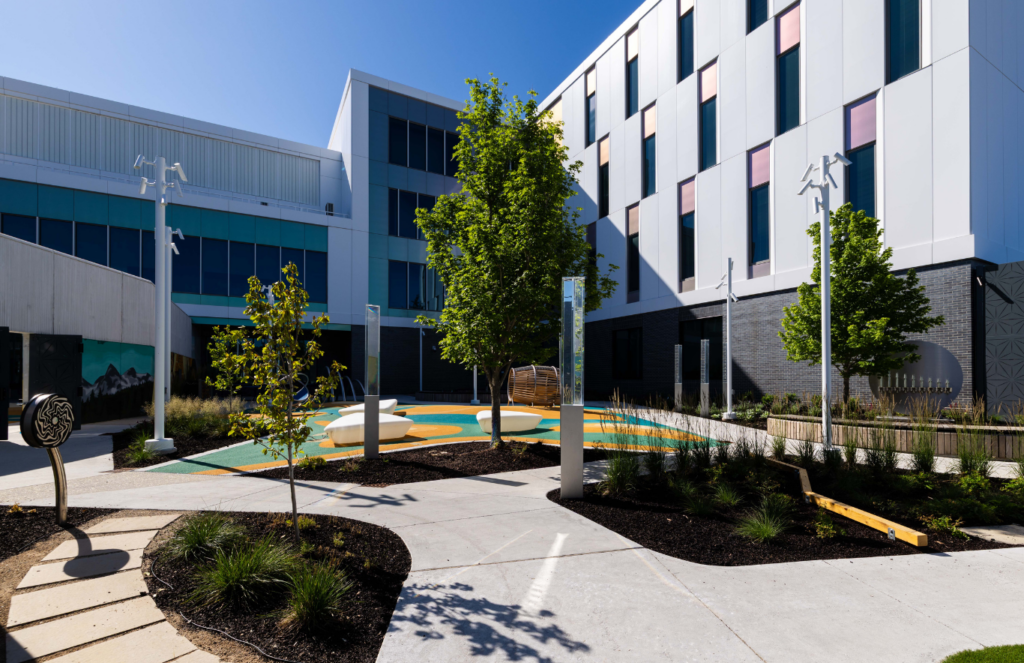
The exterior of the building also features a calming color palette and colored translucent panels and the welcoming design is even extended to the secure sallyport, where patients in crisis may arrive in a police car.
Such intentional use of color and engaging spaces reflects a shift away from earlier thinking that behavioral health facilities needed to be sterile, Rafferty said.
The Nebraska facility also was built to ensure patients and their families can have private and reflective time, facilitated by private nooks where a child can read a book while feeling sheltered and secure. There are also places where kids can interact, including an activity room where they can create art, watch movies, dance and enjoy karaoke nights. Many of the details, from the furniture to the layout, were tested by young people during design sessions to help planners better understand what felt calming and comfortable to children.
“You can really tell people invested in the building because so many details were considered to create a sense of joy and play,” said Rafferty, noting how joy and playfulness through connections with others should be available during a person’s darkest times.
“We focus on de-escalation and connection as part of the strategy for safety rather than creating a barrier,” she said. “The entire building is focused on creating an open connection, supporting the staff interacting with the teams and making sure that they were not separated from the kiddos behind plexiglass.”
The facility also embraces the use of natural light, with floor-to-ceiling windows in some areas, and outdoor space. There is a therapeutic courtyard with walking paths and mindfulness areas to connect the patients to nature. Designed for patients through age 19, it includes basketball, musical instruments and other activities surrounded by trees and calming landscaping.
The project includes a 24/7 crisis assessment center, a 40-bed pediatric inpatient facility, partial hospitalization programs and outpatient behavioral services. Technical features include circadian-rhythm lighting, rooms that accommodate virtual reality therapy, and CoWin interactive wall panels that allow patients to choose activities and help de-escalate crises. There are also design elements that reduce crowding and lower the risk of agitation or aggression through circulation strategies and “back of house access routes” for staff, according to HDR. The patient units were further designed to balance clear staff sightlines with patient dignity and privacy.
The project was built in partnership with the Nebraska-based nonprofit Mental Health Innovation Foundation, led by Ken Stinson, a philanthropist and retired Chair and Chief Executive Officer of Kiewit Corp., the construction firm that built the center. In a recent interview, Stinson said the goal extended beyond constructing a new facility.
“Our hope is that we want it to be transformational in the community, that it takes mental health care to a new level,” he said.
Project Data
- Project Name: Children’s Nebraska Behavioral Health and Wellness Center
- Client: Children’s Nebraska
- Size: 107,000 square feet
- Cost: $114 million
- Architect: HDR
- Structural Engineer: HDR
- General Contractor: Kiewit Building Group
- Landscape Architect: HDR
- MEP Engineer: HDR
- Civil Engineer: HDR
- FF&E: Equipment Planning – HDR, Kitchen and Cafe Equipment – Trimark, Furniture -Sheppard’s Business Interiors & HDR
- Owners Representative: CBRE
- Interior Wall Graphic Artist: HDR
Product Data
- Windows/Integrated Blinds: Unicel Architectural
- Wall Graphics: Inpro, 3M, Designtex
- Flooring : Altro, Tarkett, Nora, Patcraft, Hero Flooring, Interface
- Tile: Crossville, Caesar Ceramiche, Daltile
- Carpet: Interface, J+J Flooring
- Casework - Solid Surface: Corian
- Millwork: Kaydee
- Specialty Ceiling: Arktura, Gordon – WinLock
- Acoustic Ceiling Tile: Armstrong
The post Facility of the Month: Children’s Nebraska Behavioral Health and Wellness Center Reflect Exemplifies Shift Toward Recovery-based Design appeared first on HCO News.
The post Facility of the Month: Children’s Nebraska Behavioral Health and Wellness Center Reflect Exemplifies Shift Toward Recovery-based Design appeared first on HCO News.