
 Torah In Ten Blog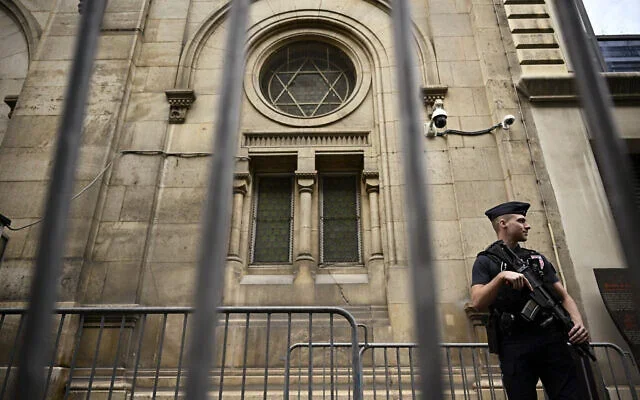
A policeman stands guard outside a Paris Synagogue.
Few debates in recent years have been as charged as the debate over policing. Calls to "defund the police" sparked a national conversation about government authority, crime, accountability, and the allocation of public resources. Some argued for redirecting funds toward mental health, education, and addiction treatment. Others insisted that strong police departments are indispensable for protecting innocent people and maintaining public order.
Before weighing in on either side, it's worth asking a more fundamental question: Why does society need a justice system at all?
This week's Torah portion, Shoftim, offers an answer. As the verse states: “You shall appoint judges and police officials for your tribes, in all the settlements that the Lord your G-d is giving you, and they shall govern the people with due justice (Deuteronomy 16:18)”.
We need Judges to determine what the law requires, and police to enforce it. The Talmud (Avodah Zarah 4a) explains the necessity with a stark image: “Just as with the fish of the sea, the larger swallows the smaller, so too with human beings: were it not for the fear of the government, the one who is greater would swallow the other.”
Police, in other words, aren't a luxury, they are the backbone of a functioning civilization.
And yet, when the prophet Isaiah envisions the messianic future, he conspicuously omits them.
Isaiah writes: “I shall restore your judges as at first, and your counselors as at the beginning” (Isaiah 1:26). Judges reappear, but police officers do not. In their place, Isaiah introduces an entirely new category: counselors and advisors. This language became so central to Jewish prayer that it was woven into the Amidah, recited three times daily: "Restore our judges as of old, and our advisors as in the days of yore."
Why the shift? The Rebbe, Rabbi M.M. Schneerson explains: Isaiah is describing the era of Moshiach, when people will no longer need to be compelled to follow the law, they will want to. When every person's inner Divine spark is fully awakened, coercion becomes superfluous. At that point, we can, at last, “defund the police”.
But how do we get from here to there? The answer lies in that word Isaiah adds: counselors/advisors.
A judge speaks in the name of authority. However correct his ruling may be, the person receiving it may feel that the judge cares about the law or other factors, not about him/her. That gap breeds resentment and sometimes outright rebellion, which is precisely why officers are needed to enforce what judges decide. A counselor operates differently. A personal advisor is someone I choose to bring into my life because I trust that they understand me, care about me, and want what's genuinely best for me. Their guidance isn't something I endure, it's something I seek out.
The Rebbe's insight is that the shift from our world to the messianic one depends on this transition: from coercion to coaching. From demanding compliance to helping people internalize Torah as something personal, relevant, and authentically their own. The counselor doesn't replace the judge; he or she makes the judge's wisdom feel like my wisdom.
The great novelist Herman Wouk once asked the Rebbe, back in the 1950s: "Do you really believe you can tell young American Jews what to do?" The Rebbe replied: "The American Jewish community is wonderful. While you cannot tell them to do anything, you can teach them to do everything.”
This same spirit, meeting people where they are, rather than waiting for them to come to you, lies at the heart of the new Hebrew month we now enter: Elul.
Elul marks the beginning of the High Holiday season. It is a time of introspection, repentance, and prayer, but also a time of unusual closeness with G-d, a period when we have a heightened capacity to ask for, and receive, blessing for a good and sweet new year. One of the traditional acronyms for Elul is drawn from the verse in Song of Songs: "Ani l'dodi v'dodi li" — "I am to my beloved and my beloved is to me."
Rabbi Schneur Zalman of Liadi captured the essence of Elul through a parable: Throughout the year, a king resides in his palace, largely inaccessible to ordinary citizens. But once a year, the king leaves the palace and ventures into the field. There, he receives everyone — each person can approach, and the king greets them with a warm and open face, granting their requests. When the king returns to the palace, those who met him in the field are counted among the privileged few granted a private audience in his inner chamber.
During Elul, G-d does the same. He metaphorically leaves the palace and enters the field, making Himself accessible to everyone, not only the spiritually prepared. Those immersed in work, family, and the ordinary routines of daily life can approach just as readily as those steeped in Torah and prayer. G-d meets us where we are, ready to listen and to bless.
This isn't incidental to the sanctity of the season, it is the season. The Midrash teaches that the purpose of creation is to "make a home for G-d in the lowest world." G-d's presence is not confined to the synagogue or the study hall; it belongs in our homes, our workplaces, our daily lives. Elul is when that truth becomes most tangible.
And this is exactly what the counselor does. Just as G-d comes into the field to meet us, the coach and advisor go to where the person actually is, not requiring them to reach some spiritual threshold before they qualify for guidance, but meeting them with warmth, recognizing what they genuinely need, and walking alongside them.
While we still live in a world fraught with danger, we certainly need strong police protection and enforcement. But the path from today’s world to the Messianic era runs not through more enforcement, but through deeper relationships; not through telling people what they must do, but through helping them discover what they truly want.
Let us take on one more mitzvah, offer guidance and assistance to one another and may we be inscribed and sealed for a good and sweet new year, with the coming of Moshiach now!
 NEWS10 ABC » Massachusetts
 Nabamart
  The New York Times » Technology
 TechSpot
  The Independent - World
  Transit Police