John Fetterman is trending nowKaren Read is trending nowFlorida Panthers is trending nowGeorgia baseball is trending nowMalawi is trending nowTony Evans is trending nowRebecca Grossman is trending nowiOS 18 beta is trending nowMaren Morris is trending nowNvidia stock price is trending nowiOS 18 beta is trending nowMaren Morris is trending nowJohn Fetterman is trending nowKaren Read is trending nowFlorida Panthers is trending nowGeorgia baseball is trending nowMalawi is trending nowTony Evans is trending nowRebecca Grossman is trending nowiOS 18 beta is trending nowMaren Morris is trending nowNvidia stock price is trending nowiOS 18 beta is trending nowMaren Morris is trending now
World
Staying healthy on the Out of Eden Walk
P
Public Radio International ··79 views
National Geographic Explorer Paul Salopek has been walking across the globe for over a decade as part of the Out of Eden Walk. He often walks through sparsely populated, extremely remote places. That trek comes with a major concern: What do you do when you get sick? Salopek tells Host Carolyn Beeler how he stays healthy on the road, noting that health care comes in many forms.
The post Staying healthy on the Out of Eden Walk appeared first on The World from PRX.
Getting sick from time to time is a fact of life. That is especially true during the holidays — which are just around the corner — given the number of people traveling.Â
But what if your whole life is travel?
National Geographic Explorer Paul Salopek has been walking the global path of human migration for his project, the Out of Eden Walk. The World’s Host Carolyn Beeler caught up with Salopek to find out how he’s managed his health and wellness on the go.
Carolyn Beeler: So, Paul … what do you do to stay healthy on your walk?
Paul Salopek: To start out with, I have to say that I was 50 when I started this walk. I’ve traveled an awful lot as a foreign correspondent. I’d been exposed to a lot of different kinds of bugs and often different environments. So, I guess you could say that I had a pretty good flora, getting off on the first step. My immune system was probably pretty bulked up. That’s number one. And number two is that walking, as you know — and increasingly studies are showing — is actually really good for keeping your immune system healthy, keeping your whole body actually happy. So, I would just say those two kinds of preventive things were probably the best possible antidote to any disease or kind of illness that I could encounter, walking tens of thousands of kilometers across the world.
So, did you ever get very sick or injured in a way that put your travels on hold for a while?
Yes, I had some problems. I twisted a knee pretty seriously in the Caucasus mountains, rolling down the mountains into Georgia. I’ve had gastric distress at various stages of the walk. Sordid fevers … most of them nameless. I had no idea what they were. And of course, I caught COVID along the way, too.
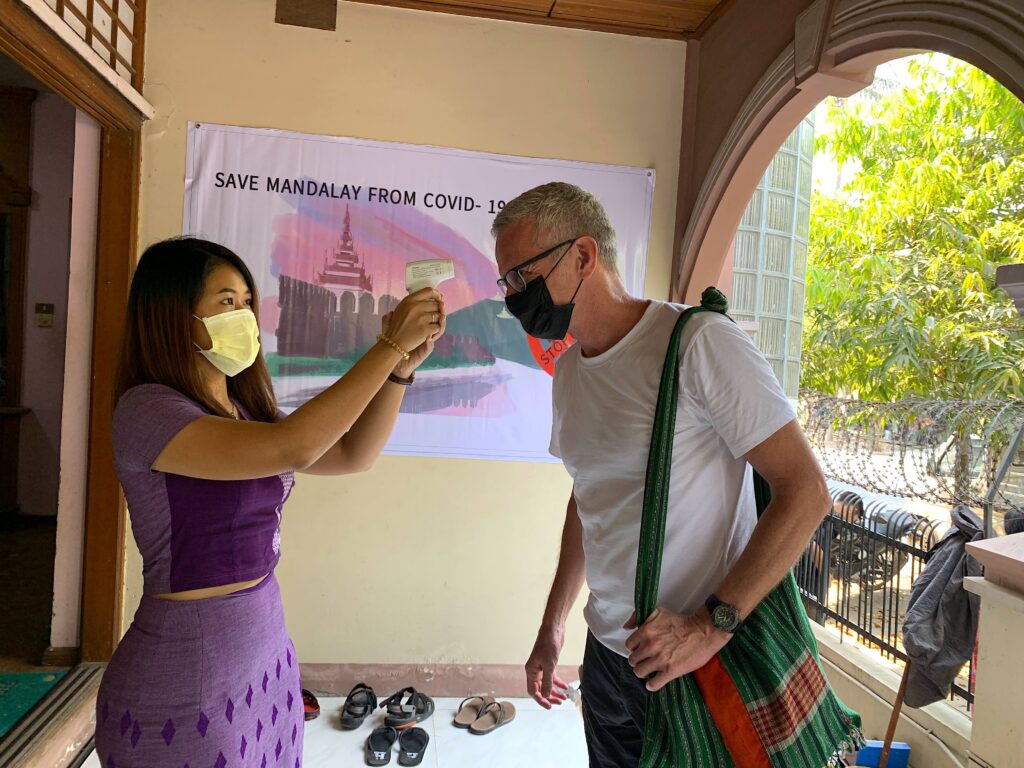
Paul Salopek gets his temperature taken in Mandalay, Myanmar, during the outbreak of the COVID-19 pandemic. He self-isolated for months in a remote village.Paul Salopek/National Geographic, Out of Eden Walk
You mentioned an injury while walking through the Caucasus. I’m wondering what you do to prepare before you enter a rather remote stretch of your walk, where you might not have access to a hospital, a drugstore or the supplies you might need.
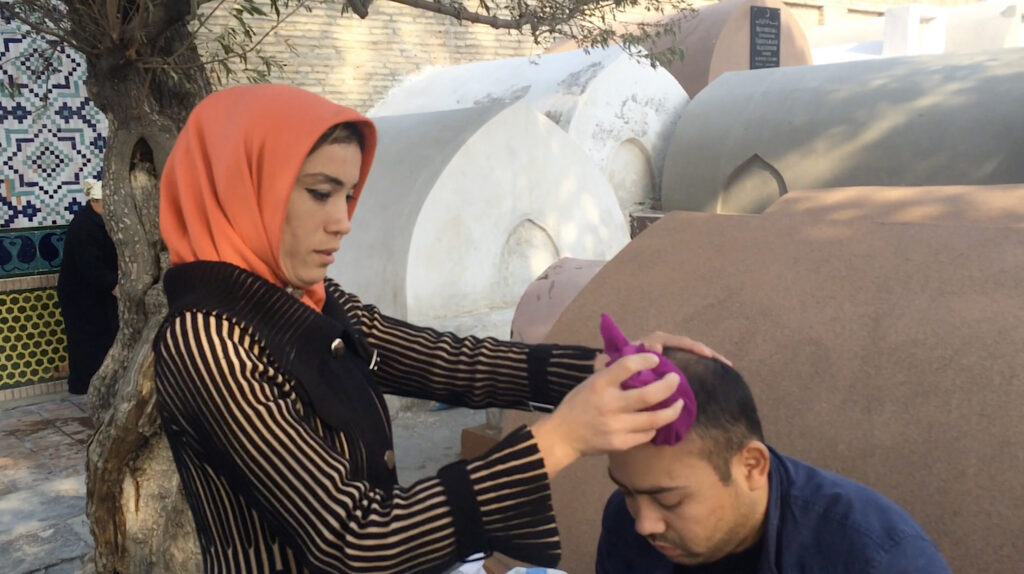
So, I carry a first aid kit that’s pretty thorough. It has prescription painkillers and antibiotics. I started this journey with some medical training. I went through a six-week course, embedded with the US Air Force, years ago. They kind of basically get EMT training. But also, I kind of put myself at the doorstep of local healers — and that’s everything from primary health care clinics and economically struggling economies that offer just really basic kind of interventions. And I must say, Carolyn, the treatment was incredible. I’ve been treated by shamans. I went to a spiritual cleanser in Uzbekistan. I wasn’t going there to seek help, but she asked me to see kind of if I, you know … she wanted to practice on me, and this was a woman named Shakhlo Teshabaeva in the old Silk Road town of Kokand in Uzbekistan in Central Asia. She had set up shop under a tree, outside the local cemetery, where she was rubbing a glass full of ashes on patients whose ailments weren’t being cured at the local hospital, right? So, people might go to the local hospital as a first recourse. But if it was a chronic illness or maybe even a very serious one that was getting worse and that wasn’t reacting to modern medicine, they would go to Shakhlo. She would recite prayers over them and kind of rub a glass full of ashes over their bodies and then basically burp out, I mean, it sounded like a belch, the evil spirits that were inhabiting these patients. And she did that to me, too.
Faith healer Shakhlo Teshabaeva cures all comers in the ancient SIlk Road city of Kohkand, Uzbekistan. Teshabaeva uses the ashes from burned cotton plants to absorb and “burp out†malignant forces causing disease.Paul Salopek/National Geographic, Out of Eden Walk
Was there an ailment that you were going to report?
You know, I felt a little awkward because I was feeling great, but she was quite insistent and was in a public square in front of a cemetery, so I [felt] like, “Okay, well, why not? It’s another part of the experience.†So, I said, “Yeah, well, I’m a guy who’s walking around with a heavy pack. My back gets sore sometimes.†So, she rubbed this glass of ashes on my back — and yeah, it felt great. I think just the human touch is enough to, kind of, you know, it’s very ancient, just to kind of heal each other. If nothing else, in our minds, right? So yeah, it was great.
You said you carry a first-aid kit. I’m wondering if there’s one essential item that has been more useful than any others.
Probably the most used thing would be the same thing that you have in your bathroom behind the mirror, is something for a headache, right? Something for some aches and pains. If you’ve kind of walked 30 kilometers a day and it’s been super hot or you feel dehydrated, you’re feeling a little bit nauseous. So, I would say the top things would be like a little bit of analgesic. Maybe in very rare cases, some some antibiotics for a gastric ailment that wasn’t quickly healing itself because you don’t want to dehydrate. And those two things were probably the most useful.
For some strange reason, I don’t get blisters, so I’ve not really gone through my supply of Band-Aids; they’re still there. So, that’s about it, you know, there were some kind of cultural healing methodologies along the way that I recorded [and] wrote about, but I certainly wouldn’t want to subject myself to. I mean, Shakhlo was a very benign and even interesting and kind of empathetic one. But there was, I ran across a woman who was doing the fire cure in Saudi Arabia. And that was something I’d never seen before, where she was pressing hot irons into somebody to cure their ailments. I did not volunteer for a demonstration. So yeah, it’s kind of been interesting to see how human beings think about illness — both psychologically and physically — and how we come up with cures, particularly when there aren’t many resources around.
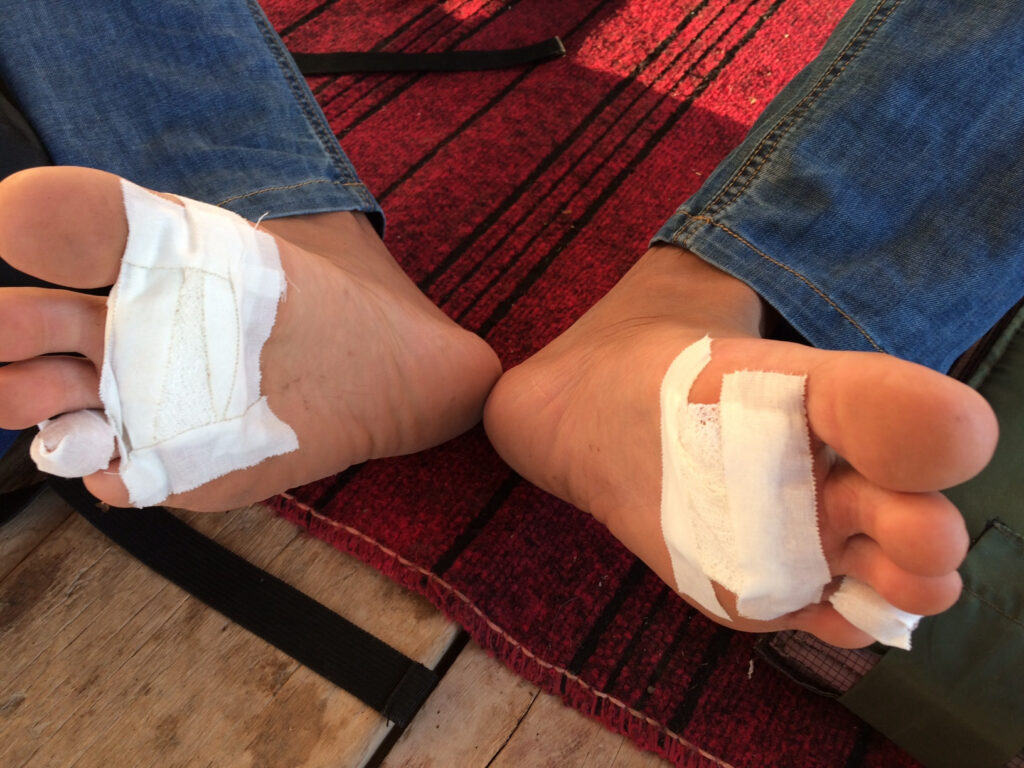
A chronic malady on a walk around the world: blisters. These are the battered feet of one of Paul Salopek’s walking partners in Uzbekistan.Paul Salopek/National Geographic, Out of Eden Walk
Was there ever a point when you thought you might have to turn around or stop your journey because of illness, injury or anything like that?
Up until now, thankfully, knock on wood, knock on these old knees … not yet! But who knows, our supply of cartilage in our bodies is sort of finite. So, I’m very aware that I’m racking up the miles. I’m trying to be more mindful about how I use my body, right? I didn’t used to do things like stretch in the morning. I’m starting to do that now. I’m just being aware, you know … how long I’ve been on the trail and how many miles and years have gone by walking. I’m trying to be a little more careful about all these, this amazing walking machine that we all carry around with us: the body.
Parts of this interview have been lightly edited for length and clarity.
Writer and National Geographic Explorer Paul Salopek has embarked on a 24,000-mile storytelling trek across the world called the “Out of Eden Walk.†The National Geographic Society, committed to illuminating and protecting the wonders of our world, has funded Salopek and the project since 2013. Explore the project here. Follow the journey on X at @PaulSalopek, @outofedenwalk and also at @InsideNatGeo.