
2025-11-20. “Our goal is to deliver more to more people,” Pia Rehnquist, Head of Sweden’s Bonnier News Local, told participants at our Newsroom Summit in Copenhagen on Tuesday. The post Bonnier News Local succeeding by focusing on those in their 30s appeared first on WAN-IFRA.
Bonnier News Local is on a multi-year success streak that most publishers would love to emulate.
“We have about half a million subscribers in total, and we have had that many for a long time. But we have changed from almost only print subscriptions to a majority of digital,” Pia Rehnquist said during her keynote presentation at WAN-IFRA’s Newsroom Summit this week in Copenhagen.
Digital subscribers now make up 62 percent of their total subscribers, and this has happened within the past 10 years, she said.
“That is why we are a strong company right now,” Rehnquist added.
Specifically, as they’ve transformed their titles to digital-first, Bonnier News Local has converted their number of digital subscribers from 20,000 to more than 300,000. Sweden’s population is about 10.6 million, and Bonnier has dozens of news titles across the country.
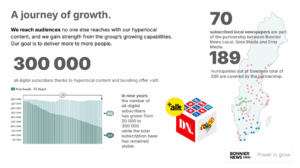
Digital subscription revenues showing strong growth
Meanwhile, Bonnier News Local’s digital subscription revenues have grown from 301 million Swedish Krona (about 27.3 million euros) in 2021 to 492 million Krona (approximately 44.7 million euros) in 2024, and will be more than 619M Krona (about 56.3 million euros) in 2025, she said.
“We are actually doing better than that – I looked at the numbers yesterday,” Rehnquist said. “This is the forecast, but it will be even bigger: the actual numbers for next year’s digital subscription revenues. And we hope to continue to grow. … we have grown at 15 to 20 percent for a long time. Now the growth is a bit slower, but we also have a much stronger focus on the money. So, we are focusing on increasing the ARPU (Average Revenue Per User) more and more,” she said.
Additionally, the company is forecasting 10x EBITA growth from 2023 to 2028.

While Bonnier News Local currently earns more revenues from their print subscribers and print advertising, Rehnquist said they are expecting their total digital revenues to overtake those of print in both areas in 2027.
From our vault: ‘AI is a mean, not a goal’ – Bonnier’s Pia Rehnquist on integrating AI into your local news strategy
Growing the right way by focusing on journalism
A focus on journalism is central to Bonnier’s strategy.
“That is our core. That is what we do, and that is what our business is about,” Rehnquist said.
“We listen to our customers and readers needs, solve their problems and create habits that keep them coming back. Our journalism is based on an ongoing interaction with the surrounding community. We want to reach more people with more, and we do that by growing,” she said.
While growth is essential to Bonnier News Local, it’s equally important the company grows the right way, Rehnquist said.
“We want to be customised, relevant, measurable,” she added.
To do this, Bonnier News Local has kept their customers at the heart of their digital transformation: “What do they want? What do they read? How do they read it? And we have been focusing the whole time on the younger audience,” Rehnquist said.
This doesn’t mean teenagers, she noted, but young adults between the ages of 30 and 39.
“All of our newspapers are measured on how they perform with the 30-39 age group, because that is the future” she said.
“We talk a lot about the content, and how we do the journalism: What do you write? And what’s the approach you take? And there are so many things that we know that work with this younger audience.”
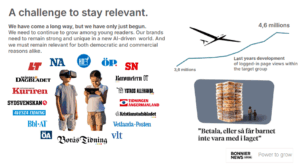
Logged-in page views within the target group have risen from 3.6 million to 4.6 million in the past year, and Rehnquist noted: “Writing about children in the local environment is something I can recommend.”
‘We want to be big, and we need to be very efficient’
A key part of their strategy is also based on scale.
Bonnier News Local is a big company with a lot of local newspapers within it. Parent publisher Bonnier News is even larger and includes some of the biggest news brands in Sweden, such as Dagens Nyheter and Expressen, as well as many titles in 11 more European countries.
“That’s a very important part of the strategy – that scale is inevitable in this type of media business. We want to be big, and we need to be very efficient in the way that we do things,” Rehnquist said.
“We’re a big company, and economically, we are in a very good position right now,” she said. “But we need to succeed because what we do is so extremely important. That’s why we need to succeed, and I think that’s why we have succeeded – because it hasn’t been easy.”
“It’s not easily done. There’s no one way to do it. We use a lot of toolboxes,” she noted.
Journalism decisions are in the hands of the local editors-in-chief, almost everything else involving the running of Bonnier News Local’s news titles is centralised and co-ordinated, she said.
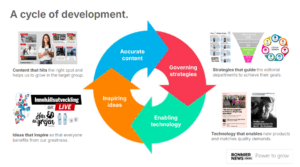
‘You can never relax’
While acknowledging they are doing well, Rehnquist stressed the need to maintain a high level of vigilance across the industry, their audiences and their primary markets.
“Two years ago, we thought, ‘We have the digital subscribers, we kind of know how to do things.’ And then there was Generative AI all over the place. You can never relax. You have to be very aware of the fact that this will continue to change. There is never a solution. If you invite me back in two years, we’ll have probably done something completely different because everything around us changes.”
“The big challenge – the real struggle – is to succeed in the long run.”
Asked by moderator Kevin Anderson, Director of WAN-IFRA’s Digital Revenue Network, to describe a couple of the most important steps in their journey from a print to a digital business, Rehnquist replied: “Getting the newsroom to understand that the future is digital is key. It’s not a question of if we want to. It’s a question of adapting. So, measuring the right things and talking a lot about it within the newsrooms is very important.”
“Our newsrooms have also been digital-first for maybe seven or eight years, so that’s also something that we have been working a lot with: Trying to focus on the digital way of doing things,” she added.
“We have come a long way, but we have only just begun,” Rehnquist said. “We need to continue to grow among young readers. Our brands need to remain strong and unique in a new AI-driven world. And we must remain relevant for both democratic and commercial reasons.”

WAN-IFRA’s Newsroom Summit took place on 18-19 November in Copenhagen at JP/Politikens Hus.
The post Bonnier News Local succeeding by focusing on those in their 30s appeared first on WAN-IFRA.

![BREAKING: Trump says he’s gonna sue ABC News and here’s why… [VIDEO]](https://therightscoop.com/wp-content/uploads/2026/06/elizabethschulze_abcnews_gma-620x300.jpg)