New AI method can support real-time management of infectious diseases is trending nowKatsina Government Opens New Diphtheria Isolation, Treatment Centre is trending nowRole of ethics education in accounting fraud prevention is trending nowEven ancient bacteria possessed intercellular communication structures like humans today,… is trending nowNASA inaugurates first telescope named after female scientist is trending nowSalah's successor arrives at Anfield: Liverpool sign Barcola in a historic deal is trending nowAston Villa vs Arsenal: Shearer predicts Monday’s EPL fixture is trending nowMan City agree £65m deal for Everton's Ndiaye is trending nowBarcelona's comeback against Rayo Vallecano reminds Real Madrid of a painful past is trending nowIkogosi Resort partners AFRIMMA to promote Nigeria’s tourism is trending nowMindustry Conference Partners Warner Music Africa/Africori For Fifth Edition, Opens Regis… is trending nowBBNaija S11: Aikou, Flora Risk Losing Gambit Status is trending nowNew AI method can support real-time management of infectious diseases is trending nowKatsina Government Opens New Diphtheria Isolation, Treatment Centre is trending nowRole of ethics education in accounting fraud prevention is trending nowEven ancient bacteria possessed intercellular communication structures like humans today,… is trending nowNASA inaugurates first telescope named after female scientist is trending nowSalah's successor arrives at Anfield: Liverpool sign Barcola in a historic deal is trending nowAston Villa vs Arsenal: Shearer predicts Monday’s EPL fixture is trending nowMan City agree £65m deal for Everton's Ndiaye is trending nowBarcelona's comeback against Rayo Vallecano reminds Real Madrid of a painful past is trending nowIkogosi Resort partners AFRIMMA to promote Nigeria’s tourism is trending nowMindustry Conference Partners Warner Music Africa/Africori For Fifth Edition, Opens Regis… is trending nowBBNaija S11: Aikou, Flora Risk Losing Gambit Status is trending now
World
Taliban forces fire on civilians protesting morality police in Afghanistan
Public Radio International ··55 views
Women in Afghanistan are increasingly facing arrest and detention for leaving their homes without wearing a full face and body covering. Rights monitors say they have verified at least 16 arrests and detentions, including that of a pregnant woman, in the western city of Herat. Rina Amiri, the former US special envoy for Afghan women, girls and human rights, tells The World’s Host Marco Werman that Taliban forces have opened fire on civilians protesting the restrictions.
The post Taliban forces fire on civilians protesting morality police in Afghanistan appeared first on The World from PRX.
Since the Taliban returned to power in 2021, it has steadily tightened restrictions on Afghan women. In the western city of Herat, the restrictions have reached a whole new level. Reports suggest so-called “morality police†are arresting women at hair salons. They’re also stopping women to search their bags for illicit cosmetics. Women in the city have even been detained for leaving home without a garment that entirely covers their bodies and faces.Â
During the morning of June 9, 2026, residents of Herat took to the streets in protest. Authorities then fired live ammunition at the crowds. The World’s Host Marco Werman spoke with Rina Amiri about what’s happening there. She’s the former US Special Envoy for Afghan women, girls and human rights.
Amiri said that, “Herat is one of the cities throughout Afghan history that has had a population that is mobilized and very independent, and they have pushed back and been supported by their husbands. The Taliban has fired into the crowd, injured several people. I’ve heard that at least three people have been killed. And I’ve also heard that they are planning to do the same thing in Kabul and other urban centers. But what happened is that this is the systematic escalation of what Afghans are calling gender persecution and gender apartheid in Afghanistan. This is not an isolated incident. There are over 250 edicts that the Taliban have imposed, the vast majority of them targeting women and girls. And now they just recently announced that they’re going to further enforce the hijab edict, and they’ve been targeting even women who are fully covered.â€
Marco Werman: So, what are women being detained for? You said some are being arrested even when they leave their homes fully covered. What else are they being detained for?
Rina Amiri: They have been detained simply for being outside of the house. You know, there are laws on the book by the Ministry of Vice and Virtue that a woman can be arrested simply for speaking loudly or laughing. Basically, what Afghan women are saying is that if they could arrest women for breathing, that’s what they would do. They’ve taken just extraordinary measures to legally penalize women for any activity outside of the home, and there’s such a culture of fear.
Women report feeling like they’re virtual prisoners, and they’re also targeting the men in the family to make sure that they regulate women and prevent them from leaving the house. What is extraordinary to me is that this is 50% of a population of a country — over 50% — that the world has witnessed having to live under such draconian edicts.
And the world remains silent. There has been some symbolic condemnation, but for 20 years, the international community saw the courage of Afghan women who stood up and were at the forefront of pushing for peace. They were running for office, they were members of parliament and, overnight, they were stripped of the right to work, the right to get an education. And every day the Taliban imposes another draconian and extremist decree. Yet in many ways they are legitimized and they are tacitly and actively supported by many countries.
Do we know if there was an official decree that led to these recent detentions?
I think there was an announcement at a mosque last week that they would start really monitoring and implementing the dress code. And imposing punitive measures and restrictions.
Afghan refugee women walk at Kababayan Refugee Camp in Peshawar, Pakistan, April 8, 2025.Muhammad Sajjad/AP/File photo
Well, I’ve also seen reports of Afghan men rallying in support of women and against these new restrictions. How new is that solidarity?
It has been there. I think men — during the years that I spent as special envoy, I heard from countless men saying that they did not support this, that they wanted a better future for their daughters. They saw that what the Taliban was doing was not just crushing women, but crushing the future of the country, crushing their economic prospects for their families.
And what Afghans would want you to know is this is not about Afghan culture. This is about the Taliban’s extreme and radical ideology, which the Afghan people don’t support. That level of vulnerability for their family members is crushing them. And yes, they are standing out and defending their families, and they are also being arrested. And this is the way that the Taliban is making sure that these decrees are enforced, is by going after entire families and communities and targeting them when they defy these extreme policies.
Rina, why is this happening in Herat? What should we know about the city to better understand these deeper restrictions on women’s rights?
Herat is one of the largest cities and provinces in Afghanistan. It’s a city where there has been a tradition of tremendous independence. It’s a city with tremendous cultural heritage. There’s tremendous pride, and education, and so what is being done in Herat, it really goes against the way that Herati see themselves. I have heard from Afghans, I even heard from lower-level members of the Taliban that they were unhappy with what was happening. These Talibs are quietly providing education to their daughters through tutors inside their homes, while publicly they’re denying the women and girls of the country access to education and opportunity. And that hypocrisy is something that Afghan men and women see and are aware of.
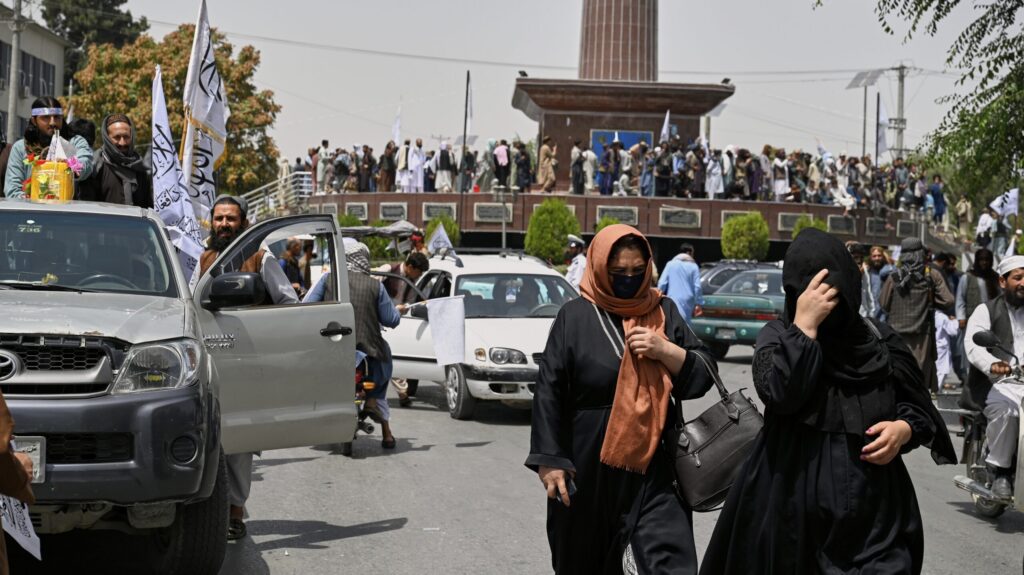
Two women walk past crowds of Taliban fighters and supporters during celebrations marking the fourth anniversary of the US withdrawal and the start of Taliban rule in Kabul, Afghanistan, Aug. 15, 2025.Nava Jamshidi/AP/File photo
Well, Rina, despite the existential dangers, Afghan women continue to protest, they continue to organize. So, as you look ahead, what’s their best hope?
Afghan women are tremendously courageous, and what they ask of us is not just to give rhetorical support. They ask for us to give concrete support. They ask for resources to be provided for women’s organizations inside the country, because they are willing to put their lives on the line. But right now, they are struggling, you know, with the administration that has cut off all assistance and funding, saying that they are depriving the Taliban of resources. No, the Taliban are not dependent on international funding. It’s Afghan people who are hurting, and particularly the women leaders. They need our support to help them carry out the very courageous work that they’re undertaking and pushing back against the Taliban.
Parts of this interview have been lightly edited for length and clarity.

 Public Radio International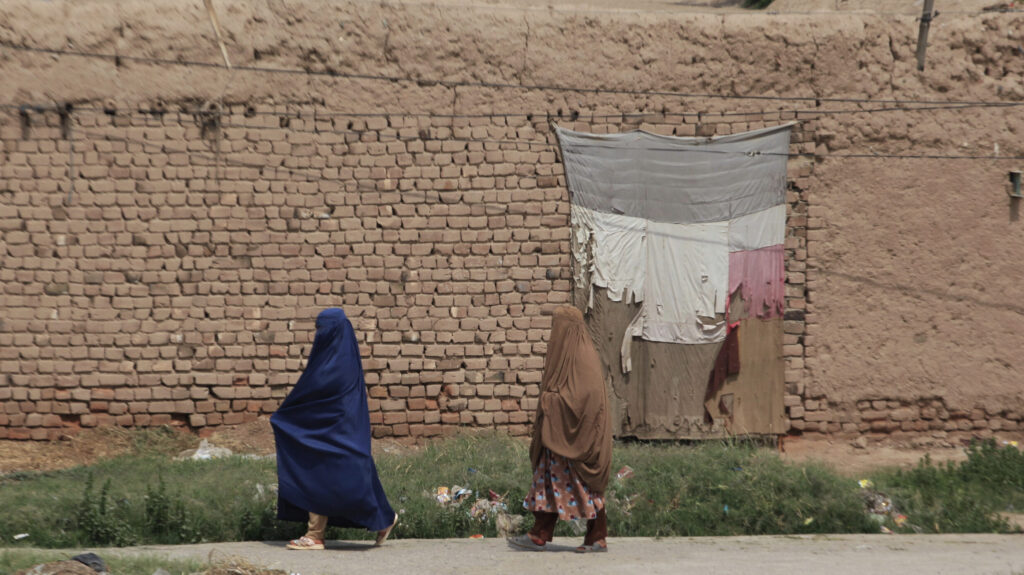

 Rugs and Pugs Blog
  The Sun » World News
  Revere Journal
  The New York Times » Technology
  Forbes Business Blog
  Westwood One Sports