There are many rechargeable battery chemistries, each with their own advantages and disadvantages. Currently lithium-ion and similar (e.g. Li-Po) rule the roost due to their high energy density at least acceptable number of recharge cycles, but aluminium-ion (Al-ion) may become a more viable competitor after a recently published paper by Chinese researchers claims to have overcome some of the biggest hurdles. In the paper as published in ACS Central Science by [Ke Guo] et al. the use of solid-state electrolyte, a charge cycle endurance beating LiFePO4 (LFP) and excellent recyclability are claimed.
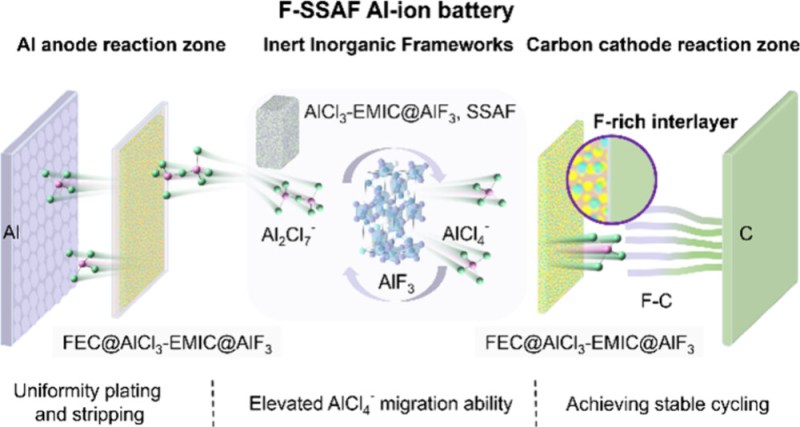
It’s been known for a while that theoretically Al-ion batteries can be superior to Li-ion in terms of energy density, but the difficulty lies in the electrolyte, including its interface with the electrodes. The newly developed electrolyte (F-SSAF) uses aluminium-fluoride (AlF3) to provide a reliable interface between the aluminium and carbon electrodes, with the prototype cell demonstrating 10,000 cycles with very little cell degradation. Here the AlF3 provides the framework for the EMIC-AlCl3 electrolyte. FEC (fluoroethylene carbonate) is introduced to resolve electrolyte-electrode interface issues.
A recovery of >80% of the AlF3 during a recycling phase is also claimed, which for a prototype seems to be a good start. Of course, as the authors note in their conclusion, other frameworks than AlF3 are still to be investigated, but this study brings Al-ion batteries a little bit closer to that ever-elusive step of commercialization and dislodging Li-ion.