New AI method can support real-time management of infectious diseases is trending nowKatsina Government Opens New Diphtheria Isolation, Treatment Centre is trending nowRole of ethics education in accounting fraud prevention is trending nowEven ancient bacteria possessed intercellular communication structures like humans today,… is trending nowNASA inaugurates first telescope named after female scientist is trending nowSalah's successor arrives at Anfield: Liverpool sign Barcola in a historic deal is trending nowAston Villa vs Arsenal: Shearer predicts Monday’s EPL fixture is trending nowMan City agree £65m deal for Everton's Ndiaye is trending nowBarcelona's comeback against Rayo Vallecano reminds Real Madrid of a painful past is trending nowIkogosi Resort partners AFRIMMA to promote Nigeria’s tourism is trending nowMindustry Conference Partners Warner Music Africa/Africori For Fifth Edition, Opens Regis… is trending nowBBNaija S11: Aikou, Flora Risk Losing Gambit Status is trending nowNew AI method can support real-time management of infectious diseases is trending nowKatsina Government Opens New Diphtheria Isolation, Treatment Centre is trending nowRole of ethics education in accounting fraud prevention is trending nowEven ancient bacteria possessed intercellular communication structures like humans today,… is trending nowNASA inaugurates first telescope named after female scientist is trending nowSalah's successor arrives at Anfield: Liverpool sign Barcola in a historic deal is trending nowAston Villa vs Arsenal: Shearer predicts Monday’s EPL fixture is trending nowMan City agree £65m deal for Everton's Ndiaye is trending nowBarcelona's comeback against Rayo Vallecano reminds Real Madrid of a painful past is trending nowIkogosi Resort partners AFRIMMA to promote Nigeria’s tourism is trending nowMindustry Conference Partners Warner Music Africa/Africori For Fifth Edition, Opens Regis… is trending nowBBNaija S11: Aikou, Flora Risk Losing Gambit Status is trending now
World
How nations weaponize the energy trade during times of war
Public Radio International ··106 views
From the Iran war to Russia’s invasion of Ukraine, events this year have highlighted the way nations use the global energy trade as another weapon of war. To learn more, The World’s Marco Werman speaks with Edward Fishman, an expert on economic statecraft at The Council on Foreign Relations.
The post How nations weaponize the energy trade during times of war appeared first on The World from PRX.
From Iran to Ukraine, energy is at the center of global conflict. Renewed attacks by Iran and the US in the Strait of Hormuz have revived concerns about oil supplies. Meanwhile, in Russia, where the economy relies heavily on energy revenues, reports of fuel shortages are emerging due to Ukrainian strikes on energy infrastructure.Â
Vehicles line up at a Rosneft gas station in Moscow, on Monday, June 22, 2026. Pavel Bednyakov/AP
“They’re one of the world’s biggest producers of both oil and gas,†said Edward Fishman, senior fellow at the Council on Foreign Relations. “And so from the start of the large-scale Russian invasion of Ukraine in 2022, cutting off Russia’s oil revenues has been a major priority of Ukraine and its friends around the world. Initially, the United States and Europe tried to do that through nonviolent means. They deployed a price cap on Russian oil in late 2022, in which they effectively told buyers of Russian oil around the world that they could only pay $60 a barrel.â€
Fishman said the weaponization of energy supplies has been ratcheting up since Russia’s full-scale invasion of Ukraine.
“But in the last year or so, as the Trump administration has kind of taken its foot off the gas on sanctions on Russia, Ukraine has stepped into the breach and started using kinetic means, drones and missiles, to try to degrade Russia’s own capacity to refine and export oil.â€
Marco Werman: There’s also the Strait of Hormuz, which, in its choking, has impacted oil prices all over the globe. These are pretty obvious examples. I wonder where else in the world you’re seeing energy supplies being weaponized.
Edward Fishman: Yeah, so I think the Strait of Hormuz is the most important one. And one thing just to note is that in the case of both Ukraine’s strikes on Russian refineries and export terminals, as well as Iran’s use of drones and missiles to disrupt shipping through the Strait of Hormuz, we’ve seen countries use military means to disrupt energy supplies. So I think those are the two most prominent examples. I think what’s being fought over right now, in the sort of this renewed fighting between the US and Iran, is whether the Strait of Hormuz is going to serve as a peacetime economic weapon for Iran, right? Iran is trying to institutionalize its control over the strait, to potentially even charge tolls to ships that go through the strait, and they’ve shown that they’re actually willing to use military force to strike neutral ships.
So, Edward, how would you categorize what’s going on, say, with Cuba and blockades of oil en route to Havana, or the detonation of the Nord Stream pipeline, which prosecutors in Germany recently alleged that Ukraine was responsible for blowing up? Ukraine denies it.
So, look, I think that those are both part of this same story of sort of the militarization of energy conflicts, right? You go back again to the original sanctions on Russia. The idea was to use sanctions, right, and sort of nonviolent economic pressure to try to reduce Russia’s oil revenues. We’re now seeing old-school tactics like naval blockades in the form of the blockade of Cuba. You mentioned the United States trying to choke off Cuba’s access to imports of oil, and certainly the alleged Ukrainian sabotage of the Nord Stream pipeline. That’s, of course, using military means to try to erode Russia’s ability to sell natural gas to Europe.
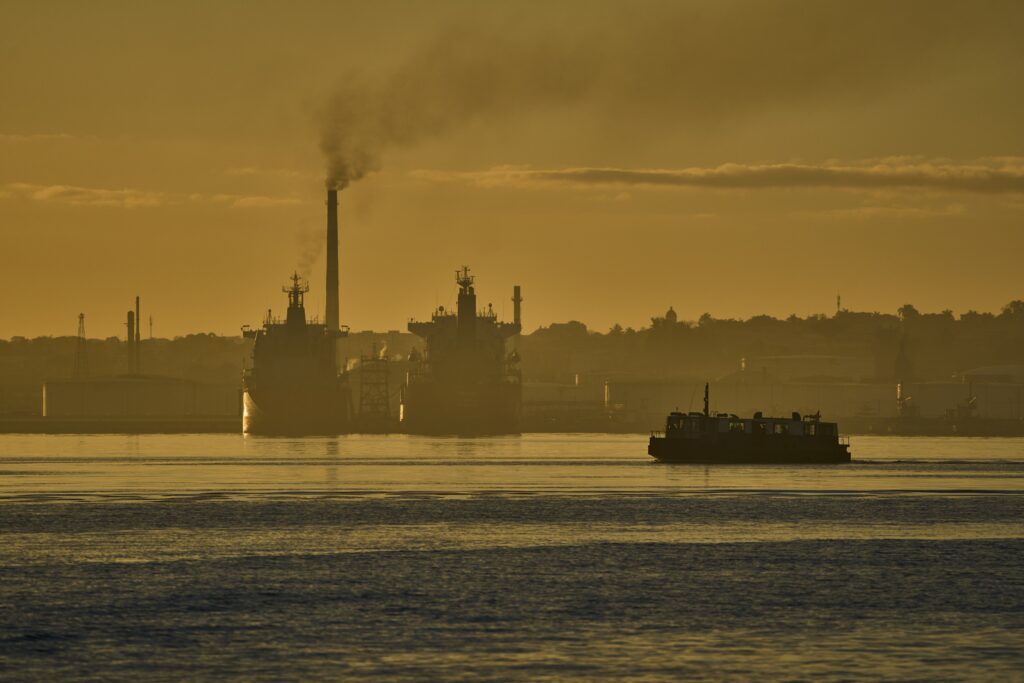
In this AP file photo, a ferry crosses Havana Bay past the Nico Lopez oil refinery where tankers are anchored in Havana Bay, Cuba, March 24, 2026. Ramon Espinosa/AP/File
How vulnerable is the global economy to disruptions in energy supplies today compared with, say, a decade ago?
Well, on a global scale, you know, we’re just as vulnerable today as we were a decade ago because ultimately there are many countries around the world that depend on importing oil, natural gas and other commodities in order to heat their homes and run their factories — the most basic components of running a society and an economy. I think the United States is in a somewhat more secure position. If you go back over 10 years, the United States was a massive importer of oil. And now, the United States is the world’s biggest producer of both oil and natural gas. I think that has given the United States a degree of safety in these types of conflicts, but I also think it’s potentially given President Trump some overconfidence in sort of his ability to wage wars like the one he’s doing right now against Iran without suffering blowback. I think the challenge is that the longer the war goes on, you will eventually reach a point where oil stockpiles run so low that there’s a massive spike in prices around the world, and even the United States would not be shielded from such a price spike.
Yeah, well, I was about to ask you: if the US can keep producing its own oil, what, then, is the Achilles’ heel for the US when we think of economic choke points? Is it time?
I think the Achilles’ heel for the United States is our low tolerance for economic pain. And I think that’s what the Iranians have successfully manipulated. It’s what the Chinese successfully manipulated last year when they cut off America’s access to rare earth minerals. President Trump, as well as previous US presidents, have shown very little appetite to stomach economic recessions or inflation as a result of economic warfare. And so I think that, for instance, if you were to go back to a scenario in which the United States was blockading Iran’s oil sales and in exchange Iran was stopping ships from going through the Strait of Hormuz, if you looked at it, the position of which country would suffer a bigger economic hit, the United States or Iran, it’s not even close, right? Iran’s economy is going to have a massive recession this year. The United States is not going to have a recession, but the prospect of oil prices that are sustained above $100 a barrel, or potentially gasoline prices that are, you know, over $4 or even $5 a gallon. I mean, that’s just something that’s politically untenable for President Trump. I think it’s the reason he wanted to strike this MOU with Iran in the first place. But I think what he’s finding out is that paying Iran to keep the Strait of Hormuz open has its limits, too.
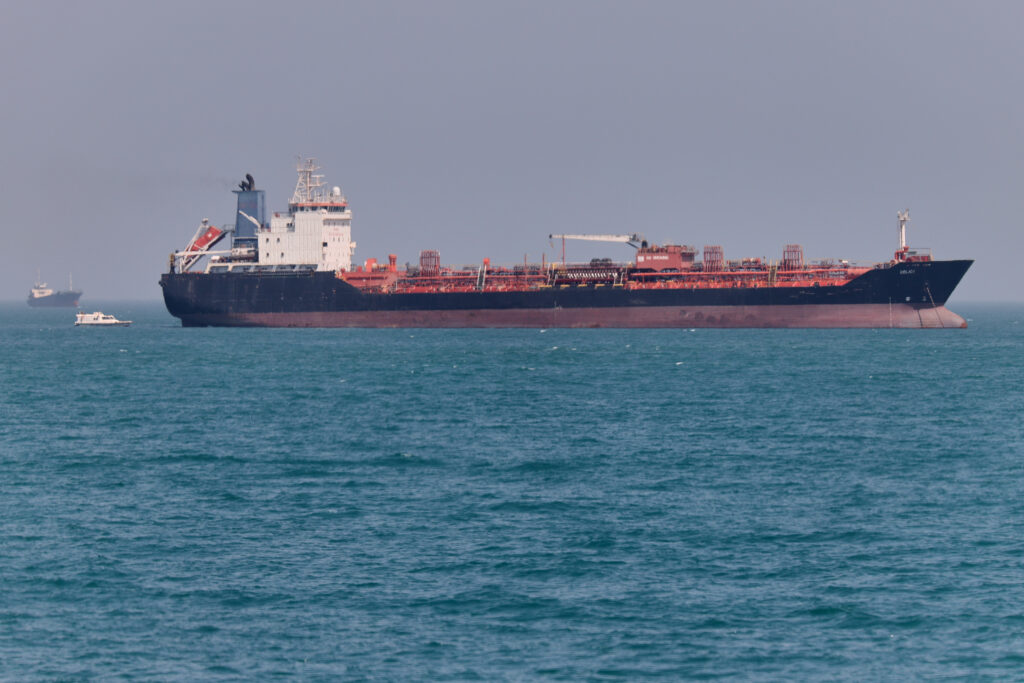
An oil tanker sits at anchor in the Strait of Hormuz off Bandar Abbas, Iran, Saturday, May 2, 2026.Amirhosein Khorgooi/ISNA via AP/File
China has long been reliant on fuel from Gulf countries, but China also hedged against a second economic choke point created by Hormuz by diversifying its energy supply. China also has a serious stranglehold on other resources like rare earth minerals. I mean, I won’t even broach the topic of water. So I wonder if you see fossil fuels as a target being just one form of an economic missile these days.
Oh, definitely. We’re living in an age of economic warfare, in which these choke points, these parts of the global economy where one country has a dominant position and there are few, if any, substitutes, have really become the key to geopolitical competition. One other point to make about energy, though, is I think one of the clearest long-term consequences of this war between the United States and Israel on one side and Iran on the other, and the prolonged disruption of the Strait of Hormuz, is that countries around the world are going to accelerate their adoption of energy sources that don’t rely on fossil fuels. You know, for instance, batteries, electric vehicles, solar panels, wind. And in all of these technologies, Chinese firms have anywhere between 70% and 95% market share. So, I think in the circumstance where much of the world reduces its reliance on the Strait of Hormuz, they may actually, at the same time, increase their dependency on China.
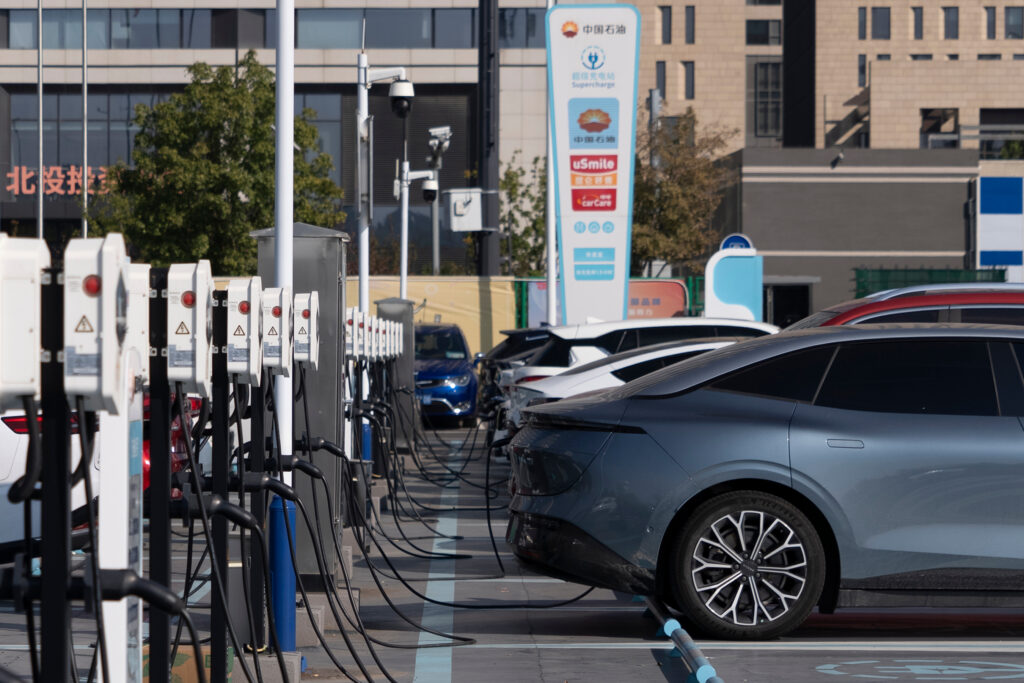
In this AP file photo, electric vehicle charging stations are seen in Beijing, on Oct. 11, 2024. AP/File
Does weaponization of energy, though, end in a world where there’s more renewable energy, i.e., more electrification? Does that defang the weaponization that we see with oil?
I don’t think it will because, as I mentioned right now, China completely dominates all of these renewable energy sources. I think if we got to a position where you had significant alternatives to buying batteries or solar panels from China, then yes, you know, that would provide a significant measure of energy security to countries around the world. But I worry that that’s really not the trajectory we’re on right now. In a lot of these industries, China has a massive lead over the rest of the world, including the United States. Now, this is a big reason why President Biden pushed forward the Inflation Reduction Act, which really was an effort to incentivize domestic production of some of these clean energy technologies. A lot of those incentives and subsidies have been pulled back by the Trump administration. And I think it’s very possible that the United States, because of the shale revolution and our bounty of oil and gas, can chug along just fine domestically using fossil fuels for a very long time. But it will significantly erode our geopolitical position if our allies in Europe and Asia become increasingly reliant on China for energy.
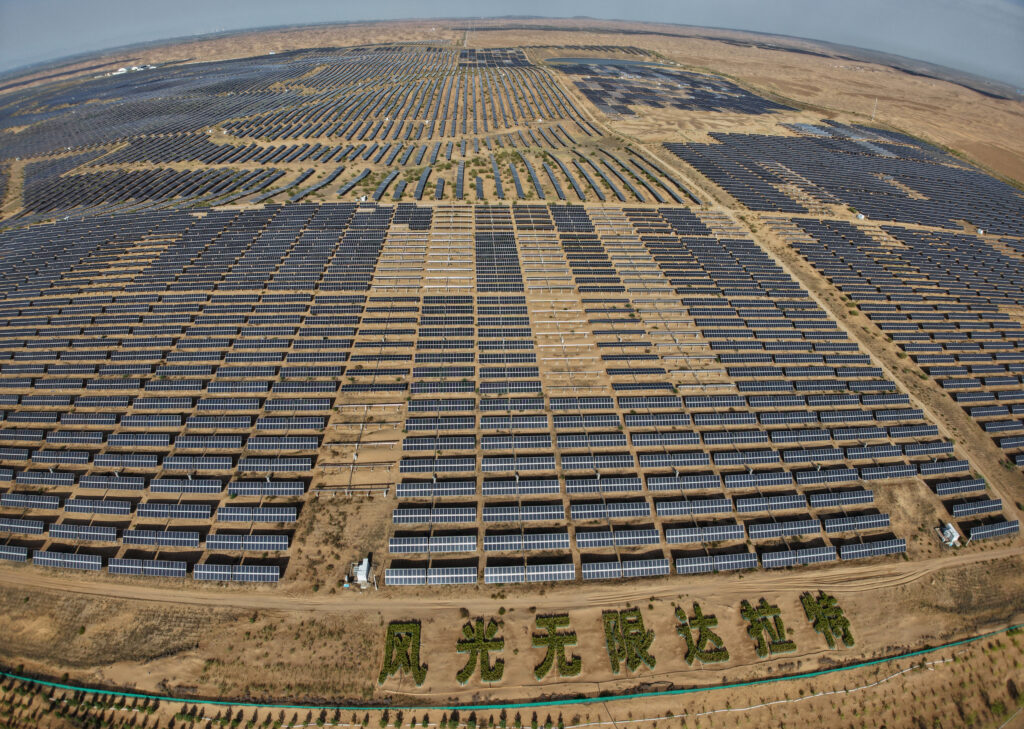
Solar panels operate at the Dalad Banner Photovoltaic Top Runner Base in northern China’s Inner Mongolia province on Friday, June 12, 2026. Ng Han Guan/AP
In September of 2025, oil giant BP acknowledged that oil demand, which it had previously forecast would peak this year, will continue climbing for the rest of the decade. So does this weaponization of energy, specifically fossil fuels, simply increase and become more intense at this point?
You know, my own bet is that you’re going to see an ongoing effort by Iran to use the Strait of Hormuz both as a source of revenue and as a weapon. So I think that certainly with respect to Hormuz, that’s not going to stop. But what I do think is that this will incentivize workarounds around Hormuz. You’re going to see investment in pipelines that bypass the strait entirely, such that countries like Saudi Arabia and the UAE may not have to sell any of their oil through the Strait of Hormuz. It’s going to cost a lot of money, but I’m pretty sure that in the next 5 to 10 years, the Strait of Hormuz is going to be less of a potent choke point. So that doesn’t mean that you’re not going to see weaponization of fossil fuels, but I do think that It’ll be a less potent weapon 5 or 10 years from now than it is today.
Parts of this interview have been lightly edited for length and clarity.

 Public Radio International
 The Politics Guys
  BBC News » Technology
 Schwartzreport
  The Sun » World News
  Surrogacy Centre Georgia
  Fractory