
Compare RingCentral pricing for RingEX, RingCX and AI Receptionist: plan costs, add-ons, hidden fees and whether it's worth it for your business. The post RingCentral Pricing 2026: Plans, Fees, Add-Ons & Whether It’s Worth It appeared first on Nextiva Blog.
RingCentral is an established name in cloud communications, known for its unified communications features and powerful RingEX platform. But for many businesses, the sticker price is just the beginning. Between strict SMS limits, expensive AI add-ons, and compliance fees, the final bill can look different from the advertised rate.
In this guide, we’ll break down the RingEX and Ring CX pricing structures, their AI Receptionist pricing plan, uncover the hidden costs, and compare it directly to their top competitor, Nextiva, to help you decide which business phone system offers the best value for your budget.
RingCentral Pricing in 60 Seconds
RingCentral’s pricing is easiest to understand when you split it into three product categories: business phone service (RingEX), contact center (RingCX), and AI receptionist.
How RingCentral Pricing Is Packaged
| Product | Starting price | Best for | Important caveat |
|---|---|---|---|
| RingEX Core | $20/user/mo annually; $30 monthly | Basic business phone service | Limited SMS/toll-free usage |
| RingEX Advanced | $25/user/mo annually; $35 monthly | Growing teams needing CRM integrations, analytics, recording | Better value than Core for many teams |
| RingEX Ultra | $35/user/mo annually; $45 monthly | Larger teams needing more analytics, storage, and toll-free minutes | Still may need add-ons |
| RingEX Customer Engagement Bundle | Contact sales | SMBs that need shared SMS + call queues without full contact center complexity | Sits between business phone service (RingEX) and full contact center (RingCX) |
| RingCX Standard | $65/user/mo annually; $75 monthly | Basic customer experiences across voice and digital channels. | Lacks AI features, so you may soon need to upgrade to Professional. |
| RingCX Professional | $95/user/mo annually; $110 monthly | Growing teams who want more control over CX, AI-powered monitoring, and agent assistance. | If you don’t use AI Quality Management or AI Agent Assist, you may be overpaying for features. |
| RingCX Elite | $145/user/mo annually; $165 monthly | Larger teams who want to equip supervisors with AI coaching, forecasting, and more. | Elite may just be an expensive upgrade with diminishing returns. |
| RingCX Enterprise | Contact sales | Support teams, sales teams, full contact center operations. | It’s the least transparent plan from a pricing standpoint. |
| AI Receptionist | Starts at $49/mo | 24/7 call answering, routing, FAQs, scheduling | Includes limited usage (100 minutes); extra minutes may add cost |
RingCentral is not just a simple three-plan phone system. Their pricing navigation treats the Business Phone and Contact Center (and AI Receptionist) as separate pricing categories:
- RingEX is the core business phone product (which now includes a new Customer Engagement Bundle for shared engagement workflows).
- RingCX is the contact center product.
- AI Receptionist is an AI front-desk tool that can be purchased as a standalone product or added to RingEX. It handles routine calls, FAQs, appointment scheduling, lead capture, texts, and routing.
Let’s go through them one by one.
RingEX: Business phone and unified communications
This is the base business phone section.
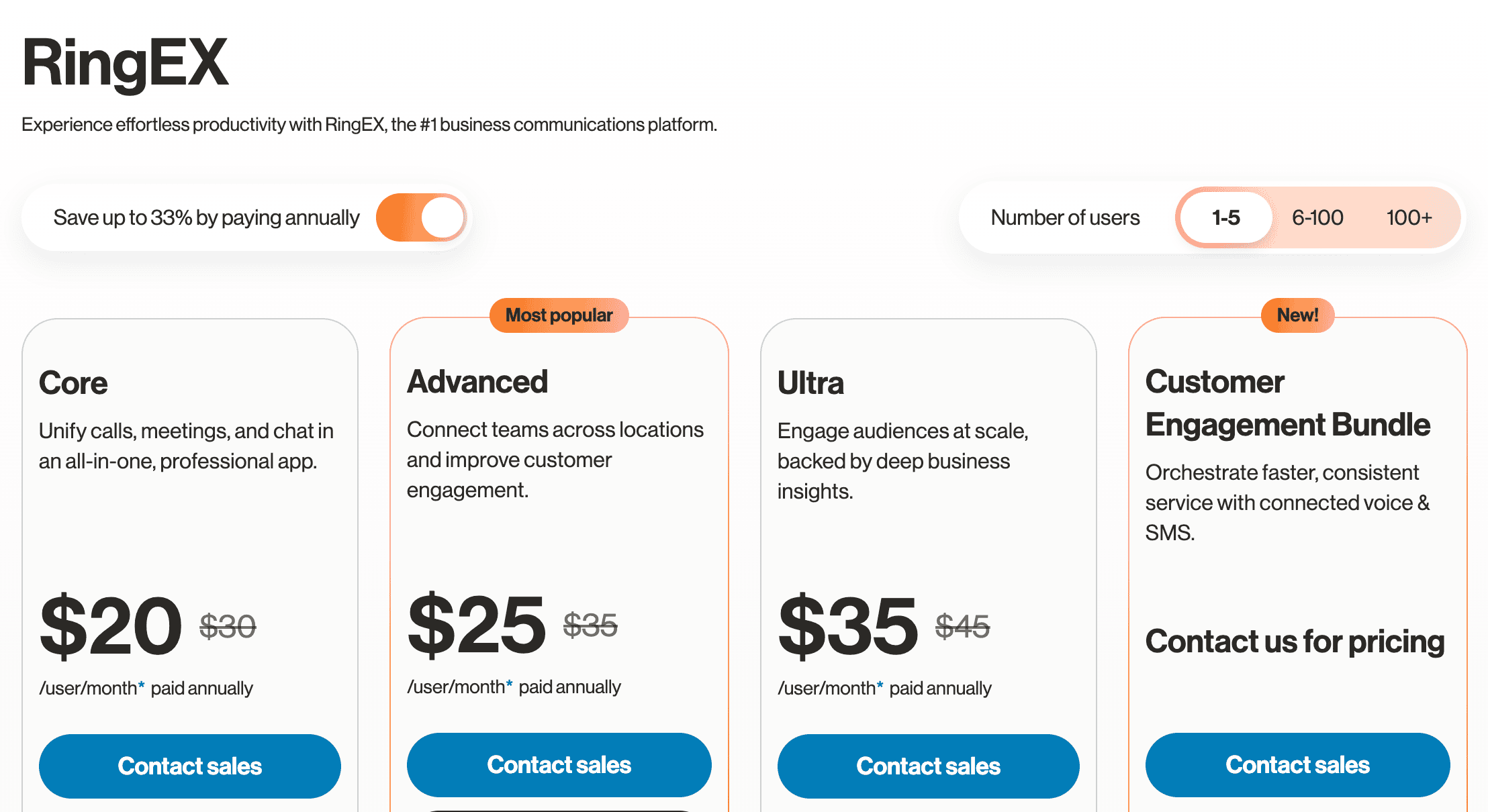
Prices below reflect annual billing. Monthly billing costs approximately 33% more.
1. Core ($30/user/mo)
RingCentral’s Core plan begins at $30/user/month if paid monthly or $20/user/month when paid annually. This plan covers the basics: unlimited domestic calling (US/Canada) and integration with Google/Microsoft.
Main features:
- Unlimited domestic phone calls in the US and Canada
- 100 toll-free minutes
- Call queues with basic rules and routing
- Voicemail to email
- AI-powered noise cancellation
- 24/7 phone support and professional implementation
- Integrations with Google and Microsoft apps
- Access to APIs
The catch: This RingEX plan is severely limited in messaging. You only get 25 SMS messages per user/month. If your team texts clients, you’ll hit overage charges almost immediately. It also lacks widely used CRM integrations like Salesforce.
2. Advanced ($35/user/mo)
Advanced is RingCentral’s most popular plan, priced $35/user/month if paid monthly or $25/user/month when paid annually. It unlocks the features most businesses actually need: automatic call recording, advanced call monitoring (whisper/barge), and critical integrations with HubSpot, Salesforce, and Zendesk.
Includes everything in Core, plus:
- Advanced call handling features and advanced call monitoring
- 1,000 toll-free minutes
- Enhanced administration and real-time analytics features
- Integrations with Salesforce, Zendesk, and other CRMs
- Video meetings for up to 100 participants
The catch: There are a few notable downsides, including the lack of device-specific analytics and limited storage for files, messages, and recordings.
3. Ultra ($45/user/mo)
RingCentral’s third tier is designed for scale. It jumps to 10,000 toll-free minutes and unlimited storage for files and recordings at $45/user/month if paid monthly or $35/user/month when paid annually. It also includes advanced device analytics, making it easier for IT teams to manage hardware.
Includes everything in Advanced, plus:
- Unlimited internet fax
- Unlimited HD video, whiteboards, and messaging
- Up to 200 video-meeting participants
- Enhanced business analytics
- Device analytics and alerts
- Customizable business insights
The catch: Ultra looks like the best value on paper, but its extras only matter for teams with heavier calling, messaging, or IT management needs. For smaller teams, the added cost may not justify the upgrade over Advanced.
4. New Customer Engagement Bundle (custom pricing)
RingCentral describes the Customer Engagement Bundle as bringing together RingEX with SMS and call queue add-ons for “lightweight contact center” use cases, and says it’s meant for organizations that need customer engagement capabilities without full contact center complexity.
RingCentral’s newest offering combines RingEX Ultra with specific “Boosters” that are usually sold separately. It is best for teams that need to handle support or sales calls but aren’t ready to pay for a full-blown Contact Center (RingCX) solution.
Key features:
- Business SMS Booster: Includes a shared SMS inbox (so the team can answer one number), reply templates, and compliance management.
- Call Queues Booster: Includes queue callbacks (so callers don’t have to hold) and wait time announcements.
The catch: The bundle is useful only if you genuinely need shared SMS and call-queue features. If you’re not sure you need those two features, it’s often better to start with RingEX and add boosters only if necessary.
Note: The AI Receptionist is a paid add-on across all plans.
RingCX: Contact center software
RingCentral offers a full Contact Center as a Service (CCaaS) platform called RingCX.
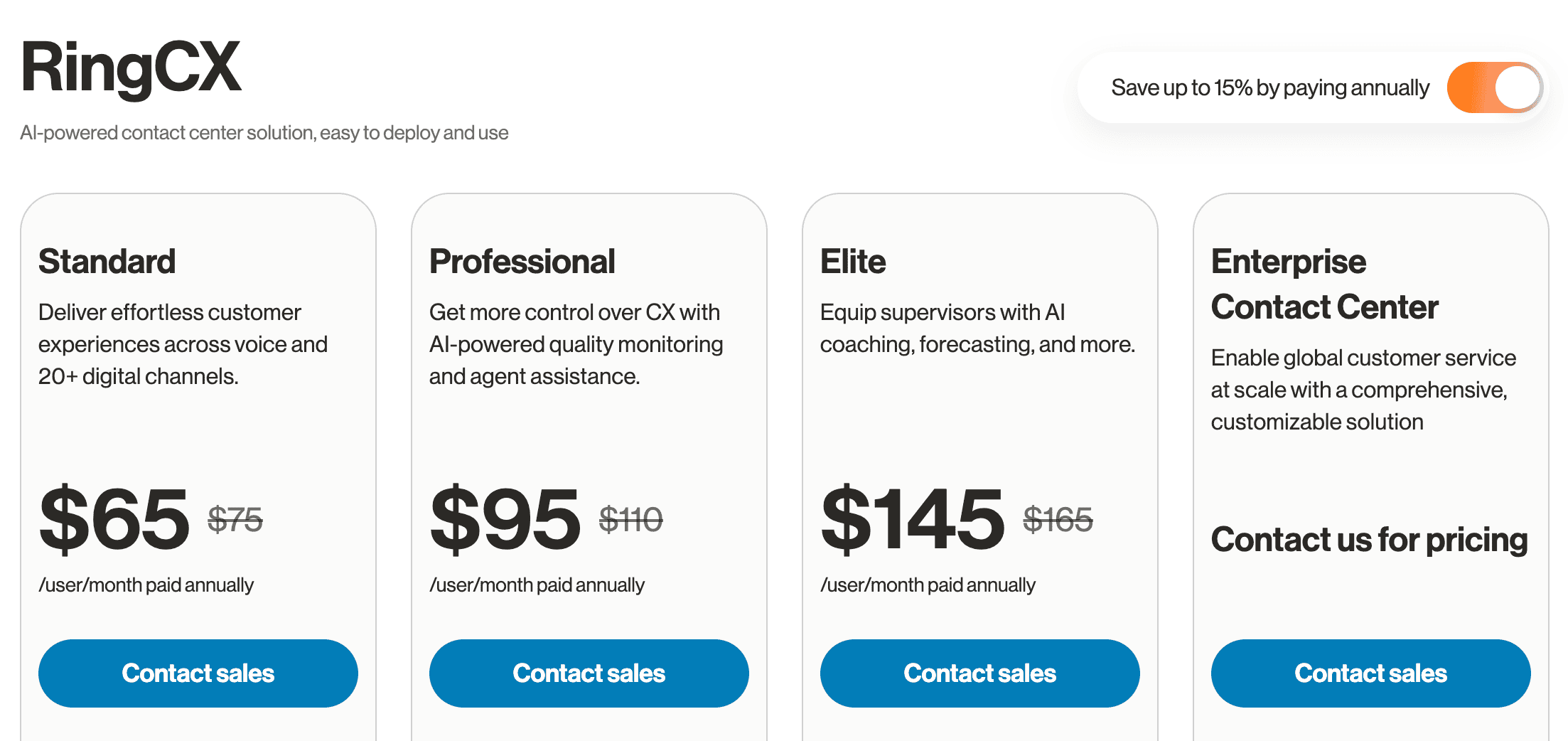
Prices below reflect annual billing. Monthly billing costs approximately 15% more.
1. Standard ($65/user/mo)
Standard is RingCX’s entry-level tier for their contact center software, priced $65/user/month if paid monthly or $75/user/month when paid annually. It allows you to provide customer experiences across voice and digital channels.
Main features:
- Voice and 20+ digital channels
- ACD, IVR, skills-based routing
- Agent screen recording
The catch: RingCX Standard is a full contact center product at a high price, but it lacks the AI features that many modern teams expect, so you may quickly need to upgrade to Professional or higher.
2. Professional ($95/user/mo)
Professional pricing is $95/user/month if paid monthly or $110/user/month when paid annually. This plan gives you better control over customer experiences with AI-powered quality monitoring and agent assistance.
Includes everything in Standard, plus:
- AI features (AI Quality Management, AI Agent Assist)
The catch: Professional is the tier most contact center teams will realistically need if they want AI, but it’s still a high per-seat price. If your team doesn’t regularly use AI Quality Management or AI Agent Assist, you may be overpaying for features you won’t fully use.
3. Elite ($145/user/mo)
Elite pricing is $145/user/month if paid monthly or $165/user/month when paid annually. With this plan, supervisors have access to AI coaching, forecasting, and more.
Includes everything in Professional, plus:
- Additional AI features (AI Supervisor Assist, AI Interaction Analytics, AI Workforce Management)
The catch: Elite only makes sense if you have a mid-to-large contact center with supervisors who actively use AI coaching, forecasting, and workforce management tools. For most teams, Professional already provides the essential AI contact center capabilities, so Elite may just be an expensive upgrade with diminishing returns.
4. Enterprise Contact Center (custom pricing)
The Enterprise plan gives you global customer service at scale with a comprehensive, customizable solution.
Key features include:
- Voice and 30+ digital channels with advanced omnichannel routing
- Feedback management
- AI features (Advanced Quality Management, Advanced Workforce Management, Advanced Interaction Analytics)
The catch: This plan is designed for large, complex customer service operations, so pricing is quote-based and may vary significantly depending on agents, channels, AI features, integrations, implementation, and support requirements.
Note: The AI Receptionist is still a paid add-on across all plans.

AI Receptionist: AI call answering and routing
The AI Receptionist is neither a basic phone feature nor the same thing as contact center software. It has its own pricing category, although you can bundle it with RingEX.
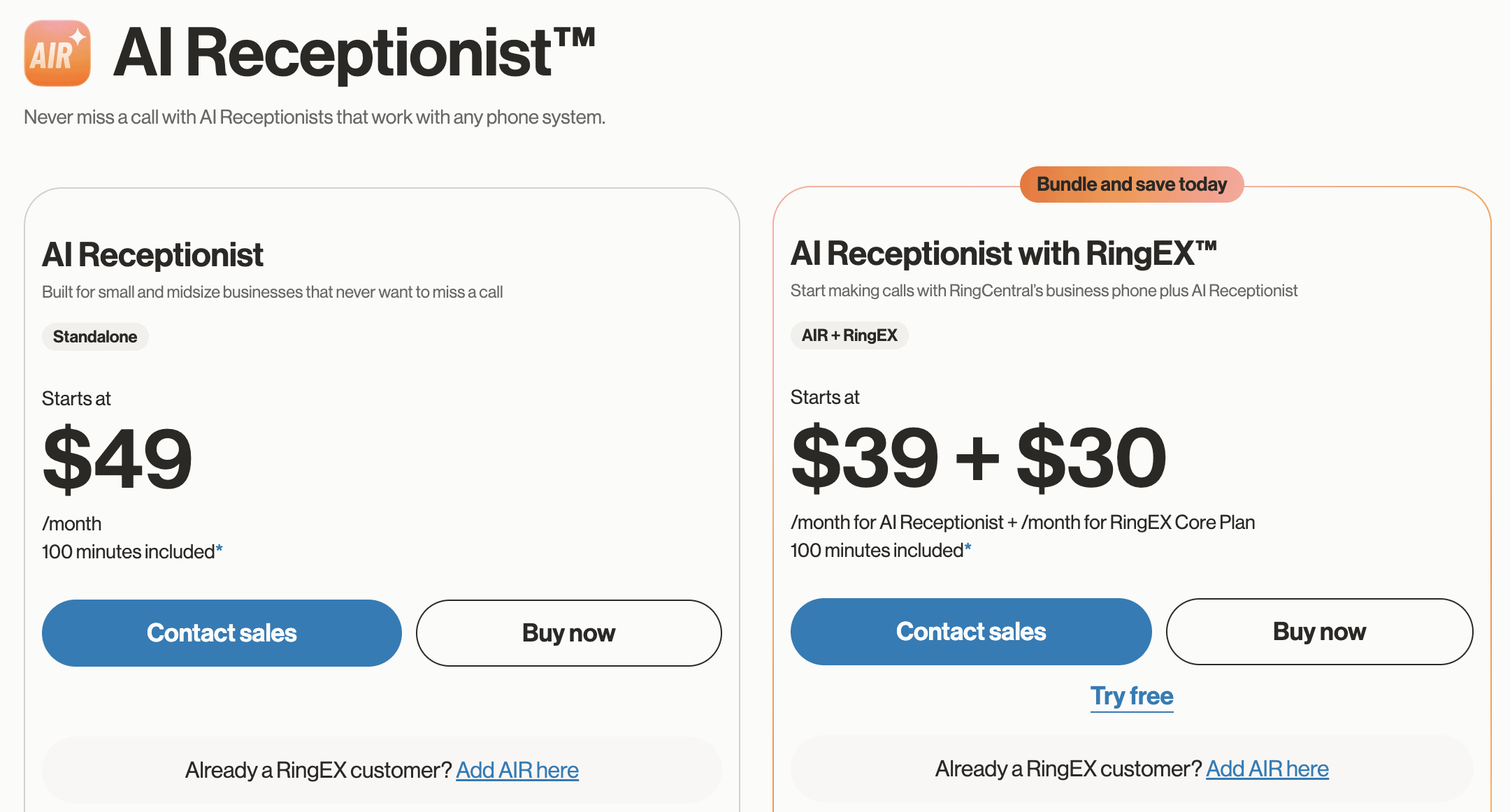
1. AI Receptionist ($49/mo)
This standalone package is built for small and midsize businesses that never want to miss a call.
Key features include:
- 24/7 call handling with intelligent routing
- Appointment scheduling, lead capture, SMS follow-ups
- Launch unlimited AI Receptionists
- Multilingual conversational support
- Deep analytics & call transcripts
- Dedicated new phone number
- Call queue integration
- HIPAA & SOC2 compliant
The catch: Although 100 minutes included, the small print says “Pay-as-you-go charges of $0.50 per minute apply if usage exceeds the total included minutes. Additional minute bundles are available for purchase. Call time is rounded up and billed in 30-second increments.”
2. AI Receptionist with RingEX ($69/mo)
If you bundle the AI Receptionist with RingEX Core, the total starting cost is $69/month ($39 for AI Receptionist plus $30 for RingEX Core).
Includes everything in AI Receptionist, plus the full value of RingEX phone, such as:
- AI phone and video meetings
- Unlimited domestic calling
- Business SMS/MMS
- Google, Microsoft integrations
- Basic call queues
- On-demand call recording
- Toll-free minutes
The catch: Like the AI Receptionist on its own, 100 minutes are included, but the small print says “Pay-as-you-go charges of $0.50 per minute apply if usage exceeds the total included minutes. Additional minute bundles are available for purchase. Call time is rounded up and billed in 30-second increments.”

How RingCentral’s Pricing Works for Small Businesses vs. Enterprises
RingCentral’s value proposition varies significantly depending on company size. Here’s what small businesses actually gain from purchasing RingCentral compared to large corporations.
For small businesses (<20 users)
- You pay the sticker price: Don’t expect negotiation leverage. You’ll likely pay the advertised $20-$35/user rates.
- The monthly flexibility: Small businesses often want flexibility, but paying monthly triggers an approx 33% price hike (e.g., Core jumps from $20 to $30).
- The feature gap: You’ll need to buy the Advanced plan ($25) to get features like call recording or HubSpot integration, even if you don’t need the other features.
For enterprise customers (100+ users)
- Volume discounts: Once you cross 50-100 seats, you can negotiate. Discounts of 10-20% off the list price are common for multi-year contracts.
- Security gating: Critical security features like Single Sign-On (SSO) are locked behind the Ultra tier or custom Enterprise contracts.
- Dedicated support: Enterprise plans include a Technical Account Manager (TAM) and professional implementation, whereas small businesses are funneled to general support queues.
What RingCentral Excludes by Plan
While each RingCentral RingEX plan includes business phone, messaging, and collaboration features, some capabilities are only available on higher tiers or as add-ons.
The Core plan includes basic analytics, such as call logs and real-time quality-of-service analytics, but it does not include more advanced reporting features like adoption analytics, Business Analytics Essentials, customer-defined locations, or report subscriptions. Core also only includes on-demand call recording, while Advanced and Ultra support both automatic and on-demand call recording.
Core and Advanced both include team messaging and file sharing, so it would be misleading to say those features are excluded. However, unlimited storage for files, messaging, and recordings is only included with Ultra. That makes Ultra a better fit for teams that need more robust analytics, storage, and administrative visibility.
The Advanced plan adds Business Analytics Essentials, adoption analytics, customer-defined locations, and report subscriptions, but its analytics package is still less comprehensive than Ultra’s.
Ultra includes Business Analytics Pro, along with additional analytics tools such as Rooms analytics and device analytics/alerts.
Note: You can find all feature exclusions in the RingCentral Business Communications Comparison Matrix
RingCX includes many core contact center capabilities in one package, but businesses should still confirm which advanced AI, workforce engagement, routing, reporting, integration, and implementation features are included in their quoted price.
RingCentral Add-On Services Pricing
While it’s convenient to add these features to any plan, it can quickly push you over budget if you’re not mindful. With add-ons, you need to make sure you have a process for license and seat management so you’re not overpaying for users who don’t need these features.
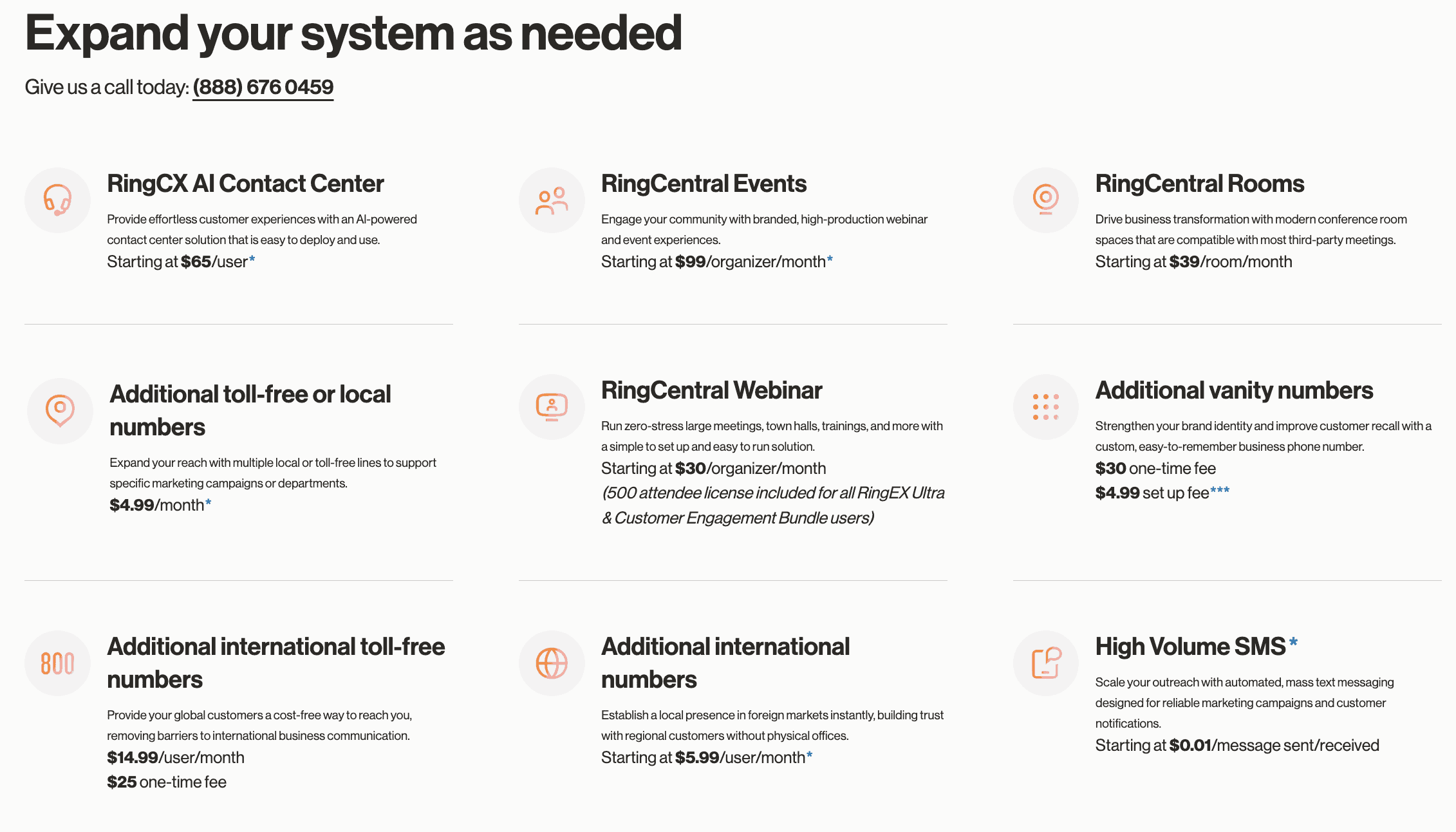
Some of the most popular add-ons RingCentral offers include:
- RingCentral Webinar for hosting online presentations and seminars, starting at $30/host/month(500 attendee license included for all RingEX Ultra & Customer Engagement Bundle users)
- Additional vanity phone numbers for a one-time fee of $30/number + $4.99 set-up fee
- Additional international numbers, starting at $5.99/user/month
- RingCentral Rooms licenses, available at $39/room/month
- Push-to-talk license for $5/user/month
- High-volume SMS for organizations sending a large number of messages, starting at $0.01 per message sent or received
When budgeting for RingCentral, be sure to look beyond the per-user license.
The AI premium
RingCentral does offer AI features, but unlike competitors that include AI in their upper tiers, RingCentral charges separately for it.
- AI Receptionist: Automated front-desk handling is another paid add-on, starting around $49/mo.
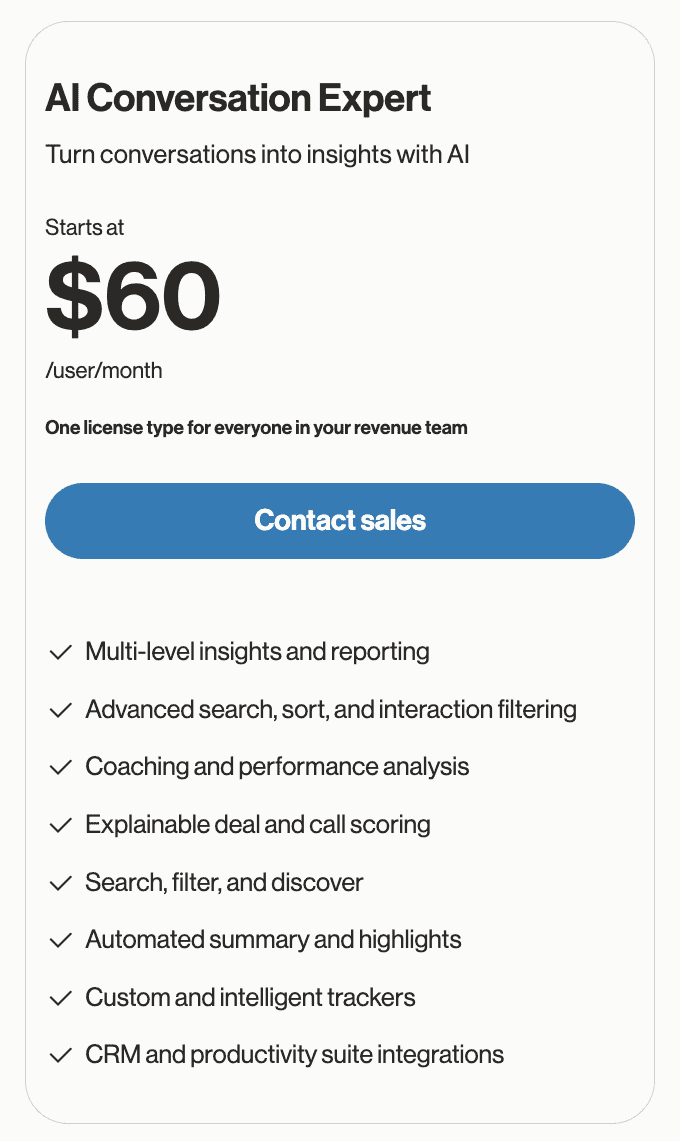
- AI Conversation Expert (ACE) (formerly RingSense): Conversation intelligence product for AI-powered call analysis, transcription, and coaching insights cost an additional $60/user/month.
SMS & toll-free overages
This is the most common complaint with RingCentral’s pricing plans.
- SMS limits: Even on the Ultra plan, you are capped at 200 texts per user. Additional SMS bundles must be purchased, or you pay per message (rates vary by type and volume).
- Toll-free: If you exceed your pooled minutes (e.g., the 100 minutes in Core), you’re charged per minute. RingCentral says toll-free minutes are per account regardless of number of lines.
Given the price of the Ultra plan, you might assume that it includes everything RingCentral has to offer, but that’s not actually the case. RingCentral has options that are available as add-on features to any plan, albeit at a higher price.
Compliance & E911 fees
Expect a “Compliance and Administrative Cost Recovery Fee” and E911 service fees on your invoice. These are standard in telecom but rarely mentioned in sales quotes.
- Charges apply for calls to 411 Directory Assistance ($1/call), which will be taken from your additional usage credits.
- Calls made to your toll-free number from payphones will incur a surcharge of $0.99/call, plus regular account per-minute charges still apply.
- A $0.99 per seat E911 Recovery Fee, in addition to the general recovery fee, will be charged to offset its costs of compliance with the FCC’s 911 requirements.
- You’ll also be charged an early termination fee (ETF) for ending annual or multi-year contracts prematurely, as outlined in your service agreement, and you will not be entitled to any refunds of prepaid charges
Clarify before buying: Always ask the sales team for a full breakdown of all potential charges, including surcharges, add-ons, overages, and contract exit terms, to understand the true total cost.
RingCentral Pricing Pros & Cons
When it comes to the crucial question “how much is RingCentral going to cost me?” things get a little less clear.
RingCentral business phone plans do have publicly listed pricing for up to 100 users, but for more advanced needs or larger implementations, businesses need a custom quote from their sales. What this means for you, as a potential customer, is that you can’t just browse online, compare features against costs, and quickly decide if a particular package fits your budget and needs.
Pros:
- Scalability: Good for enterprise-level global needs.
- Video quality: Strong HD video features are included in most plans.
- RingCX entry: The $75 RingCX Standard plan (monthly billing; $65 with an annual contract) is a competitive entry point for contact centers.
- Free trial: RingEX offers a 14-day free trial for up to 20 phone lines.
Cons:
- Lack of transparency: Most advanced configurations require a sales call and a custom quote.
- Add-on fatigue: Features like Webinars, Rooms, and AI Receptionist are all separate line items.
- Sales process: You often enter a sales engagement before you can fully evaluate the budget.
- No free trial: RingCX does not offer a free trial for its contact center (some online sources say that it does, but there is no mention of it on its pricing page).
RingCentral Customer Reviews on Pricing Value
Looking at user feedback and analytics can offer some context. User feedback on reputable review sites like G2.com indicates that while the product itself is generally well-received, pricing transparency and contract flexibility are a concern for some.
General score vs. pricing score
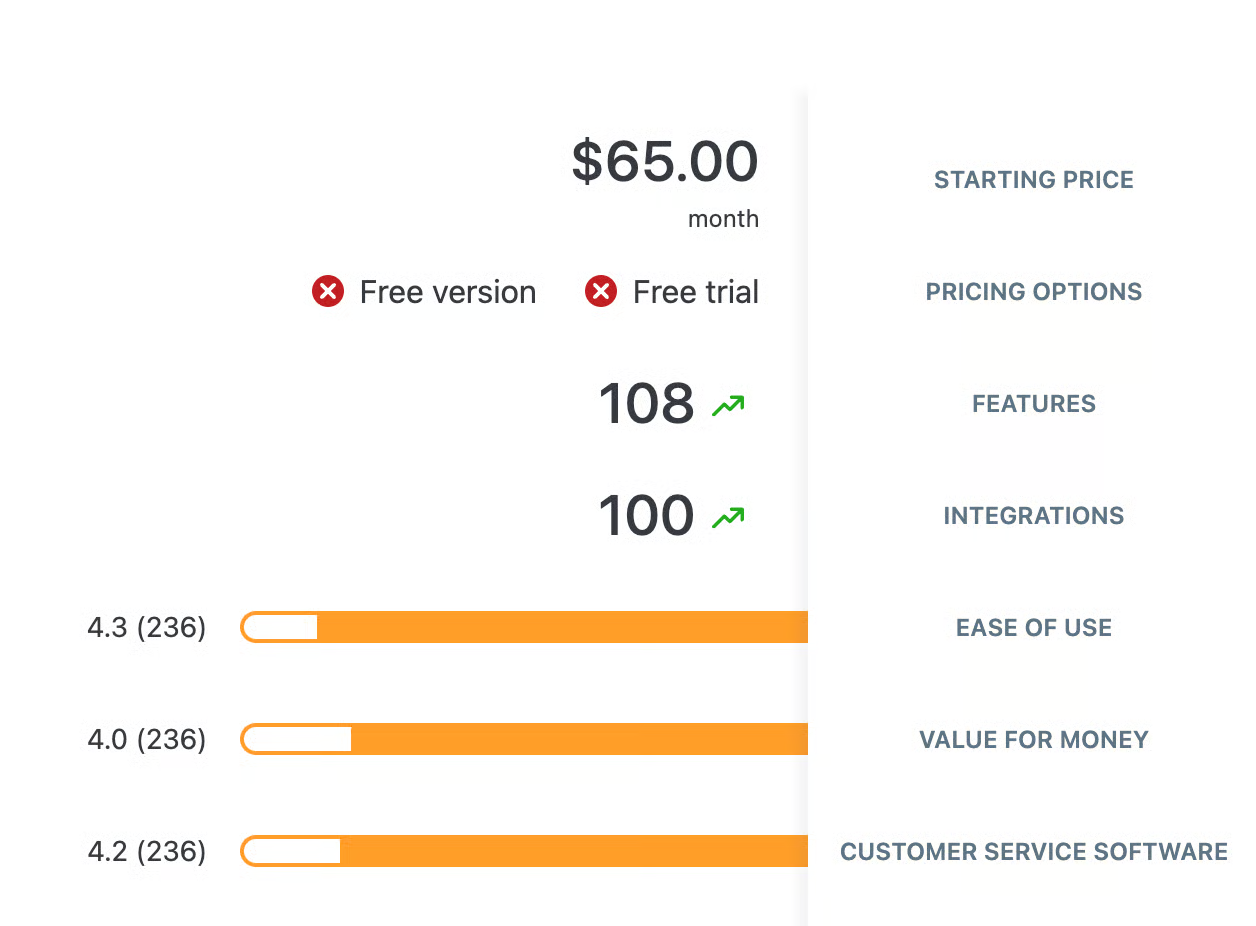
RingCX has an overall rating of 4.3/5 from 3,075 reviews on G2. RingEX has 4.2/5 (from 1,371 reviews) and RingCX has 4.5/5 (from 46 reviews).
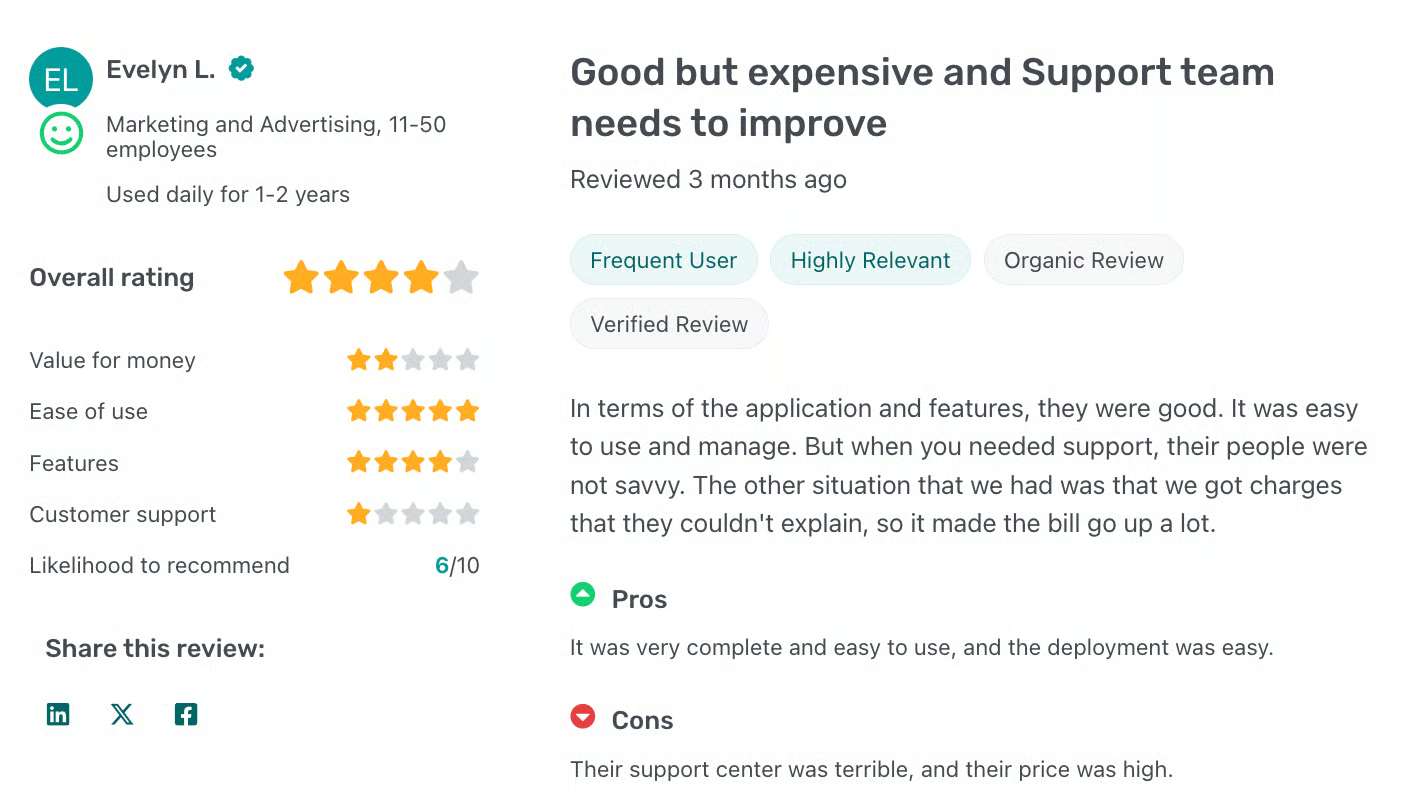
However, aggregated reviews have shown that ratings for pricing tend to be lower due to a lack of pricing transparency and annual discounts.
One user noted:
“I had to call and have my plan updated because my current plan was no longer offered, it was outdated. I felt like someone should have let me know I was over paying for over 9 months.”
Via G2
Another reviewer noted:
“Ringcentral is quite pricey. There are limited phones as well and support is quite hard to reach and can be difficult addressing and resolving an issue.”
Via Capterra
Several similar reviews highlight that RingCentral’s contact center plans may not offer value for money, aside from the added complexity of the lack of contract flexibility and high costs, especially when business needs change (e.g., downsizing).
RingCentral vs. Nextiva Plans Compared
| Category | RingCentral | Nextiva | Better fit |
|---|---|---|---|
| Entry-level business phone | RingEX Core | Core | Nextiva for lower starting price, RingCentral for broader ecosystem |
| Mid-tier business phone | RingEX Advanced | Engage | Depends on feature needs and texting/analytics priorities |
| Higher-tier business phone | RingEX Ultra | Scale | Depends on included features and usage limits |
| Contact center | RingCX (4 tiers) | Enterprise contact center (3 tiers) | Depends on support complexity and sales-led requirements |
| AI receptionist / AI layer | AI Receptionist | XBert AI | Depends on minutes, routing needs, and bundle value |
Now that we understand what RingCentral’s plans provide, it’s time to explore some alternatives and glean how much value RingCentral provides compared to its competitors. We’ll take a look at Nextiva’s business plans — RingCentral’s top competitor — to see how they compare on value.
Watch the video comparison:
Top Features Compared
RingCentral
The most important features of RingCentral’s communication solution include:
- Unlimited enterprise-grade HD video: RingCentral’s unlimited HD conferencing capabilities are a good fit for larger businesses that need video conferencing, as they enable high-quality communication and collaboration across enterprises and organizations with remote locations.
- Advanced call management: RingCentral offers call management features such as call routing, call monitoring, call whisper, and call barge as part of RingCentral Contact Center, providing organizations with sophisticated tools for handling customer service and internal communications.
- Integration capabilities: RingCentral’s UCaaS platform can integrate with a wide array of applications, including Salesforce, Zendesk, and several other apps and platforms. This allows businesses to connect their VoIP phone systems with their CRM and other business tools.
- Analytics and insights: RingCentral provides comprehensive analytics and reporting tools, which businesses can use to gain insights into their communications, manage training and compliance, and make data-driven decisions.
- Customizability and API access: Businesses in need of a tailored solution can access RingCentral’s developer platform and APIs to create custom integrations and workflows.
Nextiva
Nextiva’s top features are quite impressive, with an array of tools to improve business communications and the customer experience. These include:
- Voice analytics: Nextiva’s Premium plan includes voice analytics, providing businesses with deeper insights into their call data. This helps create new strategies to optimize customer interactions as well as improve internal communications.
- Unlimited participants in video conferences: The ability to allow unlimited participants is vital for companies that conduct large-scale meetings, webinars, or training sessions.
- Call recording: Nextiva offers call recording, an important tool for organizations of all sizes. Recordings can be used for quality assurance, compliance, training, and dispute resolution, making them vital for contact centers, sales teams, and more.
- CRM integrations: Nextiva’s integrations with major CRM systems, such as Salesforce, let employees easily create call logs and access customer information. This is essential for organizations that rely on CRM data for their sales, marketing, and customer service.
- Unlimited SMS and conference calling: For businesses with large workforces, unlimited SMS and conference calling can ensure that communications remain uninterrupted, no matter how many conferences or text messages they require.
Business phone plans compared
Now let’s go through and compare plan by plan (in the three main categories: business phone, contact center, AI receptionist). Prices stated are on an annual contract.
The Basic Plan (Core vs. Core)
- RingCentral Core ($20/user/mo): Strict limits, 25 SMS texts, 100 toll-free minutes, no video recording.
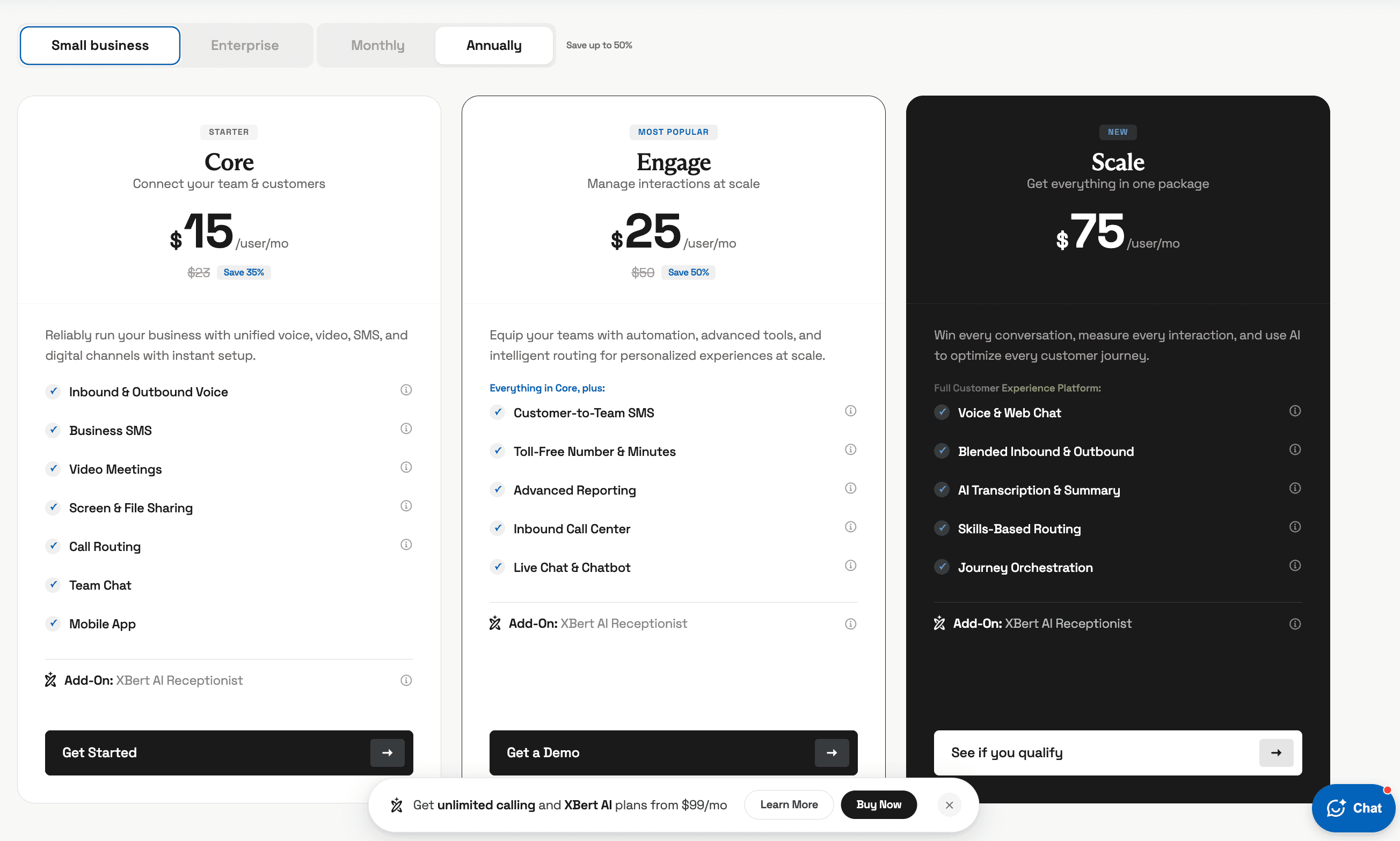
- Nextiva Core ($15/user/mo): Includes inbound/outbound calling, business SMS, video meetings, call routing, team chat, no toll-free minutes.
Winner: Nextiva. For small businesses, the SMS limit on RingCentral Core is a dealbreaker. Although toll-free minutes are only included starting at the next tier, Nextiva provides more utility overall for a lower entry price.
The Growth Plan (Advanced vs. Engage)
- RingCentral Advanced ($25/user/mo): Adds CRM integrations, core reporting and insights, and increases toll-free minutes (1,000) and SMS texts (100).
- Nextiva Engage ($25/user/mo): Adds a toll-free number, advanced reporting, inbound Call Center, live chat & chatbot, and customer-to-team SMS messaging.
Winner: Tie. Choose RingCentral if you need a specific niche integration (e.g., Canvas, Smarsh). Choose Nextiva if you want to engage customers via SMS and Web Chat without buying separate software.
The Scale Plans (Ultra vs. Scale)
- RingCentral Ultra ($35/user/mo): Adds RingCentral Webinar, historical and real-time insights, unlimited storage (excludes video recording and storage retention period applies), device analytics & alerts, and increases toll-free minutes (10,000) and SMS texts (200).
- Nextiva Scale ($75/user/mo): Full Customer Experience Platform. Adds voice & web chat, blended inbound & outbound, AI transcription & summary, skills-based routing, journey orchestration.
Winner: Nextiva. If your budget is the main priority, choose RingCentral. But if you want to get everything in one package that makes it easy to scale and provide quality CX, choose Nextiva.
Contact Center Software
The Entry-Level Contact Center Plan (Standard vs. Essential)
- RingCX Standard ($65/user/mo): Includes voice, 20+ digital channels, IVR, skills-based routing, analytics, and AI assistance.
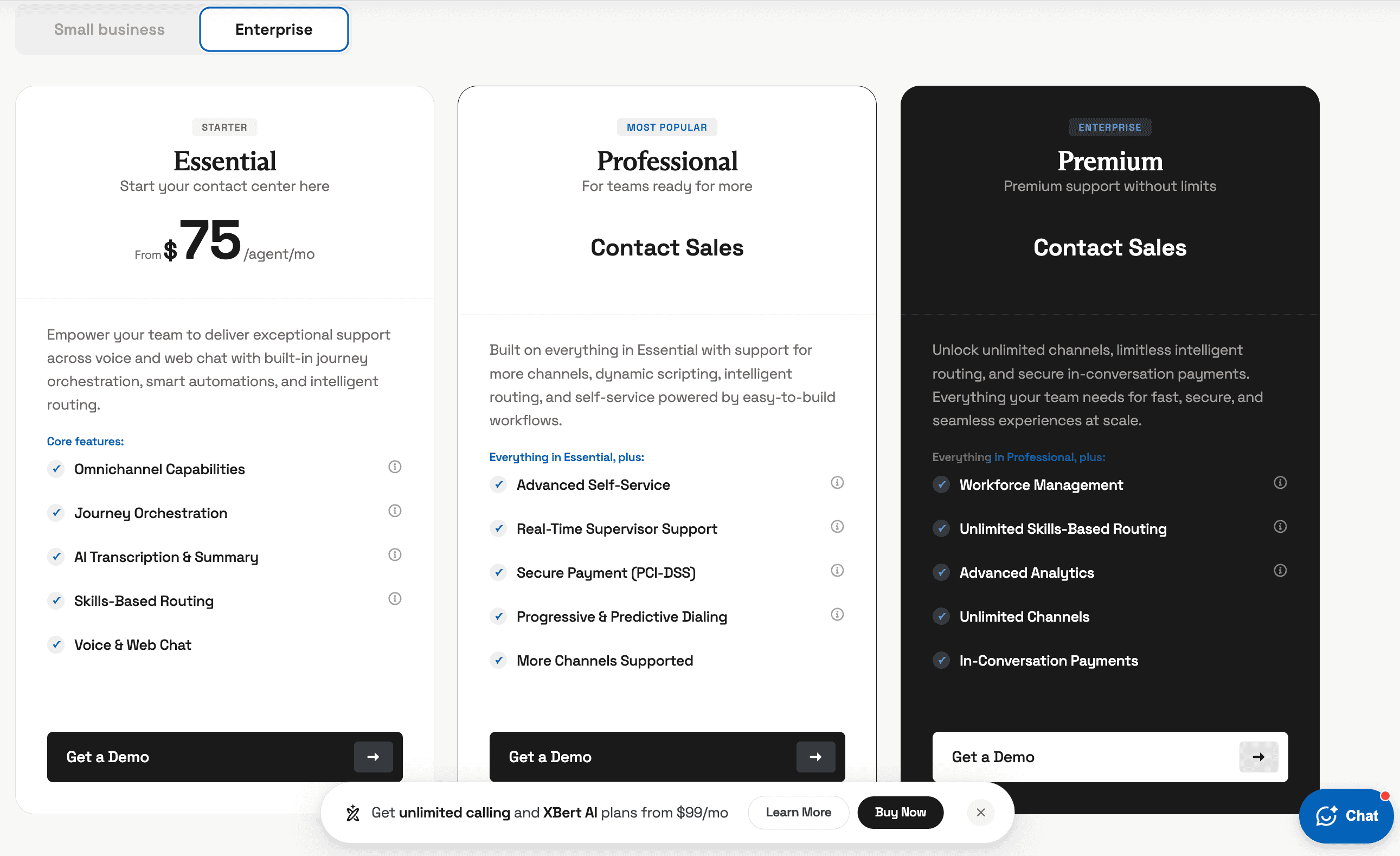
- Nextiva Essential ($75/agent/mo): Includes voice and digital channels, omnichannel routing, call recording, analytics, supervisor tools, and AI transcription in the base price.
Winner: Nextiva. RingCentral’s $65 RingCX Standard plan looks cheaper at first glance, but Nextiva includes more practical contact center functionality in its entry-level plan. The biggest difference is AI transcription: Nextiva includes it, while RingCentral may require a separate RingSense add-on.
The Mid-Tier Contact Center Plan (Professional vs. Professional)
- RingCX Professional ($95/user/mo): Adds AI Quality Management and AI Agent Assist.
- Nextiva Professional (custom pricing): Supports more channels, adds dynamic scripting, intelligent routing, and self-service powered by easy-to-build workflows. Pricing requires contacting sales, so the final cost depends on the team’s needs and configuration.
Winner: Tie. RingCentral has the advantage of showing a clear starting price for this tier. But Nextiva may be the stronger fit for teams that want more advanced features and a more flexible quote based on their actual needs.
The Enterprise Contact Center Plan (Enterprise vs. Premium)
Note: RingCentral has four tiers to Nextiva’s three, so we’ll be comparing the highest-level of each one here. That means RingCX Elite ($145/user/mo) isn’t being compared.
- RingCX Enterprise (custom pricing): Built for global customer service teams that need a comprehensive, customizable contact center solution. Adds advanced AI capabilities such as autopilot, proactive AI agents, workflow automation, AI routing, copilot for agents and supervisors.
- Nextiva Premium (custom pricing): Built for businesses that need advanced contact center capabilities, AI-powered customer experience tools, omnichannel support, integrations, and scalable service operations. Adds unlimited channels, limitless intelligent routing, workforce management, advanced analytics, and secure in-conversation payments.
Winner: Depends on complexity, but Nextiva is likely the better value for many teams. RingCentral Enterprise may be the stronger fit for very large, complex, global contact center operations that need extensive customization. But because pricing is custom, the true cost depends on channels, agents, AI tools, integrations, implementation, and contract terms. For many growing businesses and mid-market teams, Nextiva may offer a more practical path to advanced contact center functionality without the same level of enterprise complexity.
AI Receptionist (AIR vs. XBert)
- RingCentral AI Receptionist (AIR) ($49/mo standalone or $39/mo for RingEX customers): Includes 100 minutes, then additional usage charges apply. AIR answers calls, routes callers, schedules appointments, captures leads, sends SMS follow-ups, and can work with any business phone system.
- Nextiva XBert AI Receptionist ($99/mo): Includes 100 interactions across calls, texts, or chats, then $0.99 per additional interaction. XBert AI answers calls 24/7, handles AI text messaging and live chat, books appointments, qualifies leads, integrates with calendars and CRMs, and provides transcripts, analytics, and smart handoffs.
Winner: Nextiva. RingCentral has the lower starting price, especially for existing RingEX customers. But Nextiva’s pricing is easier to understand because it’s based on interactions across calls, texts, and chats rather than call minutes. Overall, XBert offers a broader AI front-desk experience with clearer value.
Notable exclusions per Nextiva plan
Nextiva’s plans are packaged based on common business scenarios and use cases. Some features are saved for higher tiers, so customers looking for specific features might want to consider upgrading.
The Core plan doesn’t include CRM integrations (although it does integrate with Outlook and Google Contacts). It also doesn’t offer toll-free minutes.
The Engage plan doesn’t include omnichannel engagement, which is reserved for the Essential contact center plan.
Which Provider Is Right for Your Business?
Now that it’s clear what RingCentral and Nextiva have to offer, we can weigh the pros and cons for each to see what they bring to businesses.
RingCentral
RingCentral provides a good selection of features for businesses looking for:
- Advanced features and integrations: RingCentral has an extensive list of integrations, including over 300 apps, which can be beneficial for businesses that need a wider range of integrations with other software and services.
- International presence: RingCentral has a broad scope of international calling and office locations, which larger enterprises with a global footprint might find preferable.
- High-volume communications: RingCentral’s plans offer a high number of toll-free minutes and call-handling features, which are useful for businesses with high call volumes.
- Comprehensive analytics: RingCentral’s advanced analytics capabilities can provide valuable insights into communications performance and customer interactions.
Nextiva
Nextiva is an excellent choice for organizations that want:
- Cost-effectiveness: Nextiva’s competitive pricing (particularly for the entry-level Core plan) provides a budget-friendly option for businesses keeping an eye on their bottom line.
- Simplicity and user-friendly service: Nextiva’s Core plan offers a straightforward feature set, including unlimited calling, faxing, and voicemail to email, which is great for businesses looking for ease of use.
- Scalability: Nextiva offers a scalable cloud-based communications platform, so businesses can move to new plans with more advanced features (such as CRM integrations and voice analytics) as they grow.
- Reliability and customer support: With 24/7 customer support and a reputation for high reliability and quality of service, Nextiva customers can rest assured that they don’t have to w

.jpg)