Medical experts urge men to embrace early health screening is trending nowDR Congo Ebola Outbreak May Have Circulated for Months Undetected is trending nowFrequent bending at work may raise miscarriage risk —Study is trending nowNigeria trains 80 health workers to expand HIV prevention services is trending nowScientists simulate cosmic crashes to test whether icy moons gain or lose their ability t… is trending nowScientists find that “perfect” systems may be surprisingly fragile is trending nowThis tiny organism can shrink to one quarter its size in milliseconds is trending nowAfrica and the new (infrastructure) race to the Moon is trending nowUnai Emery makes bold prediction for Tottenham's season after slow start is trending nowSaturday's La Liga predictions including Sevilla vs. Barcelona is trending nowHISTORY MAKER! Harry Kane smashes Bundesliga record to become fastest-ever player to 100 … is trending now"Why I hid her face": Aisha Lawal opens up on daughter’s birth story is trending nowMedical experts urge men to embrace early health screening is trending nowDR Congo Ebola Outbreak May Have Circulated for Months Undetected is trending nowFrequent bending at work may raise miscarriage risk —Study is trending nowNigeria trains 80 health workers to expand HIV prevention services is trending nowScientists simulate cosmic crashes to test whether icy moons gain or lose their ability t… is trending nowScientists find that “perfect” systems may be surprisingly fragile is trending nowThis tiny organism can shrink to one quarter its size in milliseconds is trending nowAfrica and the new (infrastructure) race to the Moon is trending nowUnai Emery makes bold prediction for Tottenham's season after slow start is trending nowSaturday's La Liga predictions including Sevilla vs. Barcelona is trending nowHISTORY MAKER! Harry Kane smashes Bundesliga record to become fastest-ever player to 100 … is trending now"Why I hid her face": Aisha Lawal opens up on daughter’s birth story is trending now
World
German police arrest suspect in case of apparent climate extremism
P
Public Radio International ··42 views
Police in Germany apprehended a man last week suspected of planning and carrying out sabotage against the country’s electricity network. Authorities say the 48-year-old suspect’s apparent motive was to draw attention to fossil fuels and the climate crisis. The case is raising questions about a form of politically motivated violence that some are calling “climate terrorism” or “climate extremism.” The World’s Marco Werman learned more from Hans-Jakob Schindler, senior director at The Counter Extremism Project.
The post German police arrest suspect in case of apparent climate extremism appeared first on The World from PRX.
Last week in Germany, police arrested a man suspected of trying to sabotage the country’s electrical system. Authorities say the 48-year-old, identified only as Daniel V., was carrying explosives when he was caught, and they confirmed that they found more than 40 hidden explosive devices.
Such cases are not uncommon in Germany.
The country’s already dealing with threats ranging from Russian hybrid warfare to far-right extremism. But officials say this suspect’s motive was different: he was trying to draw attention to the use of fossil fuels and climate change.
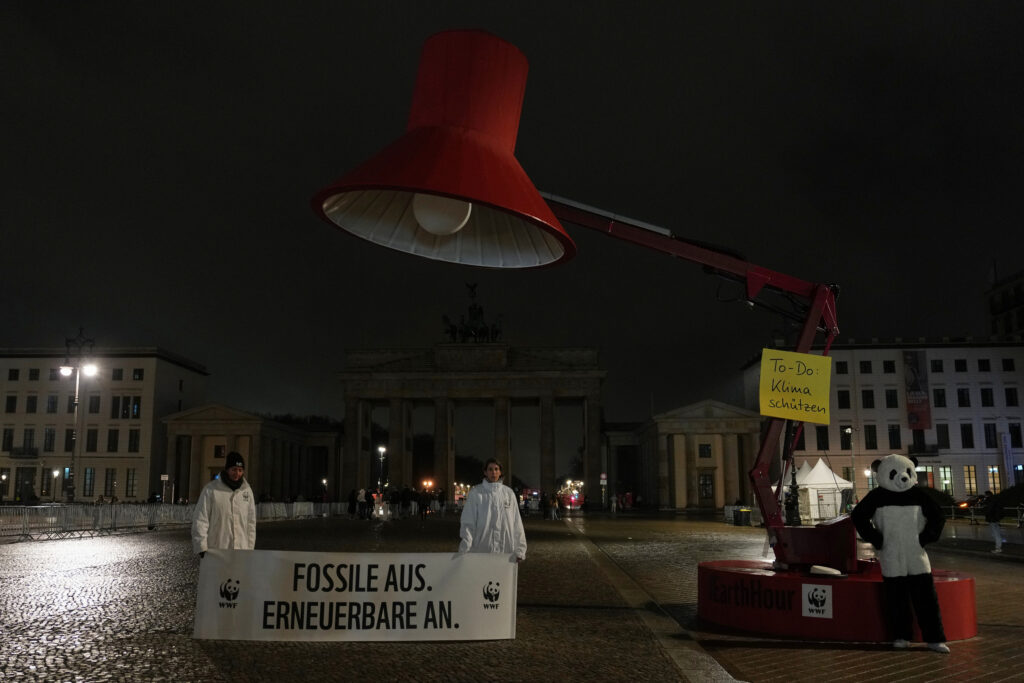
With a giant table lamp and a poster reading in German “Turn off fossil fuels. Turn on renewables”, activists of the environment organization World Wildlife Fund, WWF, demonstrate in front of the Brandenburg Gate during Earth Hour 2026, an initiative where lights are switched off in symbolic support for the environment, in Berlin, Germany, Saturday, March 28, 2026. Markus Schreiber/AP/File
It’s all raised questions about an increasing type of political violence that some are calling climate terrorism or climate extremism. To learn more, The World’s Host Marco Werman spoke with Hans-Jacob Schindler, a senior director at the Counter Extremism Project.
“We started with the evidence against the suspect released so far: He had already sent some letters acknowledging his being behind these attacks, claiming that he wanted to bring down the electricity grid because producing electricity through fossil fuel would be a crime. So he’s now in custody. But this is really one of the largest series of these kinds of left-wing climate change sabotage attacks that I have seen in a long time. There were three successful attacks and at least another 21 in planning where explosive devices near power stations or grid lines had been found.”
Yeah, so this kind of plot to sabotage power and energy infrastructure is pretty unusual?
Not totally unusual. At the beginning of this year, in January, a left-wing extremist group called the Vulkangruppe, the Vulcan Group, brought down the electricity in parts of the capital of Germany, Berlin, in the middle of January, under sub-zero temperatures. They also claim to act against or raise awareness of the impending climate crisis.
So, do we have a sense of the political leanings or intent of this 48-year-old suspect? Like, what did authorities find in these letters that they were pointing to?
Yeah, I mean, the investigation is really in its early days, but from the letters and from the attack patterns, as well as from the attack targets, he seems to belong to the broader left-wing extremist milieu here in Germany. And there is this sub-milieu, which, of course, concentrates on climate change and organizes sabotage/terror attacks against critical infrastructure related to anything to do with climate. So there was a Tesla factory attack, there was a power station attack, there was an electricity grid attack in the last couple of years. So it’s not totally unusual. What makes this unusual really is the scale of this whole thing. More than two dozen attacks and planned attacks are fairly unprecedented, especially if, as it seems until now, the individual acted alone.
Yeah, and initially this was thought to have been a Russian hybrid attack, is that correct?
Well, yeah, of course. At a point in German history, we see a very noticeable increase in aggression from Russian hybrid operations. We had just the Russian Foreign Minister [Sergey] Lavrov saying that the reaction to the latest sabotage attack by Russia against Leipzig Airport and Antonov Airlines at Leipzig Airport was the beginning of a real war with Germany. So very harsh, very direct words from the Russian side. So obviously, with any other disruption and sabotage, the first assumption, of course, could be: could this again be Russia? Because, for all intents and purposes, Russia has now officially announced, via the foreign minister, that it is going to be more aggressive.
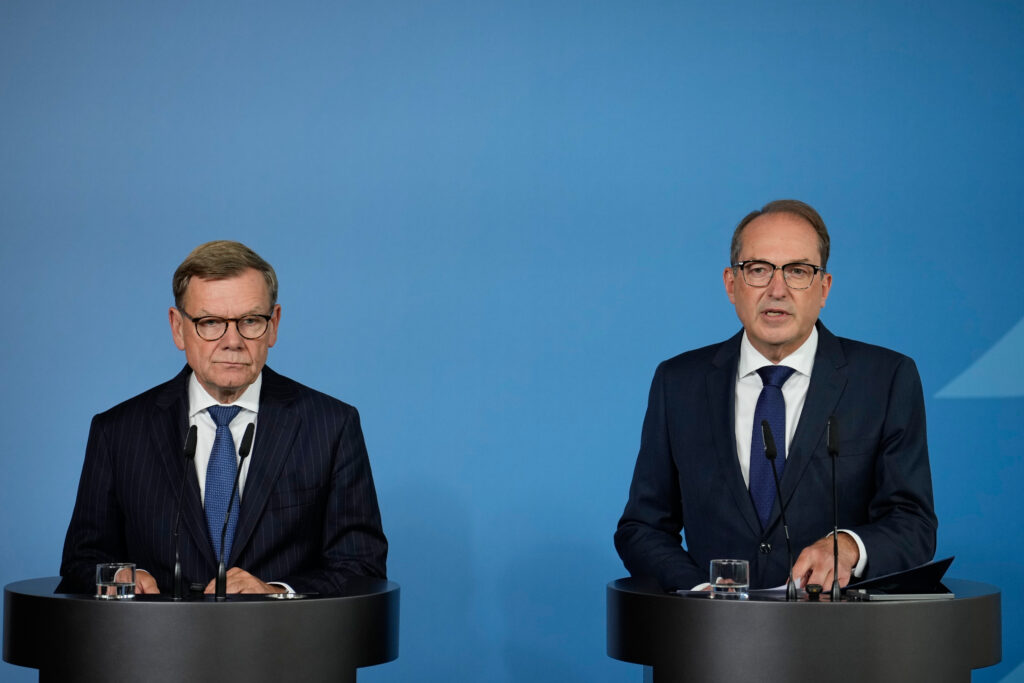
Germany’s Interior Minister Alexander Dobrindt and Germany’s Foreign Minister Johann Wadephul speak to the media during a press conference in Berlin on Tuesday, Sept. 1, 2026, about the attempted attack on Leipzig/Halle Airport last month with a drone loaded with explosives.Ebrahim Noroozi/AP/File
So, can you help us understand how this suspect allegedly managed to target power lines?
So, the idea, or what actually had happened in the times when it was successful, was to bring small explosive devices to bear to disrupt power stations and shoot small, commercially available firework rockets across power lines, which would then connect to lines and then short-circuit the power lines. That was the idea that he had. And he proved, at least in one case, that this connecting the power lines and bringing the grid down, at least very locally, worked.
So I’m curious, Hans-Jakob: where do you draw the line between climate terrorism versus climate activism? Because there’s this episode that could have done major damage but apparently did not. I’m also thinking, for example, of activists gluing themselves to a street or damaging artwork at a museum to bring attention to climate change. What comes to mind for you when you think about terrorism versus activism?
Yeah, first of all, all of these acts are, of course, legally speaking, criminal. It is criminal to damage artwork. It is criminal to disrupt traffic. But bringing down the power grid is another level of impact you’re going to have because power is what fuels not only the economy, but also hospitals, emergency services. So bringing that down is simply on a different level. So activism, of course, is totally legal in Germany. You demonstrate. You can write a petition … you can even block politicians from entering a building. None of this is inherently criminal. Gluing yourself to the street or damaging artwork is criminal, but I wouldn’t necessarily call that sabotage yet. This was on a different level. This was clearly an act of sabotage and is certainly, at minimum, aggravated sabotage according to German legal provisions.
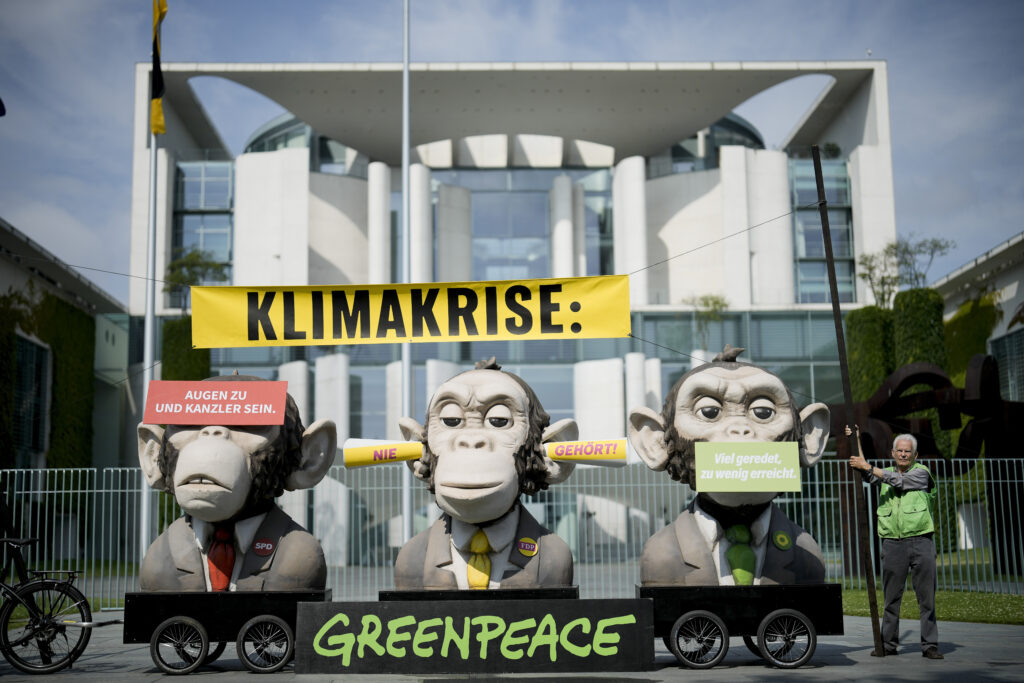
Activists of the environment organization Greenpeace protest against the climate policy of the German government in front of the chancellery, prior to the cabinet meeting in Berlin, Germany, Wednesday, June 21, 2023. Markus Schreiber/AP/File
Several things seem to be happening at once. Germany has been seeing a rise in right-wing extremism and violence. Also, the Russian hybrid attacks are a concern for the government. What would you say differentiates left-wing terrorism in Germany from right-wing extremism? Because I kind of get the impression that left-wing climate terrorism is largely directed at infrastructure. Correct me if I’m wrong.
Yes. So first of all, we have seen an increase in violence both from the left and the right, and a steeper increase in violent acts by left-wing extremists compared to the increase of right-wing extremists. So only very small numbers behind. So 1,000 violent attacks by left-wing extremists versus just over 1,000 by right-wing extremists. None of this is good, but they caught up when a couple of years ago that distance between the number of violent incidents, right-wing incidents, left-wing, was very much skewed towards the right wing. The traditional target of climate activism is indeed against infrastructure, not individuals. The wider left-wing extremist network, however, in the last two years has taken up violence against individuals as well, in particular and primarily right-wing extremists. So there are now several groups that are currently already in prison or in court cases that very deliberately try to identify, isolate and then bodily harm, and in some cases even try to murder, right-wing extremists. Now, no one needs to be a fan of right-wing extremists, but taking the law into your own hands and trying to murder other German citizens, whatever their ideological view is, is attempted murder and nothing else. So that is a very concerning development on the left.
What would you say is prompting this across-the-board increase?
I mean, we are in a very tense situation. Europe and Germany are surrounded by conflicts, all of which have an impact on the domestic security situation. You have, of course, this large-scale war of Russia against Ukraine, which is very close geographically to Germany. You have the conflict in the Middle East, in Gaza and Lebanon, and we do have large-scale migrant communities from both countries inside Germany and a newfound alliance between extreme Islamists and extreme left-wing individuals riding that conflict. We have the conflict in Iran, and then we have a more than spectacular growth of ISIS and Al-Qaeda in West Africa, which is also geographically close. And influences the security situation. So we have really a multi-pronged, very complex, however elevated security threat in Germany as we speak. All of that together makes for a pretty interesting time.
Parts of this interview have been lightly edited for length and clarity.