
 Getting Smart
 By: Ernesto Rodriguez
Imagine walking into a classroom where the ceiling stretches into a forest canopy—sunlight filtering through leaves, branches arching overhead, the entire room calm. Students relax. Teachers feel the space working with them. This is the everyday reality for schools implementing Nature In The Classroom, a biophilic design initiative bringing nature’s restorative power indoors. This initiative is rooted in nearly five decades of research in cognitive and environmental psychology—especially Attention Restoration Theory (ART). ART has empirically verified that viewing images of trees calms you, helps you focus and engage.Â
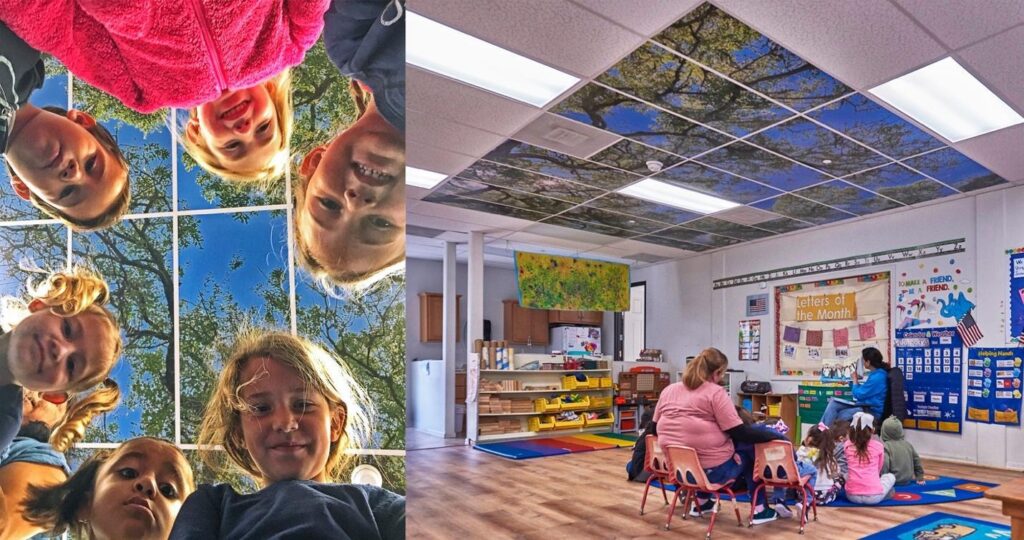
Recent research out of Spain, the 3-30-300 Rule, shows higher mental health in neighborhoods where you have a view out a window to three trees, have 30% greenery in your neighborhood and live 300 meters from a park. Many Title 1 schools in the US are predominantly asphalt and lack greenery and tend to be in neighborhoods that lack greenery. There is a movement to green up schoolyards and remove the asphalt. However, students still spend 90% of their days indoors. There are approximately 10 million students in portable classrooms with limited views to the outside. Many classrooms in Title 1 schools lack windows or natural light. The absence of greenery can elevate stress and diminish focus. ART shows that even viewing images of trees engages the brain’s involuntary attention systems, helping students restore cognitive capacity, reduce stress, and stay engaged.
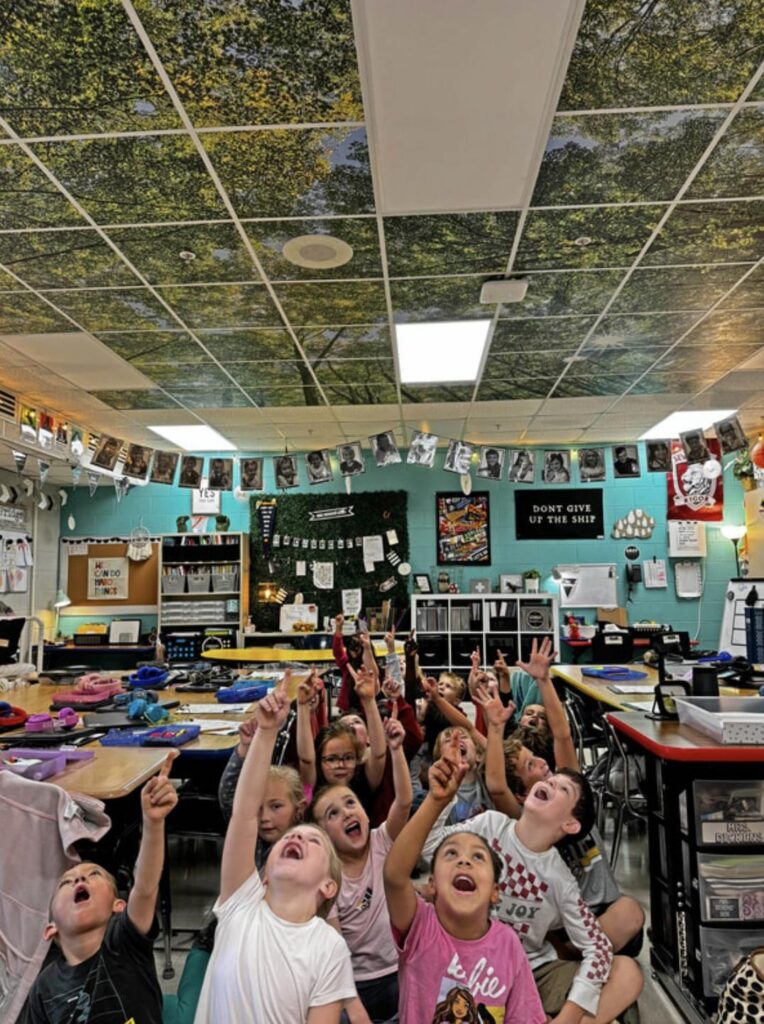
Today, the program installs high-resolution “tree ceiling†murals designed specifically for learning spaces. These ceilings are now in 20 school districts across nine states, serving more than 10,000 students. The results are consistently powerful: students are calmer, more focused, and more excited to be in school. Teachers report measurable improvements in classroom culture and attention.
“The nature ceiling has brought a sense of calm, comfort, and safety to our classroom,†says first-grade teacher Kaylee Dickens in Kentucky. “It sets a peaceful tone the moment students walk through the door.†Ms. Dickens’ experience is echoed across districts in the United States.Â
A windowless juvenile facility for at-risk youth in Indiana has found that teachers observed fewer behavioral disruptions, smoother transitions, and a noticeable improvement in students’ emotional regulation. Students describe the ceilings as “relaxing,†“cool,†and “a place that feels like outside even when we can’t go outside.†Teacher Annemarie Coak shared, “It absolutely makes the room feel warmer, and students are more calm and focused sitting beneath itâ€. The director James Steensma noted that the tree canopy reaches beyond the classroom and has a bonding effect with others. “We are a multi-faceted organization, where our judge, magistrates, probation director and officers are welcome to meet with and interact with our students. Their ability to come into the school area and experience the same effects that our students feel when around these canopies is quite amazingâ€.
Leslie Snyder, a middle-school teacher in California explains that the ceiling mural is more than an environmental change in the classroom. It’s also a cultural change. “Students linger in the classroom now. They look up and smile. The space feels humane in a way that matters every single day.â€
Why This Works: The Science Behind the Ceiling
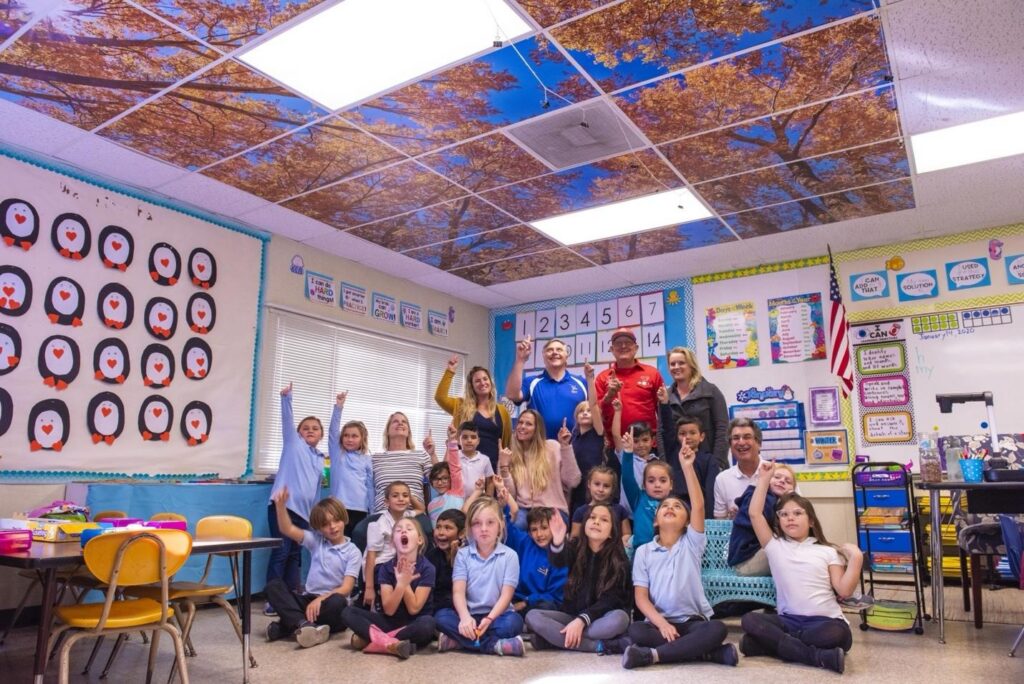
Biophilic design—integrating natural elements into built spaces—is no longer a luxury trend; it’s a research-backed strategy for learning and well-being. Exposure to trees can:
- Reduce cortisol and lower stress
- Improve sustained attention
- Increase feelings of safety and belonging
- Support creativity and cognitive flexibility
- Improve mood and emotional regulation
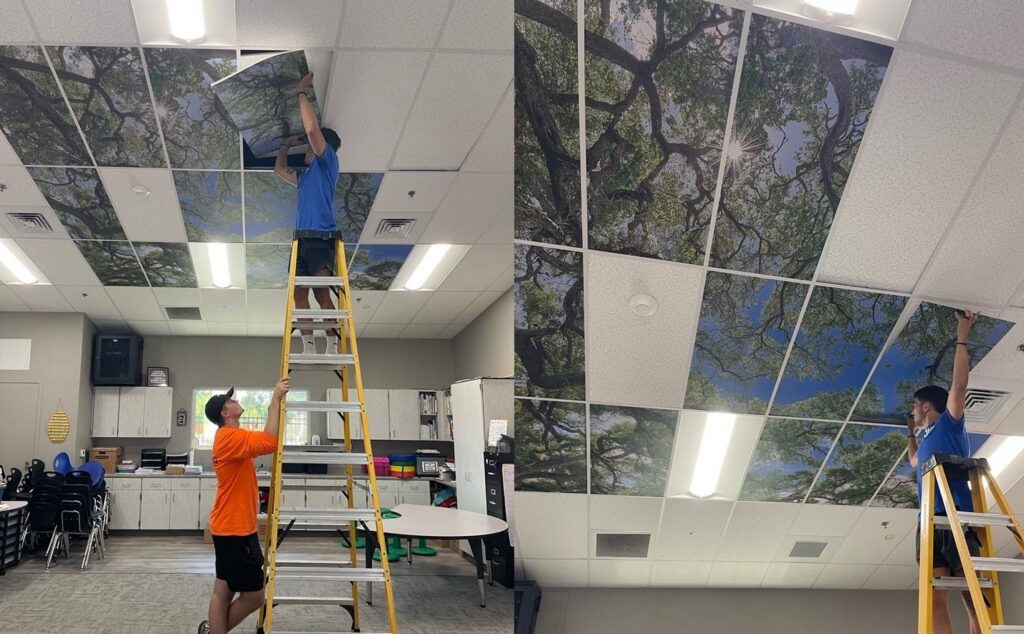
For teachers, this translates to fewer disruptions and more instructional time. For students, it means entering a classroom where their nervous systems are supported rather than overstimulated. Early prototypes were tested, refined through educator and student feedback, and designed to work across grade levels, budgets and school facilities. The result is a scalable, maintenance-free installation that transforms a room without disruptive reconstruction or exorbitant costs.
Impact That Extends Beyond Aesthetics
Schools are recognizing the unmet emotional and cognitive needs students bring each day. Sometimes addressing those needs doesn’t require new programs—it requires reimagining the space itself.
In classrooms with tree ceilings, teachers report:
- Smoother classroom management
- Faster transitions and settling at the start of lessons
- Students verbalizing increased focus and comfort
- Improved peer-to-peer interactions
Students put it more simply:
“It helps me feel calm and peaceful.â€
“I can think better.â€
“The branches are like roads to a great journey.â€
A kindergartner succinctly summed up the science of ART when I asked her how she liked her tree. She was sitting on her calves, straightened up, flicked her hair back and said “It calms me upâ€.
The human mind is wired to view and interpret nature. The natural environment is defined by a scalable pattern called a fractal. The fractal defines clouds, coast lines, mountains, forests, trees and leaves. Empirical science has documented that the mind can more quickly assess a nature scene versus an urban one. It is the fractal versus intersecting lines of an urban environment. “Greening up classroomsâ€, or softening the linear design of rooms can also be achieved by bringing in elements that are fractal based. Green plants, landscape photos for the walls, large landscape murals and the ultimate, create an indoor garden where all students can participate. Overall, green classrooms create a more conducive learning environment.    Â
A Small Change with Large Ripples
Nature In The Classroom shows that the most powerful innovations in education hide in plain sight—literally on the ceiling. As schools face rising stress, disengagement, and behavioral challenges, biophilic design offers a practical, science-aligned way to improve learning environments at scale. Nature In The Classroom is a 100% volunteer organization which donates the tree ceilings when they have the funds. Otherwise, they can be purchased at cost via the help of educational grants, parent teacher organizations and organizations like Rotary International. Educational innovation doesn’t always roar. Sometimes it whispers—through leaves, through color, through the restorative calm of nature.
Ernesto Rodriguez, MS, PPS provided psychological services for US State Department Schools in Colombia and Saudi Arabia. He founded Ernesto Rodriguez Photography in 1988, commercial and fine art photography. His work is in the Curator’s Collection at MoMA NY and on exhibit in the Smithsonian. In 2002 Ernesto founded Sereneview®, to bring the science of viewing calming nature landscapes to the hospital patient bedside. Sereneview® hospital curtains featuring nature vistas are installed in over 3,500 hospitals in the US, Europe, Australia and Canada. In 2015 he became a park ranger and a California certified interpretive naturalist on Catalina Island off Los Angeles. He is the Founder and Executive Director of Nature In The Classroom®, a 501(c)(3) to bring the science and benefits of nature views to education settings.
The post What If You Could Bring the Restorative Benefits of Nature Indoors? appeared first on Getting Smart.
 Money Crashers
  Inc. Magazine
  Money Under 30
 SavingAdvice.com
  One Submit Blog
 SlashGear