New AI method can support real-time management of infectious diseases is trending nowKatsina Government Opens New Diphtheria Isolation, Treatment Centre is trending nowRole of ethics education in accounting fraud prevention is trending nowEven ancient bacteria possessed intercellular communication structures like humans today,… is trending nowNASA inaugurates first telescope named after female scientist is trending nowSalah's successor arrives at Anfield: Liverpool sign Barcola in a historic deal is trending nowAston Villa vs Arsenal: Shearer predicts Monday’s EPL fixture is trending nowMan City agree £65m deal for Everton's Ndiaye is trending nowBarcelona's comeback against Rayo Vallecano reminds Real Madrid of a painful past is trending nowIkogosi Resort partners AFRIMMA to promote Nigeria’s tourism is trending nowMindustry Conference Partners Warner Music Africa/Africori For Fifth Edition, Opens Regis… is trending nowBBNaija S11: Aikou, Flora Risk Losing Gambit Status is trending nowNew AI method can support real-time management of infectious diseases is trending nowKatsina Government Opens New Diphtheria Isolation, Treatment Centre is trending nowRole of ethics education in accounting fraud prevention is trending nowEven ancient bacteria possessed intercellular communication structures like humans today,… is trending nowNASA inaugurates first telescope named after female scientist is trending nowSalah's successor arrives at Anfield: Liverpool sign Barcola in a historic deal is trending nowAston Villa vs Arsenal: Shearer predicts Monday’s EPL fixture is trending nowMan City agree £65m deal for Everton's Ndiaye is trending nowBarcelona's comeback against Rayo Vallecano reminds Real Madrid of a painful past is trending nowIkogosi Resort partners AFRIMMA to promote Nigeria’s tourism is trending nowMindustry Conference Partners Warner Music Africa/Africori For Fifth Edition, Opens Regis… is trending nowBBNaija S11: Aikou, Flora Risk Losing Gambit Status is trending now
World
Despite policy change, dowry deaths persist in India
Public Radio International ··90 views
The death of a newlywed woman in Delhi last weekend is among a string of cases this year rekindling public discussion in India about dowry deaths. Thousands of women are reportedly killed in India every year in dowry-related disputes despite laws on the books intended to penalize this violence. The World’s Carolyn Beeler learns more from Kriti Kapila, an anthropologist at King’s College London, who has studied this phenomenon.
The post Despite policy change, dowry deaths persist in India appeared first on The World from PRX.
In India, the recent death of a newlywed woman in Delhi is the latest in a string of cases drawing renewed attention to dowry deaths.Â
Twenty-eight-year-old Akriti Sutar died last week after falling from a building, a few months after her wedding. Her family says she was murdered over her dowry, the traditional practice of the bride’s family giving money and gifts to the groom’s family.Â
Government data shows thousands of suspected dowry deaths are reported in India every year, even though giving and receiving dowries have been illegal for decades.Â
Kriti Kapila is an anthropologist at King’s College London who has studied dowry deaths. She explains that dowries in India were traditionally a symbolic gift.
“Basic household goods, maybe sometimes some cash, whatever parents could do. And over time, the components of dowry have changed radically. It involves cash transfers. It includes now asset transfers, it includes other financial products.â€
Carolyn Beeler: It became more of a really important financial agreement that was being entered into.
Kriti Kapila: Exactly, and much more of a wealth transfer. And the young men or sons became a commodity, you know, who commanded a price. So that price that they could command was the dowry. How much dowry they could beget, that dowry was still calculated in terms of class, caste, educational background, and professional status, all of that. And if it’s seen that you’ve either gone back on your word, or you could just be very greedy in-laws, which, you know, most of them tend to become, they can start demanding more and more, saying, you may have said X amount, but can you also now ask your father or your brother or, you know, your mother to now give us more?
It turns into extortion after the wedding takes place sometimes.
Absolutely. I’m not saying it happens in every case, but right, the extortion may end at the time of the transaction itself, and that may never be a further extraction. But in very many cases, it’s an ongoing process.
Brides wait inside a room prior to a mass community marriage in Bahirkhand, about 70 kilometers (44 miles) northwest of Kolkata, India, Feb. 2, 2014. Bikas Das/AP
Can you describe more about what dowry deaths actually are?
Dowry deaths are murders of brides on the grounds of bringing inadequate dowry.
And then, as you said, if the family of the bride doesn’t deliver, then the bride can, in extreme cases, be tortured or killed.
Because you see, the thinking [is] that if she dies, then we can marry our son again. And there could be a second dowry that we can access, and so on and so forth. Whereas the number of women who don’t kind of wait to be killed, they kill themselves. It’s a gruesome and grim picture.
Just for a little bit of context here, the government figures from the most recent year available, 2023, the Indian government says there were about 6,000 dowry death cases registered and about 1,200 convictions. Are you saying that is likely an undercount?
I would imagine this is a bit of an undercount because not every case would be reported. I suspect there is a degree of underreporting in these cases. But as I said, it’s very difficult to pin a number on it. The kind of argument I was making in my own research is that it doesn’t really matter. One death is one death too many.
In this May 27, 2004 file photo, an in-law accused of dowry crimes sleep at a communal cell in Tihar Jail’s dowry wing, in Asia’s largest prison in New Delhi, India. An Indian report released in August 2013 says a woman dies every hour in disputes over how much her family has paid in dowry to the groom for her marriage. Elizabeth Dalziel/AP File Photo
Have these cases, have dowry deaths gotten more common over the years, less common? Is there a clear trajectory?
They’ve maintained the same percentage in overall death rates. But the fact is that the population has grown since the Sikhs were being compiled and collected, so the numbers are absolutely, you know, through the roof. It’s the tens of thousands of women I imagine are either tortured or killed, or then kill themselves because of dowry. And what has changed over the years is that there is absolutely no discussion now about this. And they’ve been — there used to be not just a public debate, but actually a very robust politics of mobilization around and against dowry deaths in the ’70s [and] ’80s.
There are, though, these news articles that we are talking about. This is being reported on. I understand you’re saying there is nobody marching in the streets like there was in the ’70s and ’80s, but are there other types of discussion? Are there policy discussions? Does it look different than it used to?
Some of my colleagues have written that the protests receded because many of these cases are [handled] judicially. So, you know, once you get people litigating around this issue, it takes on a different form. It no longer makes for that active politics it used to decades ago. I think in recent weeks we have had a few more high-profile cases which have been reported in the media, and I think it’s a good thing that people are speaking up against it again. I really welcome it.
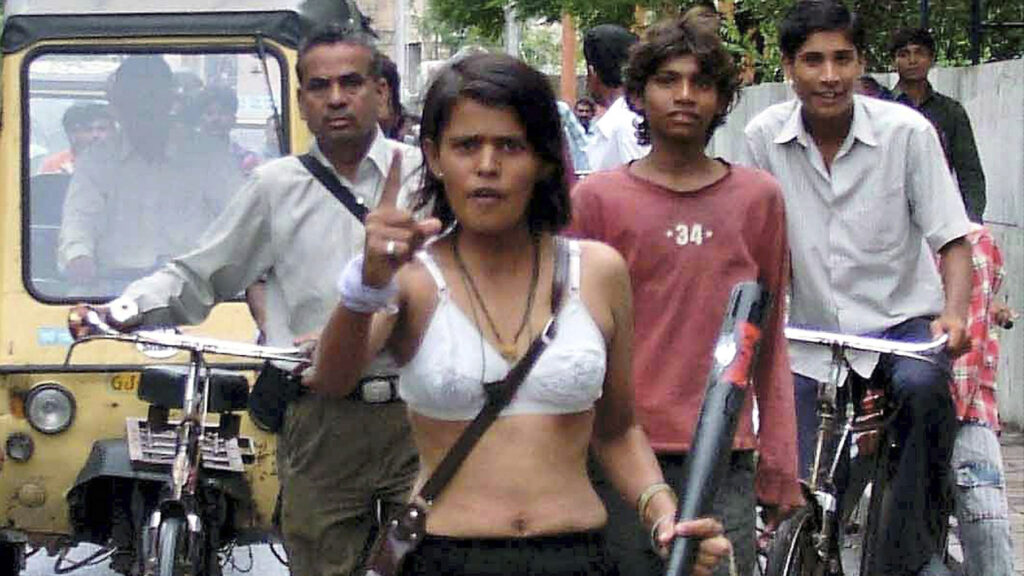
Indian woman Pooja Chauhan, in her undergarments and carrying a baseball bat and bangles in her hands, marches to the police commissioner’s office to protest dowry harassment by her husband and in-laws, in Rajkot in the western Indian state of Gujarat on July 4, 2007. AP File Photo
The government of India has taken steps to try to reduce dowry deaths. It made giving and taking dowries illegal back in 1961, and in the late 1980s enacted a law change aimed at making it easier to prosecute suspected dowry killings. Exactly. Did either of those changes work to actually reduce the number of women being killed?
I’m not very sure. I mean, what difference has this made in the institution of dowry itself? While there is some kind of legal consciousness around the fact that it is actually a crime and it’s actually an illegal activity, there are other ways in which it is now justified. So it’s sometimes justified as women’s own right, you know, in their parental property. ‘Or this is how they will have access to wealth.’ But actually it’s a half-truth because the law is very clear. You are [entitled] to be an equal heir under the Hindu Succession Act.
And what about dowry deaths? Have they changed at all? As it sounds like the law has been tweaked to try to allow for more prosecution of these crimes.
It’s made some difference, I would say. I’m not saying that has made no difference, but the fact that the numbers continue to be high and that women continue to be killed, or they kill themselves. That just shows us that there is something amiss, that there is still a very big gap between the enactment of the law, the prosecution, you know, the litigation, and actual experience of women on account of dowry. Even when they’re not killed, a large number of women continue to be tortured.
So what do you believe it would take to actually end this practice?
It’s a very uphill task because it takes on a very particular form in India. It’s been impossible to root it out because it’s tied not just to how people get married in India through arranged marriages, but also to the fact that marriage and caste are completely tied. So it’s tied to the caste system. And till you root out the caste system, you will not be able to reform marriage. You will not be able to make daughters equally good to have, even when they are actually equally well-educated, if not better educated or higher achieving than sons. But that has made no difference. To the practice itself.
Parts of this interview have been lightly edited for length and clarity.

 Public Radio International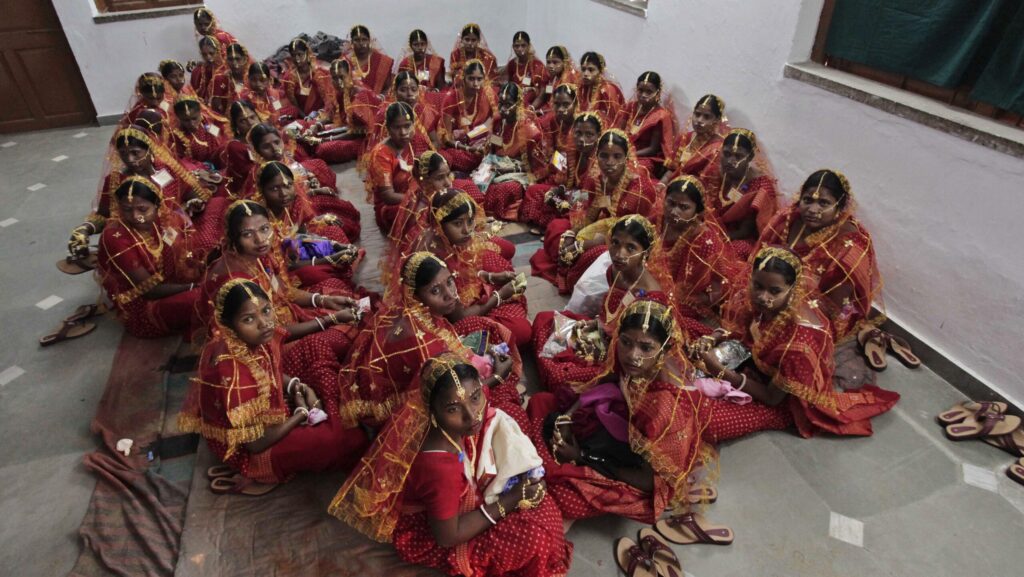

 The New York Times - Politics
  Entrepreneur
 The Campaign Workshop
  Sportstar
  The Chalk Blog By Learners Edge
  Xavor Corporation Blog