 Public Radio International
 The French film “The Marching Band” has been described as a feel-good movie, a crowd-pleaser and a bromance that moves between comedy and drama. It is all of that. It’s also a poke in the eye of the American Dream myth and the belief that anyone can succeed if they work hard enough.
The film opens during a rehearsal of a French orchestra led by world-renowned conductor Thibaut Désormeaux, played by actor Benjamin Lavernhe. The rehearsal seems to be going well at first, but Thibaut looks increasingly exhausted. Minutes later, he collapses from his podium.
In the following days, Thibaut learns that he has leukemia and that he urgently needs a bone marrow transplant. After DNA testing, he learns that the person he’s known for 37 years as his sister isn’t genetically related to him.
He also learns that he was adopted as a baby and that his parents chose not to adopt his younger biological brother when they had the chance. So Thibaut tracks his brother, Jimmy Lecoq —played by Pierre Lottin — who lives in a small mining town in northern France.
During an impromptu and awkward visit to Jimmy, Thibaut drops his bombshell revelations, one after the other: the leukemia diagnosis, the need for a compatible donor, the sister who is not a match, the adoption, and that he found out he has a biological brother. And that brother, says Thibaut, is you.
The story does not center on Thibaut’s illness, however, but on the nascent relationship between two men from radically different social classes. Thibaut was raised in an upper-class family in a wealthy Paris suburb, studied music in a conservatory, and became a renowned conductor. Jimmy was adopted by a loving couple with modest means. He, too, has a passion for music, but he has a low-paying job in a school cafeteria and plays trombone in a marching band.

The music itself embodies each brother’s world: the honking of a marching band whose members–for the most part—are miners, versus the high-brow classical music and fine concert halls on the other. But the film makes no judgment of either world.
The film’s director, Emmanuel Courcol, says the tension created by the juxtaposition of social classes is an ideal premise for any comedy. But it comes with traps.
“The trick,” said French film director Emmanuel Courcol, “was to feature those two distinct archetypes, Jimmy, the blue-collar worker, and Thibaut, the bourgeois, without turning them into caricatures. That was the challenge in writing this script.”
Paris-based film critic Lisa Nesselson says she is worried about that premise too.
“Oohhh two brothers, gna-gna-gna … one is well off, one isn’t … life-threatening illness, music,” she said, “it sounded like it was a little over the top, and in fact, it is not.”
And that, she said, is due in great part to a talented cast, swift editing, and concise writing that stops short of sentimentality. There is also some good music, from Beethoven, Mozart, Charles Aznavour and jazz great Lee Morgan’s cover of “I Remember Clifford.”
In one key scene, Thibaut discovers that Jimmy has turned his garage into a music studio with a piano and a collection of vintage jazz records. When Jimmy speaks of his fondness for jazz trumpet, Thibaut quizzes him jokingly at first about pitch and asks him what notes he can pick out from sounds around them.
It turns out Jimmy can discern a G-sharp-B chord from a taxi honking its horn, and G and D from his mother’s voice calling him for the next room.
That’s how we learn that Jimmy not only shares Thibaut’s genetic musical gifts, but he also has perfect pitch.
“It just comes naturally to him,” said critic Lisa Nesselson, “but it is not particularly useful to him, because all he does is play kind of standard songs in a small local band. But we sense that there could have been more, and maybe there still could be.”
Jimmy derides his brother’s “posh” upbringing, as he puts it, but it’s clear he’s bitter about having missed out on it. Thibaut feels guilty about that, and he tries to help Jimmy’s musical pursuits. The two grow closer, walking around the town they were born in and humming tunes together by the seaside.
But for Jimmy, changing course will be difficult. It’s nurture versus nature.
Director Courcol says his film is about social determinism.
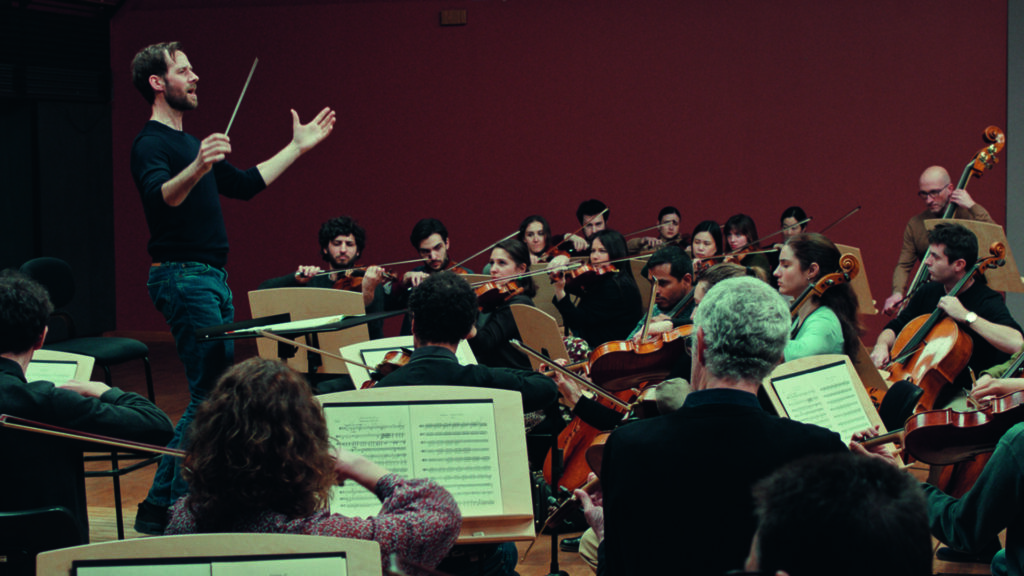
“Depending on where one comes from,” he said, “with equal abilities, we do not have the same opportunities to develop those qualities and talents. That’s what the film is about.”
Critic Lisa Nesselson said these characters will resonate with American moviegoers.
“Even though these characters are extremely French,” she said, “I think the average American viewer will be able to recognize that a lot of how your life turns out is the cards you’re dealt. We tend to believe that if we work hard enough or, you know, have enough luck, we can rise up in society or make more money or whatever it is. I think French people are a little more pragmatic about that.”
Emmanuel Courcol said he didn’t try to make an optimistic movie, but a realistic one, in which human bonds have more value than where you come from.
“The Marching Band” is currently playing in select US theaters.
The post French dramedy ‘The Marching Band’ questions the American Dream appeared first on The World from PRX.
 The Washington Times - World
 LabourList
 Quit The Nine To Five
  Sun Power Lawn Care
  AppleInsider
  Scrapbooking By Phyllis